
A bizarre sight on a remote Canadian lake recently captured worldwide attention after boaters spotted what appeared to be an entire forest floating across the water.
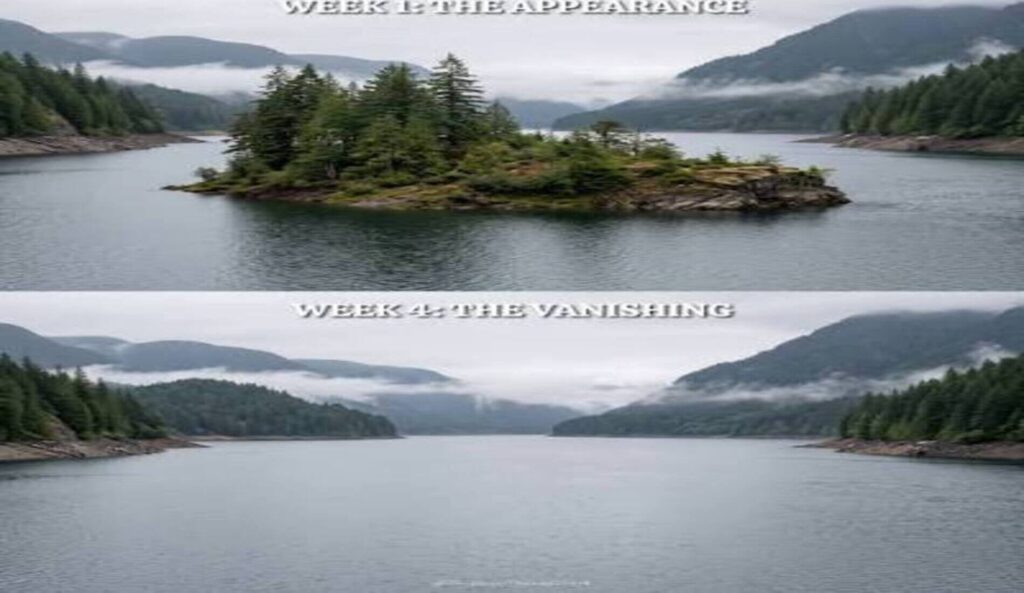
The unusual landmass drifted across Williston Lake in northern British Columbia earlier this summer. At roughly two and a half acres, the vegetation-covered formation was about the size of a Canadian football field.
Videos quickly spread across social media. Because the sight looked so unusual, some viewers even questioned whether the footage had been created using artificial intelligence.
However, satellite observations later confirmed that the floating formation was real.
Mysterious Floating Island Spotted
Local boaters first noticed the forested mass moving across the reservoir. The formation appeared to contain soil, vegetation, shrubs and trees, making it look like a small island had somehow broken free from the shoreline.
Residents alerted hydro officials because large floating debris can create hazards for boats and potentially threaten hydroelectric infrastructure.
The sighting also attracted attention because several major events were expected to take place around parts of the lake.
Satellite Images Confirm the Sighting
At first, officials had reason to doubt the social media videos.
The formation looked so unusual that some Hydro BC officials reportedly suspected the images could have been generated or manipulated using AI.
Satellite observations eventually settled the question.
An aerial observation team confirmed that a large debris island had appeared in the reservoir. The formation had also been documented in the area in late July.
However, the mystery deepened when later satellite passes showed that the floating island had disappeared.
Scientists Offer a Natural Explanation
Although the sight looked extraordinary, environmental scientists say there is no need to invoke anything supernatural.
Instead, the phenomenon can occur through natural hydrological processes.
Large reservoirs can collect substantial amounts of vegetation and other organic material along sheltered shorelines. Over many years, soil, mud and sediment can become trapped among roots, branches and other debris.
Eventually, the accumulated material can create a thick floating or semi-floating mass capable of supporting vegetation.
How Can an Entire Forest Float?
As soil and debris build up, plants can take root in the material.
Shrubs and young trees may then grow on the accumulated mass. Over time, the vegetation can become dense enough to resemble a small forest.
The resulting structure may remain attached to the shoreline for years.
However, unusually high water levels can weaken or break that connection.
Once the mass becomes detached, wind and water currents can push it away from the shore and into the wider reservoir.
Why Did the Island Disappear?
The disappearance of the floating formation also fueled speculation online.
Some social media users suggested that an underwater event or another unexplained force had suddenly removed the island.
Experts, however, point to more ordinary possibilities.
Floating debris islands can eventually move back toward a shoreline and become anchored again. They can also break apart as waves, currents and weather gradually weaken their structure.
Therefore, the apparent disappearance of the formation does not necessarily require a dramatic underwater event.
Social Media Turns Natural Event Into Mystery
The unusual sight became a viral sensation largely because few people had seen anything similar before.
Images of trees apparently drifting across an open lake naturally sparked questions about how such a structure could exist.
The initial uncertainty also encouraged speculation that the footage was artificial.
Satellite evidence ultimately showed that the phenomenon was genuine. At the same time, scientific explanations have made the event far less mysterious.
A Rare but Natural Phenomenon
The floating forest in Canada may look like something from a science-fiction movie, but scientists say nature can produce remarkably strange sights.
A combination of accumulated vegetation, soil, sediment, high water levels, wind and currents can create large floating masses that temporarily behave like islands.
The Williston Lake formation may have disappeared from view, but its brief journey across the reservoir has provided a striking reminder of how dynamic natural environments can be.
For now, what appeared to be an impossible floating forest has a much more grounded explanation: years of natural accumulation, followed by the right conditions to set the vegetation-filled mass adrift.