
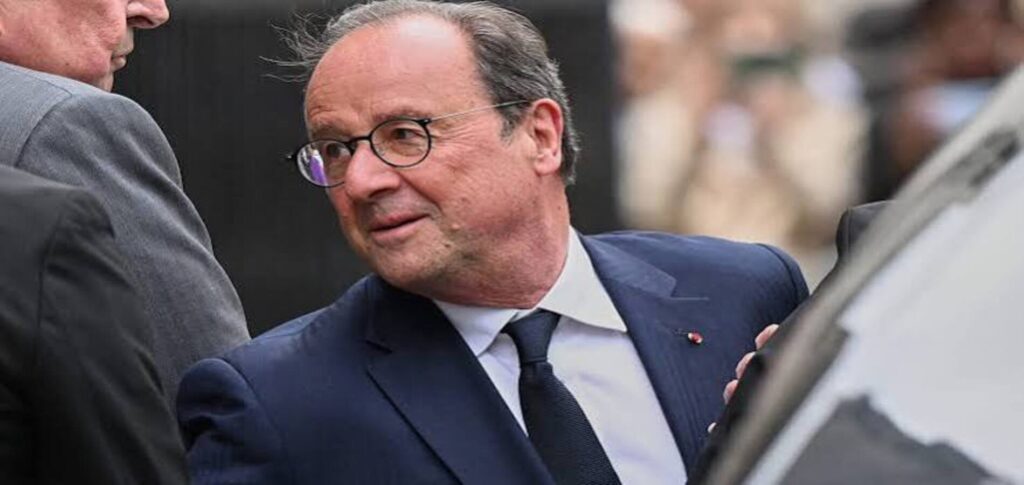
Former French President François Hollande has published a new book outlining 80 proposals for France, giving a detailed look at his political vision while leaving open the possibility of another presidential campaign.
Hollande released “Unite. New World, New Left” on Thursday. The book presents ideas covering the French economy, pensions, taxation, Europe and the country’s role in a changing international environment.
Despite the manifesto-like nature of the publication, Hollande has not confirmed that he will seek the presidency.
The former Socialist president says he plans to wait until December before making a final decision.
Hollande keeps presidential plans open
Hollande will not take part in the left-wing primary scheduled for October. Instead, he intends to watch how the political landscape develops and assess whether a credible candidate emerges.
If no candidate convinces him, Hollande could decide to enter the race himself.
The possibility of another presidential bid has attracted attention because Hollande chose not to seek re-election in 2017 after suffering extremely low approval ratings during the final part of his presidency.
Almost a decade later, his new book suggests that he wants France to rethink its political approach and raise its “level of ambition.”
Speaking to French public radio France Inter on Wednesday, Hollande said one of the country’s biggest challenges is bringing people together.
He pointed to growing political polarisation, saying France faces pressure from extremists who benefit from division as well as an increasingly uncertain international environment.
Hollande distances himself from the Socialist Party
Several of Hollande’s proposals differ significantly from the current positions of France’s Socialist Party.
One example involves the proposed Zucman tax, which would target the wealth of ultra-rich individuals. Hollande has criticised the idea, describing it as more of a slogan than a practical solution.
His position on pensions also separates him from the Socialist Party.
While the party supports returning France’s legal retirement age to 62, Hollande proposes setting it at 63 and gradually increasing the required contribution period as life expectancy rises.
He also proposes limiting pension indexation to 1% for five years, arguing that the measure could generate savings comparable to delaying the retirement age by one year.
Hollande further supports adding a funded component to the pension system under the supervision of social partners.
Plan to increase take-home pay
The former president also proposes changes designed to increase workers’ take-home pay.
His plan would reduce employee social contributions, which he says could increase net wages by around 10%.
The resulting reduction in social security revenue would be compensated through higher taxes on capital and financial income.
Hollande also proposes gradually increasing France’s standard value-added tax rate from 20% to 24%.
To soften the impact on households, he would abolish the reduced 5.5% VAT rate that currently applies to certain areas, including food and energy renovation work. He also proposes temporarily removing reduced VAT treatment for fuel.
Hollande wants to reduce production taxes as well, although he would offset the move by cutting some forms of business assistance.
Hollande calls for stronger European autonomy
Europe occupies an important place in Hollande’s political vision.
He argues that France must remain firmly committed to the European Union while pushing the bloc toward greater strategic autonomy.
The former president says the international environment has changed dramatically, with wars, climate change, inequality, drug trafficking and artificial intelligence creating new challenges for democracies.
Hollande also believes Europe cannot simply assume that its traditional relationship with the United States will return to the way it was in the past.
He has previously argued that Europe should prepare for a future in which it takes greater responsibility for its own security and strategic interests.
The former president supports a multi-speed European Union in which a smaller group of six to eight countries could take the lead in developing strategic industries, including digital technology and artificial intelligence, as well as defence.
Could Hollande attract centrist voters?
Hollande’s proposals have already attracted attention from politicians outside the traditional Socialist camp.
François Bayrou, president of the centrist MoDem party, said Hollande’s current ideas appear more compatible with the political centre than they once were.
A senior figure from Édouard Philippe’s Horizons party described Hollande’s positioning as potentially resembling that of a centre-right candidate.
Another presidential hopeful, however, suggested that Hollande still sounds too conservative for someone seeking to represent the political left.
Hollande rejects the idea that he has abandoned his socialist identity.
Hollande insists he remains a socialist
Despite moving away from several positions associated with the current Socialist Party, Hollande says he remains committed to left-wing principles.
His proposals include higher taxes on large inheritances and estates worth more than €10 million before tax.
He also wants to increase employee representation on company boards to 30%.
For young people completing civic service, Hollande proposes a €10,000 payment called “entrée dans la vie,” designed to help them as they begin adult life.
These policies demonstrate the balance Hollande is attempting to strike: maintaining traditional socialist principles while offering economic and institutional proposals that could appeal to voters in the political centre.
December could decide Hollande’s next move
For now, Hollande remains officially undecided about another presidential campaign.
His new book nevertheless gives him a platform to present a detailed political program and test how voters and rival politicians respond to his ideas.
The former president will spend the coming months watching developments on the left and across the political centre before deciding whether to enter the race.
His decision in December could therefore reshape the field ahead of France’s next presidential election.