
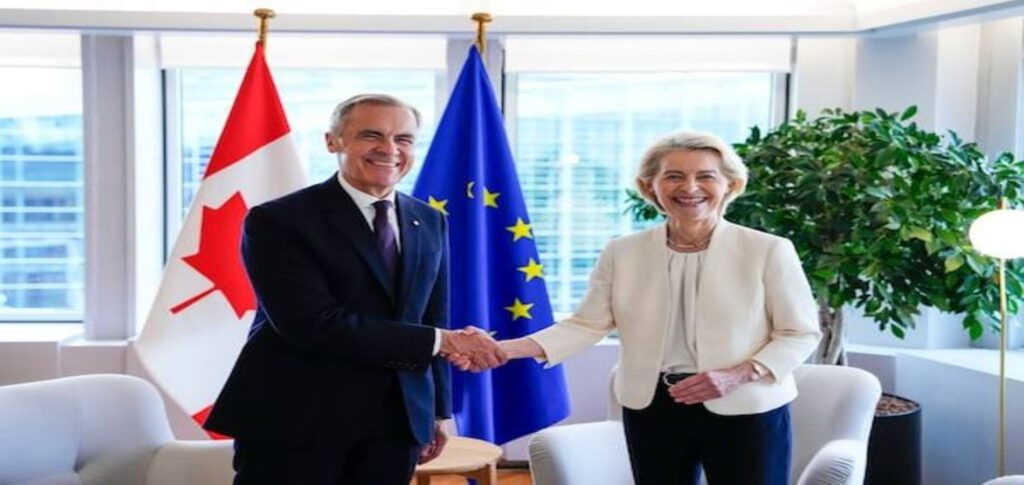
European Commission President Ursula von der Leyen has proposed opening the door for Canada EU associate membership, potentially making Canada the European Union’s first country with such a status.
Von der Leyen made the proposal during her annual State of the Union address to the European Parliament in Strasbourg on Wednesday. Canadian Prime Minister Mark Carney attended the speech.
EU lawmakers applauded the proposal. However, von der Leyen cannot establish the arrangement alone. The EU’s member states would need to agree to the proposal.
Canada EU Associate Membership Would Create New Partnership
Von der Leyen said Europe needs stronger partnerships as it faces growing geopolitical and economic pressures.
She pointed to cooperation between Canada and the EU on Ukraine, defence, critical raw materials and supply chains.
She also highlighted areas such as artificial intelligence, climate policy and Arctic affairs.
According to von der Leyen, the EU and Canada share similar positions on democracy and several major international issues.
Canada Would Not Become a Full EU Member
The proposed arrangement would not mean that Canada joins the European Union as a full member.
The exact meaning of “associate membership” also remains unclear. EU diplomats told Reuters that there is no established legal framework for such a status, while some expressed surprise at the proposal.
The EU has previously discussed flexible forms of cooperation with non-member countries. However, proposals for associate membership have not yet created a standard model within the bloc.
Therefore, any Canada EU associate membership plan would require further negotiations and agreement among EU governments.
Mark Carney Seeks a Unique Alliance
Carney has said Canada wants a “unique alliance” with the European Union rather than full EU membership.
His government has been looking to expand Canada’s economic relationships beyond the United States. Carney has said Canada wants to double its non-US trade over the next decade.
The Canadian prime minister is also scheduled to address the European Parliament as part of his European visit.
Meanwhile, Canada and the EU are expected to hold more detailed discussions at a summit in Montreal in October.
Trade Remains a Major Challenge
Despite growing cooperation, significant trade obstacles remain.
The EU and Canada already have a major trade relationship through their existing agreement. However, some European officials have raised concerns about Canadian restrictions in sectors such as telecommunications and dairy.
As a result, closer political and strategic ties would not automatically remove existing economic disagreements.
Both sides would still need to negotiate the details of any expanded relationship.
Defence and Technology Cooperation Could Expand
Von der Leyen outlined several areas where Canada and Europe could work more closely.
These include defence industries, advanced technology, intelligent manufacturing and critical supply chains.
She also highlighted the Arctic as an area for joint cooperation.
The two sides have already been increasing collaboration in defence and other strategic sectors.
Canada and EU Face Changing Global Pressures
The proposal comes as Canada and the EU respond to a changing international environment.
Russia’s war against Ukraine continues to shape European security policy. At the same time, the EU faces trade and strategic competition involving both the United States and China.
Canada, meanwhile, is seeking to reduce its dependence on the US market as trade tensions between Ottawa and Washington continue.
Von der Leyen presented closer partnerships as part of the EU’s response to these wider challenges.
Canada EU Associate Membership Still Needs Approval
The proposal is an opening step rather than a completed agreement.
EU member states would have to decide whether to support the idea. Further negotiations would also need to establish what rights, responsibilities and areas of participation an associate member would have.
For now, Canada and the EU are continuing discussions on trade, defence, technology, energy and other strategic areas.
The upcoming Canada-EU summit in Montreal could provide another opportunity to define how the relationship develops.