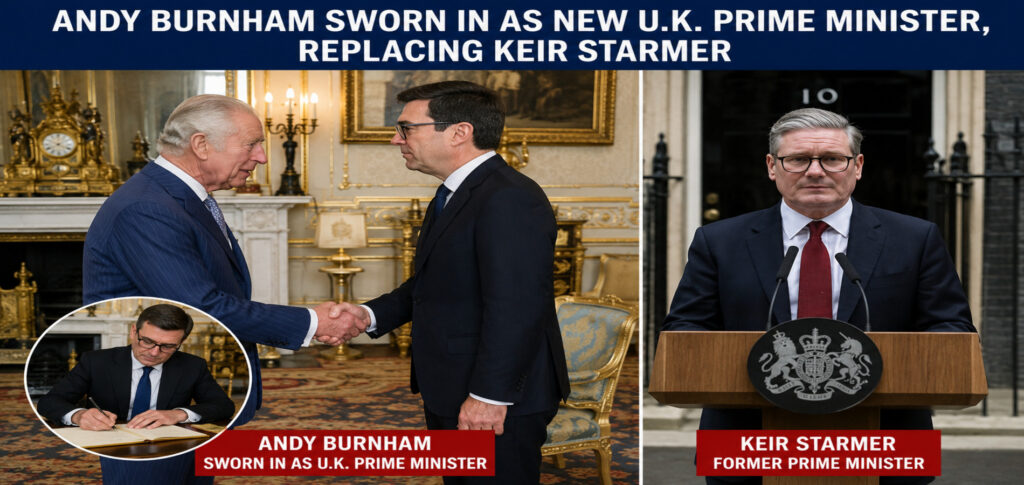
Andy Burnham has officially become the United Kingdom’s new prime minister after replacing Keir Starmer, marking a major change in Britain’s political leadership.
Burnham, the former Mayor of Greater Manchester, was formally appointed by King Charles III at Buckingham Palace on Monday, 20 July 2026. The King invited him to form a government after Starmer resigned as prime minister.
Burnham’s appointment followed his selection as Labour Party leader. Because Labour remained the governing party, he became prime minister without a general election.
Andy Burnham Takes Office
Burnham travelled to Buckingham Palace after Starmer formally tendered his resignation to the King.
During the constitutional ceremony, known as “kissing hands,” Charles III invited Burnham to form a new government. Burnham accepted the invitation, officially beginning his premiership.
He then travelled to 10 Downing Street to deliver his first speech as prime minister.
Burnham Delivers First Speech as Prime Minister
Standing outside Downing Street, Burnham called for a new period of political stability and renewal.
He said Britain needed to restore confidence in politics and make government work more effectively for people across the country.
Burnham also stressed the need to reconnect politics with the public after years of political instability.
In his first speech, he described his appointment as an opportunity for a new generation of politicians to meet the country’s challenges.
Keir Starmer Leaves Downing Street
Earlier in the day, Keir Starmer resigned as prime minister after meeting King Charles III.
Starmer had announced his decision to step down following political difficulties within the Labour Party. He remained an MP after leaving Downing Street.
His departure brought an end to his premiership, which began after Labour’s victory in the 2024 general election.
Burnham’s Remarkable Political Return
Burnham’s journey to Downing Street represents a significant political comeback.
He spent almost a decade as Mayor of Greater Manchester before returning to Westminster through a by-election in 2026. He subsequently became Labour leader and was appointed prime minister.
His rise made him Britain’s seventh prime minister since the 2016 Brexit referendum.
Economic Challenges Await
Burnham takes office at a difficult time for the British economy.
His government faces pressure over economic growth, household finances, public services and government spending.
The new prime minister has already placed regional economic development and decentralisation among his major priorities. His government is also pursuing measures aimed at reducing living costs.
A New Chapter for Britain
Andy Burnham’s arrival at Downing Street marks a new chapter in British politics.
His government is expected to focus on economic growth, public-service reform, regional devolution and measures designed to ease pressure on household finances.
As Burnham begins his premiership, attention will now turn to whether his government can translate his early promises into practical results across the United Kingdom.