
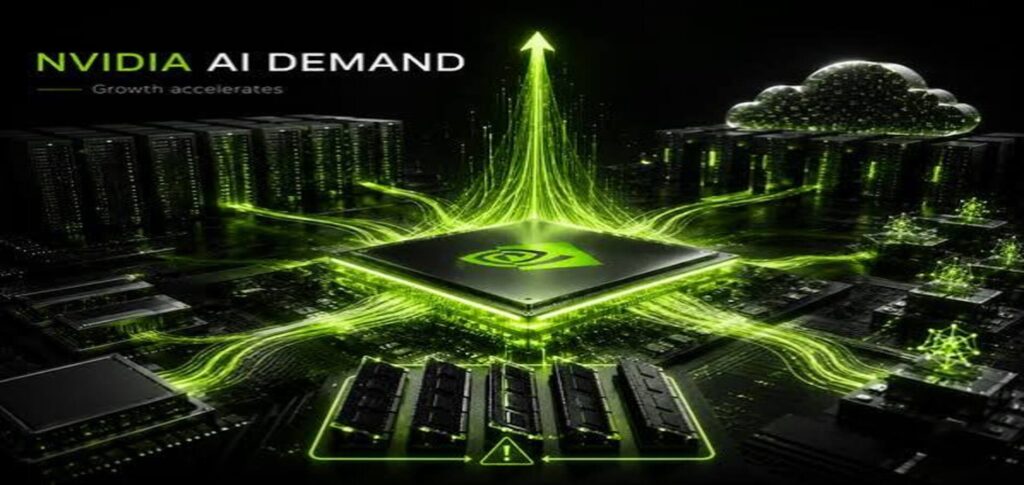
Nvidia AI spending is showing little sign of slowing, with the chipmaker forecasting a 70% jump in revenue next fiscal year and pointing to strong demand for artificial intelligence computing.
Nvidia shares rose nearly 5% in extended trading after the company released its latest outlook. The forecast offered investors fresh confidence that the global AI investment boom still has significant room to grow.
Nvidia Chief Executive Jensen Huang said AI has reached an important turning point because companies are now using the technology for productive and profitable work.
“AI has reached its inflection point. It’s doing useful work. Its tokens are productive and profitable. Now, compute is revenue,” Huang said.
Nvidia Forecasts 70% Revenue Growth
Nvidia expects revenue to grow by about 70% in its next fiscal year, which ends in January 2028. The forecast stands well above Wall Street expectations.
Analysts had expected revenue growth of about 44% over the same period. Nvidia rarely provides financial guidance that far into the future, making the projection particularly notable.
The company said demand now extends beyond the largest technology companies. AI cloud providers, businesses, governments and industrial customers are also increasing their spending on advanced computing systems.
That broader customer base could help Nvidia maintain its rapid growth as AI adoption expands across industries.
AI Demand Continues to Drive Nvidia
Nvidia’s data center business remains the main engine behind its expansion.
The company reported that data center revenue more than doubled to $89 billion in its fiscal second quarter. That figure exceeded the $85.08 billion analysts had expected.
Nvidia also expects AI laboratories to account for roughly one-quarter of its overall business next year.
The company is expanding its product portfolio as demand grows. Its next-generation Vera Rubin platform has started shipping to customers and should contribute about one-fifth of data center revenue during the current quarter.
Nvidia also expects its AI lab business to continue expanding as companies build increasingly powerful computing infrastructure.
Memory Shortages Could Limit Growth
Despite the strong outlook, Nvidia faces an important challenge: supply.
The company said shortages of memory components and rising costs could limit how quickly it expands production. Higher component prices could also put pressure on profit margins.
Chief Financial Officer Colette Kress said demand continues to accelerate even at Nvidia’s enormous scale, but added that the company remains supply-constrained.
Nvidia expects its third-quarter revenue to reach about $108 billion, plus or minus 2%. Analysts had projected approximately $104.19 billion.
The company expects gross margins to fall to roughly 71% to 72% in the fourth quarter as memory and component costs increase.
Nvidia Expands Amazon Partnership
Nvidia is also deepening its relationship with Amazon Web Services.
The companies plan to deploy an additional 2 million Nvidia graphics processors across Amazon’s global infrastructure during 2027 and 2028.
Nvidia said so-called neo-cloud companies, including CoreWeave and Nebius, are also rapidly increasing their Nvidia GPU capacity.
The company expects those providers to finish this year with more than eight gigawatts of Nvidia GPU capacity, compared with three gigawatts at the end of last year.
China Remains a Question Mark
Nvidia’s business in China remains uncertain because of changing US export restrictions.
The company did not include China data center revenue in its latest outlook. Nvidia has also been discussing its advanced chips with Chinese customers while Washington and Beijing continue to manage technology restrictions.
The uncertainty means investors will continue watching Nvidia’s China business closely.
For now, however, the company’s latest forecast suggests that Nvidia AI spending remains closely tied to a much larger global investment cycle. With cloud providers, AI laboratories, enterprises and governments continuing to build computing capacity, Nvidia is betting that the AI boom has several more years of growth ahead.