Canada Wildfires Send Dangerous Smoke Across the United States
Canada is battling one of its most severe wildfire seasons in recent years, with more than 800 active wildfires burning across the country. The fires are threatening communities while sending thick smoke hundreds of miles south into the United States.
The smoke has caused unhealthy air quality across parts of the Upper Midwest, Great Lakes and northeastern United States. Health officials are urging residents in affected areas to reduce outdoor activities and monitor local air-quality alerts.
Canada Wildfires Create Hazardous Air Quality in US States
Smoke from the Canada wildfires has significantly reduced air quality in parts of Michigan, Minnesota and New York.
Northern areas of Michigan and Minnesota have experienced unhealthy conditions, prompting officials to advise residents to stay indoors whenever possible. Prolonged exposure to wildfire smoke can cause breathing problems and may pose greater risks to children, older adults and people with heart or lung conditions.
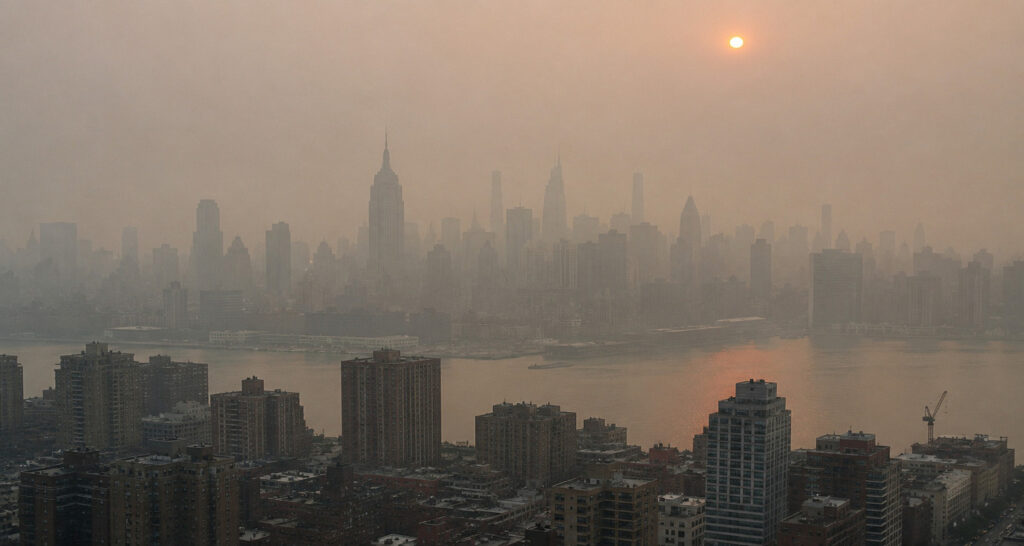
Air quality has also deteriorated across New York State. Parts of western New York have experienced very unhealthy conditions, while the New York City metropolitan area has faced unhealthy air.
Local authorities have responded by opening cooling centres and distributing protective KN95 masks to residents in some affected areas.
Hundreds of Canadian Wildfires Remain Active
Canadian wildfire officials reported 857 active fires across the country, including more than 20 new fires in a single day.
Many of the fires remain out of control despite ongoing firefighting operations.
Northwestern Ontario remains one of the biggest areas of concern. Several large fires are generating huge smoke plumes that have spread across communities including Thunder Bay and Toronto.
Winds have also carried lighter smoke over the Great Lakes and into parts of the northeastern United States.
The heavy haze has created striking red and orange sunrises and sunsets in several areas as smoke particles scatter sunlight.
Weather Provides Limited Relief
Weather conditions could provide some temporary relief, but forecasters do not expect enough rainfall to stop the largest fires.
Thunderstorms are expected across parts of Ontario in the coming days. However, experts say rainfall may not significantly reduce fire activity.
At the same time, northwesterly winds could continue pushing smoke into northern US states throughout the weekend.
Meteorologists are also monitoring whether the smoke could reach New Jersey, where large crowds are expected to gather for the FIFA World Cup final.
Conditions could improve early next week if changing winds push smoke back toward Quebec. Such a shift could allow cleaner air to return to areas farther south.
Political Pressure Grows Over Canada Wildfires
The continuing Canada wildfires have also created political tensions between Canada and the United States.
Republican lawmakers in Michigan sent a letter to Canadian Prime Minister Mark Carney calling for stronger wildfire prevention and forest management measures.
The lawmakers expressed concern after Michigan experienced the effects of Canadian wildfire smoke for the third consecutive year.
Meanwhile, global air-quality monitoring service IQAir reported that Detroit temporarily recorded the world’s worst air quality. Minneapolis and Toronto also ranked among the cities experiencing the poorest air conditions.
Public Health Remains a Major Concern
As hundreds of Canadian fires continue burning, health officials on both sides of the border are monitoring the impact of smoke exposure.
Residents in affected communities are encouraged to check local air-quality conditions before spending extended periods outdoors. People who experience breathing difficulties or other serious symptoms should follow advice from local health authorities.
The combination of dry weather, strong winds and widespread wildfire activity means smoke conditions could change quickly.
For now, Canadian firefighters continue battling hundreds of active blazes while US and Canadian authorities monitor air quality and weather patterns. The ongoing Canada wildfires demonstrate how large wildfire seasons can create environmental and public-health challenges far beyond national borders.