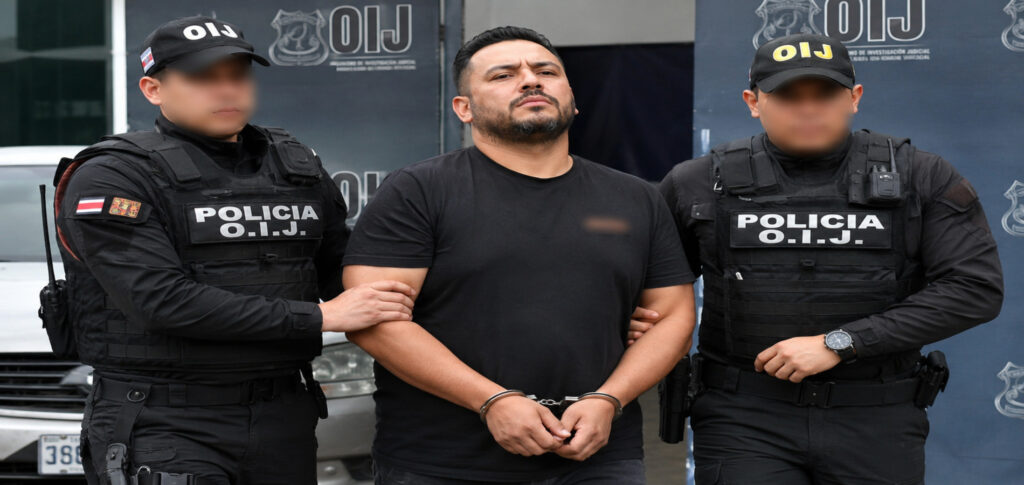
Costa Rican authorities have arrested Alejandro Arias Monge, widely known as “Diablo,” the country’s most-wanted fugitive and a major target of U.S. authorities in a drug-trafficking investigation.
Police captured Arias on July 24, 2026, during a major operation in Sarapiquí, northeastern Costa Rica. The arrest ended a years-long search for one of the country’s most wanted criminal suspects.
The operation also highlighted the continuing fight against organized crime and international drug trafficking in Costa Rica.
High-Profile Arrest After Armed Police Operation
Costa Rica’s Judicial Investigation Agency, known as the OIJ, led the operation in the Sarapiquí region.
Police confronted members of Arias’ organization during the operation. The gun battle lasted about an hour and left several officers injured. Authorities also arrested another high-profile suspect during the operation.
The operation involved tactical police units, investigators, prosecutors and judicial officials. Authorities also seized weapons and surveillance equipment from the property.
OIJ Director Michael Soto described the operation as a complex and carefully planned mission. Investigators spent years gathering information about Arias and tracking his movements before launching the final operation.
U.S. Authorities Offered $500,000 Reward
U.S. authorities had placed Arias on their radar because of his alleged involvement in international drug trafficking.
The U.S. Drug Enforcement Administration (DEA) and the U.S. Department of State offered up to $500,000 for information that could lead to Arias’ arrest or conviction. The reward became a major part of the international effort to locate him.
Arias remained at large for years despite repeated efforts by Costa Rican authorities to locate him.
U.S. authorities also explored the possibility of seeking his extradition over alleged international drug-trafficking offenses.
Costa Rica Targets Organized Crime
Costa Rican authorities have linked Arias to a criminal organization involved in drug trafficking and violent activity.
Investigators also connected his organization to violent disputes between rival criminal groups in several parts of the country. Officials say those conflicts have contributed to Costa Rica’s growing homicide problem.
The OIJ spent years investigating Arias and his network. Investigators tracked his movements, gathered intelligence and studied the security measures around his suspected hideouts before launching the operation that led to his arrest.
Michael Soto praised the investigators and tactical officers who carried out the mission. He described their work as precise and professional.
Growing Security Concerns
Costa Rica has long enjoyed a reputation as one of Central America’s more peaceful countries. However, drug trafficking and organized crime have fueled rising violence across the nation.
Criminal groups increasingly compete for control of drug routes and territories. Authorities have linked these disputes to a growing number of violent crimes and homicides.
The arrest of Alejandro Arias Monge represents a major setback for the criminal network associated with him. It also demonstrates the growing cooperation between Costa Rican law enforcement agencies and U.S. authorities.
A Major Blow to Organized Crime
The capture of “Diablo” ends a years-long manhunt and removes a major figure from Costa Rica’s organized-crime landscape.
Costa Rican investigators will now continue examining Arias’ alleged criminal activities and his organization’s wider network. Authorities must also determine the next legal steps, including whether U.S. officials will pursue extradition proceedings.
For Costa Rica, the arrest represents a significant law-enforcement victory. It also sends a strong message to criminal organizations operating across the country: authorities will continue pursuing major suspects, even after years on the run.