

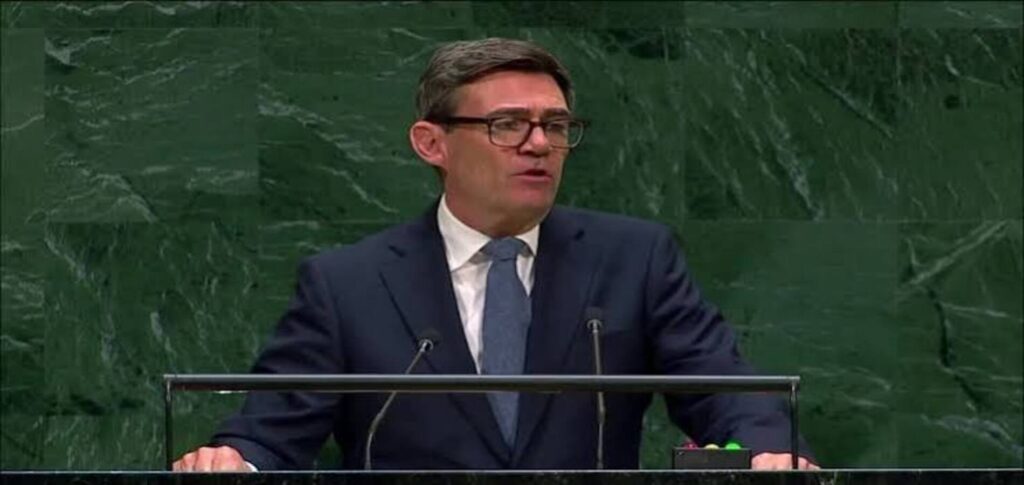
The UK plans a new UK disinformation unit to counter hostile information attacks linked to Russia and other adversaries. Prime Minister Andy Burnham announced the National Centre for Information Defence during his first address to the United Nations General Assembly.
The centre will focus on detecting, attributing and disrupting hostile state information attacks. Meanwhile, the government wants to help the public recognize misleading content as artificial intelligence makes false information easier to create and spread.
UK Targets Hostile Information Campaigns
Burnham said hostile actors have launched what he described as an industrial-scale assault on the information environment in Britain and allied countries.
In his UN speech, he specifically accused Russian agencies of spreading disinformation and exploiting public fears. He also cited bots, fake websites and falsified newspaper articles.
According to Burnham, Russian actors also forged the branding of 28 British organizations, including universities and the BBC. He further said the UK has evidence that Russian actors attempted to interfere in the 2019 general election.
Those claims remain part of the UK government’s assessment of Russian interference. Moscow has rejected accusations of hostile activity and criticized Burnham’s UN remarks.
New Centre Will Work With Civil Society
Defence Secretary Wes Streeting said the government wants the new centre to help people separate facts from false claims.
The centre will also mobilize trusted voices across civil society. That approach could bring together researchers, technology experts, media organizations and other groups that work on information security.
Furthermore, Burnham said Britain has already supported Moldova in protecting its elections from Russian interference. He argued that other European countries now face similar risks as more elections approach.
The government has not yet provided a full operational timetable for the new centre.
AI Could Increase Disinformation Risks
Artificial intelligence adds another challenge to the information environment.
AI tools can produce convincing images, videos, audio and written material at much greater speed. As a result, governments face growing pressure to detect manipulated content before it reaches large audiences.
Burnham said AI will multiply the existing threat. He also announced a new UK-US AI defence partnership focused on protecting critical national infrastructure.
The partnership will involve British and US defence teams working on AI and autonomy technologies. The UK government says the wider effort aims to improve security while supporting responsible AI development.
UK Pushes for Global AI Standards
The new information defence centre forms part of a broader UK focus on technology and national security.
Burnham told the UN that Britain wants to lead international efforts on AI standards. He said governments should agree on common principles covering transparency, access and safety.
The government also plans to place AI at the centre of Britain’s G20 presidency in 2027.
At the same time, Burnham has discussed online safety and AI risks with other world leaders. The UK and European Union have also highlighted cooperation on hybrid warfare and disinformation.
The proposed UK disinformation unit will therefore sit within a wider government strategy that links national security, elections, AI and online information.