
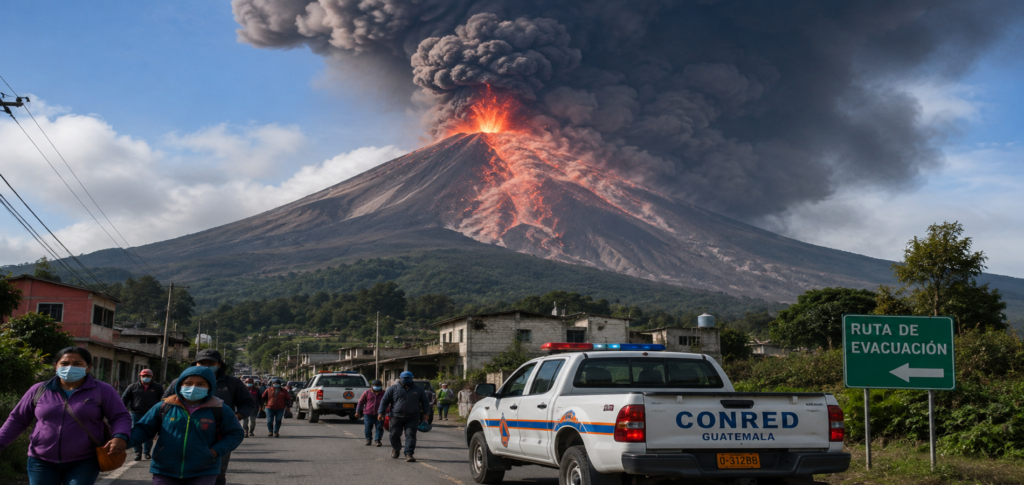
The Guatemala volcano eruption continues to threaten thousands of residents even as volcanic activity begins to slow. Authorities warned that Fuego Volcano remains highly dangerous because collapsing volcanic material could still trigger deadly pyroclastic flows and mudslides across nearby communities.
Emergency officials continue monitoring the situation closely while urging residents living near the volcano to remain alert and follow evacuation instructions.
Fuego Volcano Activity Begins to Slow
Guatemala’s National Disaster Reduction Agency (Conred) reported that volcanic activity has gradually decreased after several days of intense eruptions. Nevertheless, experts stressed that the danger has not passed.
Large amounts of volcanic material remain unstable near the crater. Consequently, collapsing debris could generate fresh pyroclastic flows capable of traveling rapidly down the volcano’s slopes.
In addition, weather forecasts predict rainfall over the affected region. As a result, authorities fear the formation of lahars, dangerous mudflows made of ash, rocks, and water that can sweep through nearby valleys.
Thousands Forced to Evacuate
Since the eruption began on Monday, emergency officials have evacuated at least 1,699 residents from communities surrounding Fuego Volcano.
Meanwhile, volcanic ash has affected more than 29,000 people, spreading across several regions of Guatemala.
Officials confirmed that ash clouds have reached heights exceeding 5,000 meters above sea level and have traveled up to 120 kilometers from the volcano.
Although Guatemala City’s international airport remains open, aviation authorities have issued warnings to pilots because volcanic ash continues affecting western airspace near the Mexican border.
Red Alerts Declared Across Several Communities
Authorities have declared the highest emergency alert level in at least three regions surrounding Fuego Volcano.
Emergency teams continue visiting homes to encourage residents to leave dangerous areas. However, many families remain reluctant to evacuate because they fear looting.
Conred Executive Secretary Claudinne Ogaldes explained that Guatemala’s evacuation orders are voluntary rather than mandatory.
Therefore, officials continue relying on public awareness campaigns to persuade families to relocate temporarily.
To strengthen security, Defense Minister Henry Saenz confirmed that military and police officers are patrolling evacuated communities to protect abandoned properties.
Schools and Roads Affected
The eruption has disrupted daily life throughout the region.
Several schools have suspended classes while education authorities assess conditions around affected municipalities.
In addition, officials have closed National Route 14, one of the primary highways serving communities near Fuego Volcano.
Tourist access to both Fuego Volcano and neighboring Acatenango Volcano has also been suspended until further notice to protect visitors.
No Major Property Damage Reported Yet
Despite the ongoing eruption, officials said no lava flows have reached residential areas.
Furthermore, emergency teams have not reported significant structural damage to homes.
However, volcanic ash continues covering nearby communities, affecting transportation, agriculture, and daily activities.
Authorities confirmed that 18 communities have experienced varying levels of ashfall since the eruption began.
Guatemala’s Most Active Volcano
Fuego Volcano is one of Central America’s most active volcanoes and has a long history of dangerous eruptions.
Its deadliest recent eruption occurred in 2018, when powerful pyroclastic flows devastated nearby communities and claimed hundreds of lives.
Because of that tragic history, emergency officials are treating the current eruption with extreme caution.
Authorities Continue Monitoring Conditions
Emergency agencies expect to monitor volcanic activity continuously over the next 72 hours.
Although the eruption appears to be weakening, officials emphasize that conditions can change quickly.
Residents living near Fuego Volcano have been advised to remain vigilant, monitor official updates, and follow emergency guidance until authorities declare the area safe.