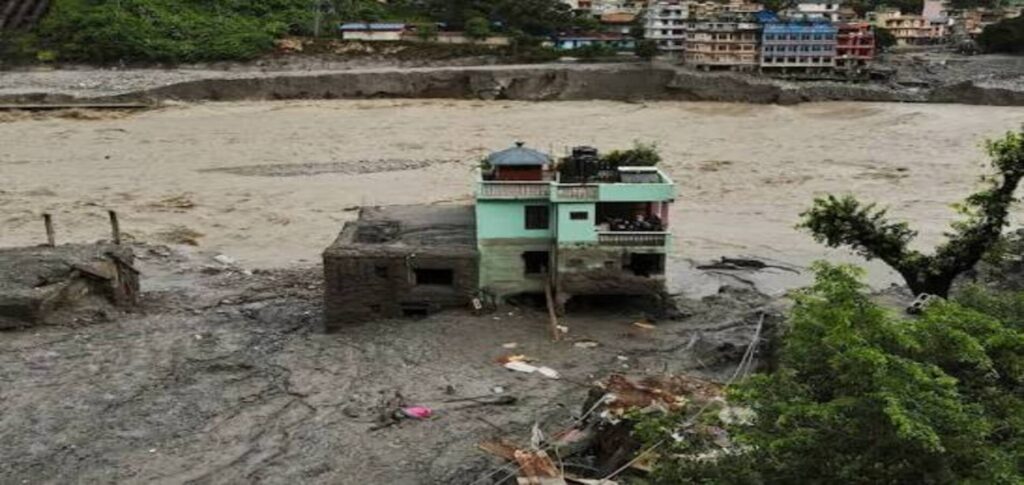
A turquoise house in Nepal has become an unlikely symbol of survival after a devastating glacier-related flash flood swept through the Trishuli area, destroying nearby buildings and infrastructure.
The striking green-blue home in Trishuli Bazaar, Nuwakot district, remained standing as a powerful torrent of water, mud, rocks and debris tore through the surrounding area.
The disaster followed a major glacial collapse near the Nepal-China border. The collapse sent a huge mass of ice, rock and debris into river channels, creating a destructive flood that raced downstream.
The force of the flood destroyed homes, roads and bridges across parts of the region. Yet the Nepal turquoise house stood through the worst of the devastation.
Images and videos from the area show the house surrounded by mud and debris. The building suffered a direct assault from the floodwaters, but much of its main structure remained intact.
Family trapped inside the house
Six members of the Pyakurel family were inside the home when the flood struck.
Prakash Pandey Pyakurel was with his wife Laxmi, their 11-year-old daughter and elderly parents. They had almost no time to react when the torrent reached the property.
Mud and water rushed into the lower levels of the house. The force of the flood carried away doors and windows as the family tried to reach safety.
The family eventually gathered on an upper-floor balcony. They remained there for around two hours while floodwaters and debris continued to batter the building.
Laxmi Pyakurel later described the experience as terrifying. At one point, the family feared they might not survive.
Their seven-year-old son was at school nearby and was safe.
The family eventually attracted the attention of rescue teams. They used a red flag to signal for help and were later rescued by helicopter.
Why did the house survive?
The survival of the Nepal turquoise house has attracted attention because surrounding structures suffered far greater damage.
Experts have pointed to the building’s construction and foundation as possible reasons for its survival.
The house reportedly has a reinforced concrete frame and stands on strong bedrock. Those features may have helped it withstand the enormous pressure created by the flood.
The surrounding torrent carried boulders, mud and other debris. Such material can cause severe structural damage when it strikes buildings at high speed.
The house’s stronger construction appears to have helped it resist the impact.
However, its survival does not mean the building escaped without damage. The lower parts of the structure were hit by the flood, while doors, windows and other elements were destroyed.
A disaster on a huge scale
The house survived while the wider region suffered catastrophic losses.
The August 2026 disaster caused widespread destruction along the Trishuli River and nearby valleys. Search and rescue teams have faced enormous challenges because roads and bridges were destroyed.
Recent reporting has described extensive damage across Nepal and Tibet. Thousands of people have been killed or reported missing, while rescue teams continue searching affected areas.
The flooding also damaged major infrastructure, including hydropower facilities and bridges.
The scale of the destruction has made the surviving house particularly striking. It offers a rare image of one structure remaining intact while much of the surrounding landscape was transformed by the disaster.
A warning about Himalayan floods
The disaster has also highlighted the growing risks faced by communities living near Himalayan rivers.
Glacier collapses and glacial lake outburst floods can release enormous quantities of water and debris within a very short period. The resulting flows can travel rapidly through narrow valleys.
The recent disaster also showed how difficult it can be to warn communities in remote mountain areas.
In this case, the sudden nature of the event left limited time for people to react. Rescue teams later faced additional dangers from unstable terrain, damaged roads and the possibility of further flooding.
Scientists and disaster experts have increasingly warned about risks linked to changing conditions in the Himalayas. Glacier retreat and unstable ice and rock can increase hazards in vulnerable mountain regions.
A symbol of resilience
For residents of Trishuli and the surrounding communities, the turquoise house has become more than a striking image.
It represents survival after one of the region’s most destructive recent disasters.
The house also raises important questions about construction standards in flood-prone areas. Strong foundations, reinforced structures and better planning could help communities reduce damage when extreme events occur.
The disaster has already left thousands of families facing loss and uncertainty. As recovery efforts continue, the Nepal turquoise house stands amid the destruction as a remarkable reminder that resilient construction can sometimes make the difference between total collapse and survival.
The wider disaster remains a humanitarian crisis, but the surviving home has provided one small and unexpected story of hope amid the devastation.