
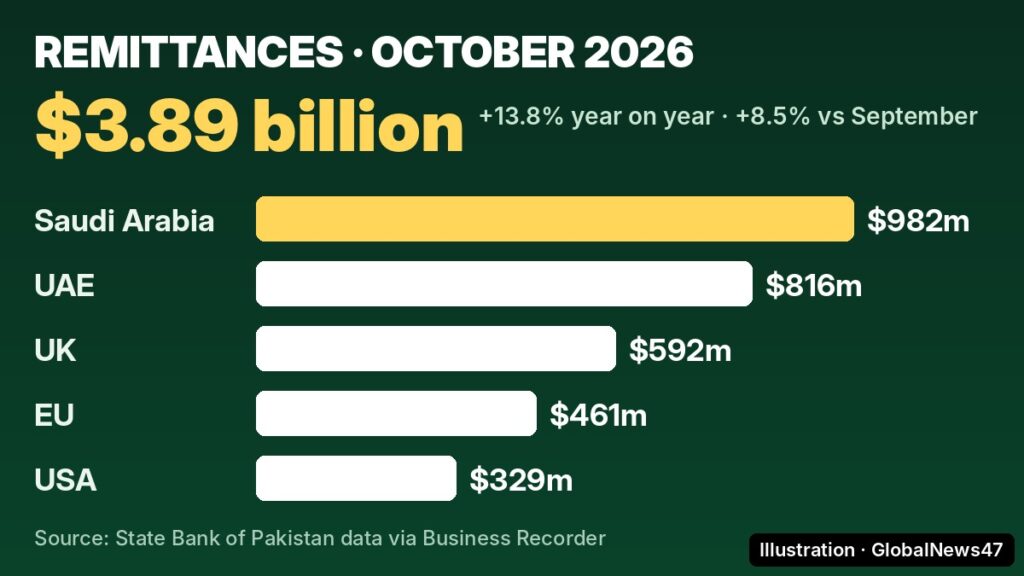
Pakistan remittances rose to $3.89 billion in October 2026, up 13.8% from a year earlier, according to State Bank of Pakistan (SBP) data. Overseas Pakistanis sent $3.42 billion home in October 2025. The monthly total was also 8.5% higher than September’s $3.6 billion, Business Recorder reported.
The strong month adds to a steady run of inflows this fiscal year. In the first four months of FY27, from July to October, workers sent $14.8 billion. That is 14% more than the roughly $13 billion received in the same period last year.
Where Pakistan remittances came from
The Gulf remained the biggest source. Saudi Arabia led the list in October, followed by the United Arab Emirates. Workers in Britain, the European Union and the United States also sent large sums, according to figures reported by Business Recorder and Xinhua.
- Saudi Arabia: $982 million, up 17% from $838 million a year earlier
- UAE: $816 million, up 16% from $703 million
- United Kingdom: $592 million, up 19% from $499 million
- European Union: $461 million, up 3% from $448 million in September
- United States: $329 million, up 9% from $301 million
Together, Saudi Arabia and the UAE sent about $1.8 billion. In other words, these two countries alone supplied close to half of October’s total. The UK showed the fastest annual growth among the main sources. Global News 47 calculated these shares from the published figures.
SBP raises its full-year forecast
The central bank has become more upbeat. Last month, it raised its projection for full-year remittances to $45 billion for FY27, up from $44 billion, Business Recorder said. It also revised its forecast for foreign exchange reserves upward.
SBP Governor Jameel Ahmed said remittances stayed resilient in the first quarter of the fiscal year. He added that they are now expected to beat the earlier assessment.
Khurram Schehzad, adviser to the finance minister, welcomed the data. Writing on X, he said “sustained inflows are strengthening Pakistan’s foreign exchange position.”
Why remittances matter for the economy
Remittances are one of Pakistan’s largest sources of foreign currency. They help pay for imports such as oil, machinery and food. They also support the rupee and the country’s foreign exchange reserves.
For millions of families, the money is a lifeline. It pays for school fees, medical bills, rent and daily household costs. As a result, higher inflows can also support spending in local markets.
The scale is striking. TechX noted that the $14.8 billion received from July to October nearly matches Pakistan’s merchandise trade deficit of about $14.6 billion over the same months. For the whole of FY26, remittances reached a record $41.6 billion, up 8.6%.
Strong inflows matter even more this year. The Middle East war has pushed up global oil prices for months, which raises Pakistan’s import bill. Therefore, steady dollar inflows from workers abroad help ease pressure on the external account.
More use of formal channels
Officials have pushed for years to move money away from informal hawala and hundi networks. Formal channels give the state better visibility and add to official reserves.
In January 2026, the SBP allowed exchange companies to use Raast, its instant payment system, to deliver home remittances, according to TechX. As a result, families can receive money in bank accounts or digital wallets within seconds rather than days. TechX also reported that 92% of remittances in the last fiscal year were sent digitally.
However, inflows can still swing. They often rise ahead of Eid and other festivals. They can also fall if job markets in the Gulf slow down or if the gap between official and open-market exchange rates widens.
What comes next
If the current pace holds, Pakistan is on track to meet or pass the SBP’s new $45 billion target. Monthly data for November will show whether the momentum continues.
For now, October’s figures are a welcome sign for an economy that relies heavily on Pakistan remittances to stay stable. They also come as fuel prices fall at home, which may give households a little more breathing room.
Related on Global News 47: Petrol Price in Pakistan Cut to Rs338 · Pakistan Cashless Economy Roadmap · KSE-100 Index Surges