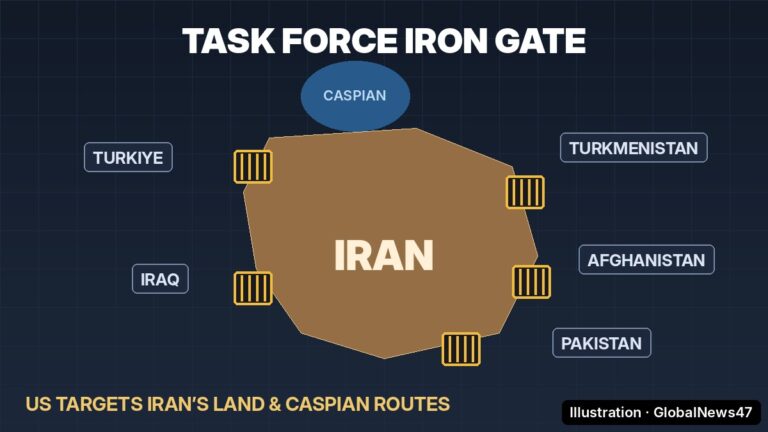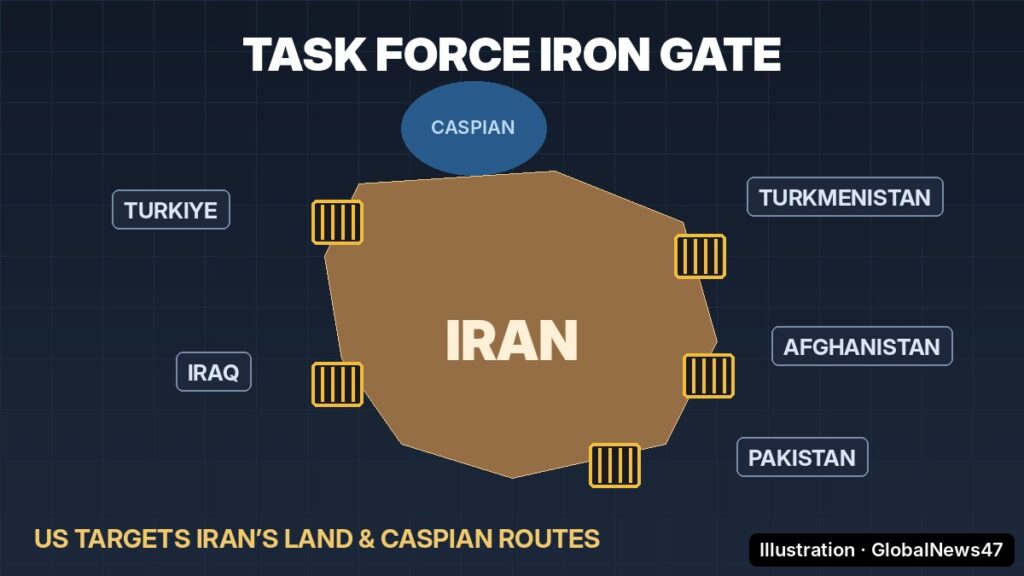
The US military has set up Task Force Iron Gate to cut off Iran’s land and Caspian Sea supply routes. The new unit adds an overland front to the US naval blockade of Iranian ports. US Central Command (Centcom) announced the move on Saturday, 7 November, as the eight-month war between the two countries continues.
A Centcom graphic shared with the announcement highlighted Iran’s land borders with Pakistan, Afghanistan, Turkiye and Turkmenistan, among others. However, Centcom did not name any specific crossings or partner countries.
What is Task Force Iron Gate?
Centcom commander Admiral Brad Cooper ordered the creation of the task force. It is a team of about 20 civilian and military staff based at Centcom headquarters in Tampa, Florida, Reuters reported. Centcom describes it as an internal unit rather than a new military deployment, according to Dawn.
The team will work with other US government agencies. Its job is to “monitor, detect, and disrupt any illicit movement of advanced weapons systems” and other goods, the Centcom graphic said. That includes dual-use technology, sanctioned materials and illegal revenue moving across Iran’s borders and the Caspian Sea.
Cooper said the step would further limit Iran’s ability to “finance terrorism” and rebuild its weapons factories. He also linked it to what he called the “ironclad blockade” at sea.
Building on the naval blockade
The US Navy already enforces a blockade of Iran’s ports along the Gulf and the Gulf of Oman coast. According to Centcom, this has blocked more than $25 billion of Iranian crude exports in recent months. Even so, Reuters noted that Iran has continued to export some oil and liquefied natural gas despite the blockade.
In addition, the US is tightening financial pressure. In a related step, the US Treasury has designated eight digital asset service providers, Dawn reported. Washington accuses them of helping Iran’s government and the Revolutionary Guards move money through cryptocurrency. The State Department is also offering up to $20 million for information on Iran’s nuclear programme.
Why it matters for Pakistan and the region
Pakistan shares a long border with Iran in Balochistan. As a result, any US effort to watch land trade routes is likely to draw attention in Islamabad. Centcom has not announced any agreement with Pakistan, Dawn’s Washington correspondent reported. No Pakistani official response had been reported as of 5:45 PM PKT on Sunday.
The other neighbours named in Centcom’s graphic include Turkiye, Afghanistan and Turkmenistan. Türkiye Today reported that Iraq, Armenia and Azerbaijan were also shown. How the task force will work with these countries is not yet clear.
Iran’s response
Tehran has struck a defiant tone. Iranian army spokesman Mohammad Akraminia said Iran’s forces were now on higher alert and stronger than at the start of the war, Dawn reported. He warned that any response would be “immediate, effective and without geographical limitations.”
Akraminia also said the Strait of Hormuz would stay closed until Washington meets Iran’s demands. These include lifting the blockade and unfreezing Iranian assets. Separately, Iran’s army said a tanker caught fire after hitting a naval mine in the strait. The US has said all mines had been cleared. These claims could not be independently verified.
Diplomacy still on the table
Despite the new pressure, talks have not stopped. Qatar is mediating between the two sides. Qatari Prime Minister Sheikh Mohammed bin Abdulrahman Al Thani said Washington was still open to a solution after Tuesday’s midterm vote. “We cannot wait to reach a perfect agreement; we hope to reach a good agreement,” he said.
President Donald Trump has also spoken about a possible deal. “They want to make a deal very badly,” he said, according to Dawn. Trump called the Emir of Qatar on Friday to discuss ending the war. Meanwhile, Iranian Foreign Minister Abbas Araghchi said he had held calls with ministers from 12 countries in 48 hours.
What comes next
The task force is small, but it signals a wider pressure campaign beyond the sea. Its real impact will depend on cooperation from Iran’s neighbours. For Pakistan, the key question is whether border trade with Iran will face new scrutiny in the weeks ahead.
Related on Global News 47: Seafarer Killed as Hormuz Tanker Attacks Rise · Turkiye Ratifies Makkah Defence Pact With Pakistan and Saudi Arabia