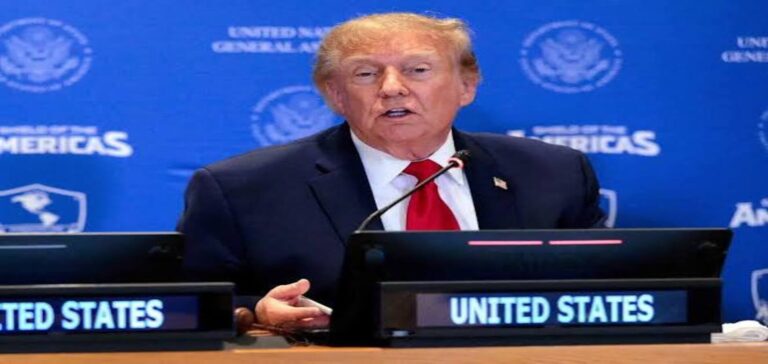

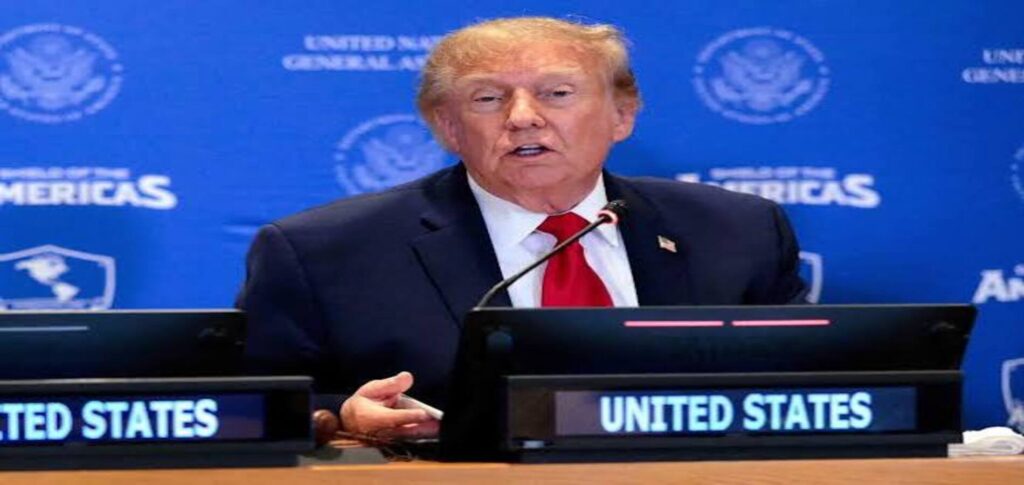
US President Donald Trump has announced that the federal government will refer to artificial intelligence as “super intelligence” in official documents. He made the announcement during his address to the United Nations General Assembly in New York on Tuesday.
Trump said the word “artificial” makes the technology sound less real than it is. He argued that “super intelligence” is a more accurate description and suggested that other countries could eventually adopt the terminology.
The announcement came as governments debate how to manage the rapid development of AI. Trump again opposed international efforts to impose broad regulations on the technology. At the same time, he said US authorities would monitor the industry and could take action if necessary.
Trump Rejects Global AI Regulation
Trump said the United States would reject attempts to create what he called a global system for controlling AI. He also compared warnings about AI to earlier warnings about climate change.
His comments came as several governments pushed for stronger international safeguards. More than 20 mostly European countries have called for binding measures covering advanced AI, arguing that technological development could move faster than governments’ ability to manage its risks.
The United States and China, two of the world’s leading AI powers, did not endorse that proposal.
Trump’s decision to promote the term “super intelligence” also follows other naming changes pursued by his administration. However, the new AI terminology is currently presented as a change in US government usage rather than a global change to the technology’s established name.
UK Plans Global AI Initiative
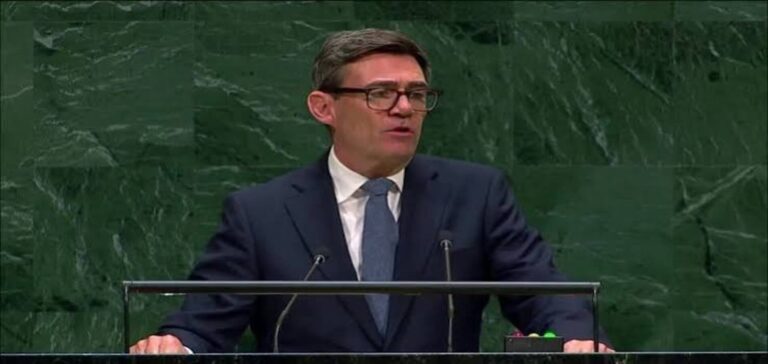
British Prime Minister Andy Burnham used his first UN appearance to call for international cooperation on AI.
Burnham said Britain would use its 2027 G20 presidency to push for a common set of global principles and standards for frontier AI. He also announced that the UK and US are developing a new AI defence partnership aimed at protecting critical national infrastructure.
The planned partnership will bring together Britain’s Defence Rapid AI Delivery Taskforce and its US counterpart to develop trusted AI and autonomous technologies for security purposes.
Burnham presented Britain as a possible bridge between major AI powers. He said governments needed to work together to capture the technology’s benefits while addressing its risks.
Macron Calls for Greater AI Independence
French President Emmanuel Macron also urged countries to avoid becoming dependent on a small number of AI superpowers.
Macron called for greater investment in open-source AI systems that could be shared internationally. His comments reflected concerns among some European governments about relying too heavily on technology developed in either the United States or China.
Meanwhile, leading figures from the private AI industry are preparing to take part in discussions at the UN. OpenAI CEO Sam Altman is expected to address the UN Security Council, while Anthropic CEO Dario Amodei and Hugging Face co-founder Clement Delangue are also due to participate remotely.
UN Seeks US-China Dialogue on AI
UN Secretary-General António Guterres has urged the United States and China to establish direct communication channels on AI.
Guterres compared the need for dialogue to efforts by the US and Soviet Union during the Cold War. He said countries with the most advanced AI capabilities also carry major responsibilities for managing shared risks.
The competing approaches at the UN highlight a growing divide over AI policy. The United States is emphasizing continued development and technological leadership, while several European governments are pushing for stronger international standards.
The debate is likely to intensify as AI systems become more capable and governments consider how existing laws and international agreements should apply to the technology.