

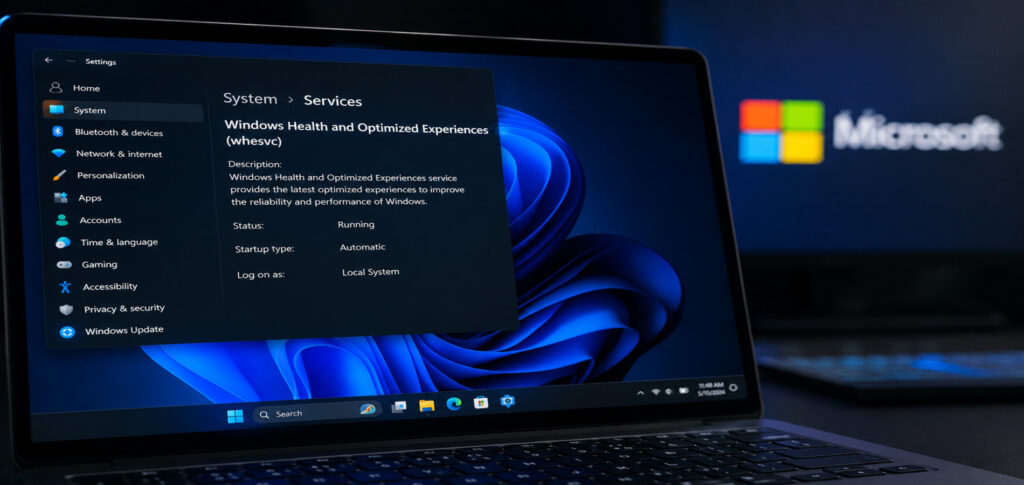
Microsoft has addressed growing concerns surrounding the Windows 11 background service, saying recent claims circulating online are misleading. The company confirmed that the service is part of Windows’ diagnostic system and does not secretly monitor users or transmit personal data without permission.
The clarification follows widespread discussion on social media, where posts alleged that Microsoft had quietly introduced spyware into Windows 11.
What Is the Windows 11 Background Service?
The feature under discussion is called Windows Health and Optimized Experiences (whesvc).
According to Microsoft, the service has been included in Windows 11 since 2025. Its primary role is to monitor system performance locally and help identify issues that may affect a computer’s speed or stability.
For example, if Windows detects that a PC is running slowly, the service can collect performance information to help diagnose the problem.
Microsoft Says Data Stays on the Device
Microsoft stressed that the Windows 11 background service stores diagnostic information on the user’s computer.
Scott Hanselman, Microsoft’s Deputy Technical Director, explained that the collected data is not automatically sent to Microsoft. Instead, it remains stored locally unless the user chooses to share diagnostic information.
The company also admitted that the current description of the service inside Windows is confusing and confirmed that it plans to update the wording to better explain its purpose.
Social Media Claims Spark Privacy Debate
The controversy began after a social media post claimed the background service sends diagnostic data to Microsoft every 15 minutes while tracking user activity.
Microsoft has rejected those allegations.
The company says there is no evidence that the service functions as spyware or secretly monitors personal behavior.
Instead, it is designed to improve Windows performance by helping identify technical issues.
Past Features Have Increased User Concerns
Although Microsoft denied the latest claims, many Windows users remain cautious because of previous privacy controversies.
One example is Windows Recall, an AI-powered feature introduced earlier by Microsoft.
Recall continuously monitors on-screen activity and can capture screenshots to help users quickly find previously viewed information.
The feature received strong criticism from privacy advocates because sensitive information could potentially be stored.
Following public backlash, Microsoft revised several aspects of Recall before its wider rollout.
Trust Remains a Challenge
The latest discussion shows that user trust remains an important issue for Microsoft.
Privacy experts say transparency is essential whenever operating systems collect diagnostic or performance information.
While Microsoft insists the Windows 11 background service only collects local performance data and requires user permission before transmitting information, many users continue to pay close attention to any new background services added to Windows.
As Microsoft updates the service description, the company hopes to reduce confusion and reassure users that the feature is intended to improve system reliability rather than monitor personal activity.