

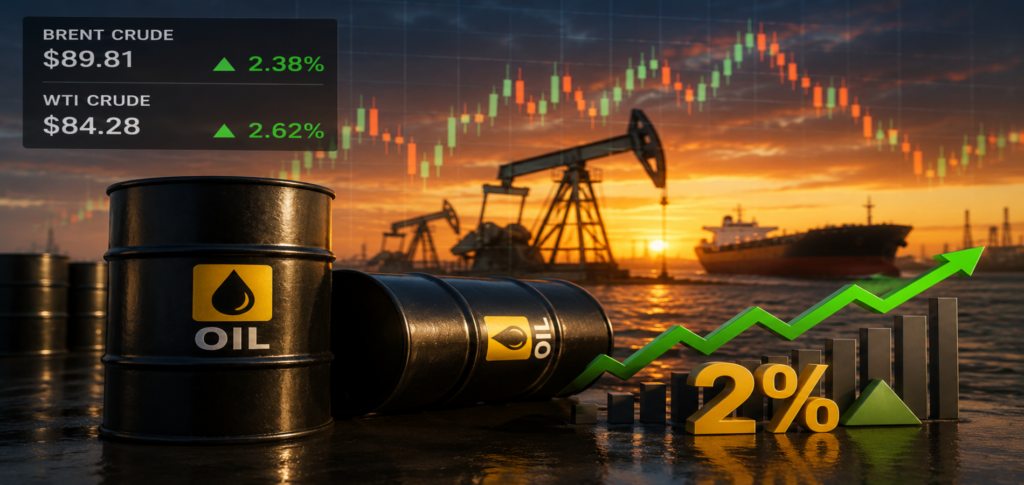
Oil prices rose more than 2% on Tuesday as fading hopes for a U.S.-Iran peace deal and continued disruption to Middle East energy routes raised concerns about global supplies.
Brent crude futures climbed $2.09, or 2.38%, to $89.81 a barrel by 0952 GMT. U.S. West Texas Intermediate crude gained $2.15, or 2.62%, to $84.28. Both benchmarks reached their highest levels since July 31.
The latest move extends a sharp rally that began Monday. Both contracts jumped more than 5% as tensions surrounding the Strait of Hormuz increased.
Oil Prices Rise 2% as Hormuz Tensions Grow
The Strait of Hormuz remains the biggest concern for oil traders.
U.S. President Donald Trump responded to Iran’s conditions for a potential peace agreement with demands for compensation related to people killed in wars, attacks and protests. Those demands could make negotiations more difficult and delay efforts to fully reopen the strategic waterway.
Trump later said the United States controlled the strait and had cleared it of Iranian mines.
However, shipping activity remains well below normal levels. Traffic through the waterway fell to just six vessels on Monday, compared with a 10-day average of around 11 vessels.
There’s no clear path to a solution,said Ole Hansen, head of commodity strategy at Saxo Bank. He added that ongoing supply disruptions were putting renewed upward pressure on oil prices.
Global Oil Supplies Face Growing Pressure
The latest shipping data has added to market concerns.
Barclays analysts said crude oil and refined-product net exports through the Strait of Hormuz averaged about 3 million barrels per day in the week ending August 7. That was down from 4.4 million barrels per day the previous week.
The waterway normally carries a huge share of global energy supplies. Before the Iran conflict began in late February, roughly one-fifth of the world’s daily oil and liquefied natural gas supplies passed through the strait.
As a result, even a partial disruption can quickly affect prices, shipping costs and insurance rates.
Houthi Attack Adds to Energy Market Risk
Concerns are not limited to the Strait of Hormuz.
A cargo ship came under attack Tuesday in the Bab el-Mandeb Strait, according to Yemeni coast guard sources and military officials. Three crew members reportedly died.
The attack adds another layer of risk for energy shipments moving through the Red Sea region.
The chokehold risk around both the Strait of Hormuz and the Bab el-Mandeb remains highly significant,said Tim Waterer, chief market analyst at KCM Trade.
He said even intermittent restrictions can raise insurance costs and force vessels to take longer routes.
Saudi Refinery Restart Delayed
Saudi Arabia is also dealing with disruption to its energy infrastructure.
Saudi Aramco postponed the restart of its 400,000-barrel-per-day Jazan refinery until August 30. The decision followed two attacks claimed by Yemen’s Iran-aligned Houthi group on Sunday.
Meanwhile, the Abu Dhabi National Oil Company has continued offering spot crude through tenders. The latest tender marks its eighth since the beginning of June as the UAE seeks ways to move oil around the Strait of Hormuz disruption.
These developments have reinforced concerns that regional energy flows could remain constrained in the near term.
Ukraine Attack Adds to Oil Market Uncertainty
The oil market is also watching developments involving Russia.
Ukraine’s military said Tuesday that it had attacked an oil refinery in Orsk, the second-largest city in Russia’s Orenburg region and an important industrial centre.
Any prolonged disruption to Russian refining or exports could add further pressure to an already uncertain global energy market.
What Happens to Oil Prices Next?
The latest oil prices rise 2% move reflects a combination of geopolitical risks, weaker shipping activity and uncertainty over the future of U.S.-Iran negotiations.
For traders, the key question is whether the Strait of Hormuz can return to normal operations. A sustained reopening could ease supply concerns and push prices lower. Continued disruption, however, could keep crude prices elevated.
Markets will also closely watch further diplomatic talks, shipping traffic through both major waterways and attacks on regional energy infrastructure.
For now, fading hopes for a quick U.S.-Iran agreement are keeping oil traders on edge and adding fresh momentum to crude prices.