Delhi air quality worsened sharply on Diwali, with toxic haze covering the Indian capital on Sunday, 8 November. A day earlier, Swiss monitoring group IQAir ranked Delhi the world’s most polluted major city. Officials now expect the air to stay in the “severe” category for several days.
The Diwali festival of lights is usually marked with fireworks. Each year, however, the celebrations add to a pollution crisis that already grips northern India in winter.
Delhi air quality on Diwali day
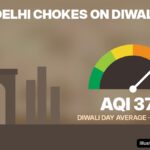
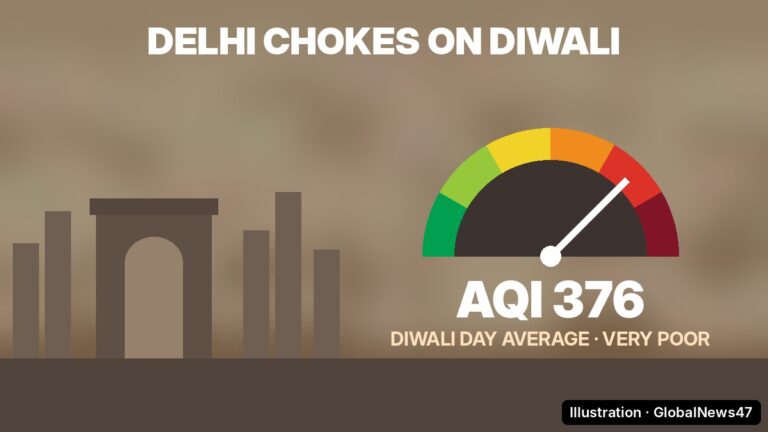
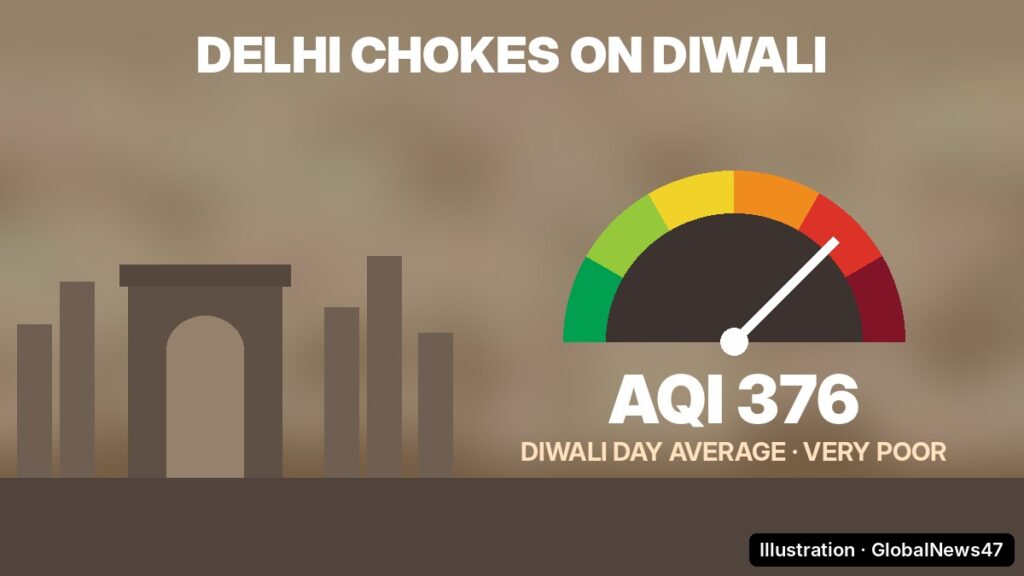
Delhi’s average air quality index (AQI) on Sunday was 376, in the “very poor” range, the Press Trust of India reported, via ThePrint. That was up from 369 on Saturday.
Of 59 monitoring stations, 12 recorded “severe” air and 22 recorded “very poor” air. Jahangirpuri was the worst-hit area, with a reading of 463. India’s official scale treats an AQI of 0 to 50 as “good” and 401 to 500 as “severe”.
Earlier on Sunday morning, The Week reported that 24 stations had crossed 400 after a night of fireworks. Areas such as Punjabi Bagh and RK Puram were among those in the severe zone.
World’s most polluted major city
On Saturday morning, IQAir’s live ranking put Delhi first among major world cities. Its reading was a US AQI of 581 at 10:35 am, Reuters reported via Dawn. That was about double the reading for Lahore, at 285.
India’s Central Pollution Control Board (CPCB) gave a lower figure of 363 at 10 am. The two numbers are not directly comparable, because IQAir uses a different scale and method.
Why Delhi’s air gets so bad
Several factors combine at this time of year. First, farmers in Punjab and Haryana burn crop stubble after the harvest. Second, cooler temperatures and calm winds trap smoke near the ground. In addition, vehicle exhaust adds to the load every day.
On Sunday, transport was responsible for about 19 percent of Delhi’s pollution, the government’s Decision Support System estimated. Stubble burning made up about 3.5 percent. PM2.5, the fine particles that can travel deep into the lungs, was the main pollutant.
Fireworks then add a sudden spike. Air quality worsened by about 30 percent within two hours of the 8 pm firecracker window opening on Saturday night, The Week reported.
Rules on firecrackers and schools
Under a Supreme Court order, only certified “green” firecrackers may be sold in Delhi and nearby areas. They can be used only during set time windows on 7 and 8 November. A full ban returns from 9 November, The Week reported.
Meanwhile, authorities ordered schools in and around Delhi to offer online classes. People were also encouraged to work from home ahead of the festival, Reuters reported.
Health risks of toxic air
Doctors warn that such air is dangerous for everyone, but especially for some groups. Children, older people and those with asthma, heart or lung disease face the highest risk. Health experts quoted by The Week urged people to take precautions.
Common advice during severe pollution includes limiting time outdoors and avoiding exercise outside. Keeping windows closed at peak hours also helps. People with existing illnesses should follow their doctor’s guidance and keep medicines at hand. This is general information, not personal medical advice.
A shared problem for Lahore and Delhi
Smog does not stop at the border. Lahore and other cities in Pakistan’s Punjab also face poor air each winter, as Saturday’s IQAir readings showed. The causes are similar on both sides, including crop burning, traffic and industry. As a result, experts have long called for regional cooperation on clean air.
What comes next
The Air Quality Early Warning System expects Delhi’s air to stay “severe” from 9 November for a few days. Stubble burning is near its seasonal peak, and winds remain weak. Unless the weather changes, residents of the capital may have to live with hazardous air well beyond the festival.
Related on Global News 47: Multi-Cancer Blood Test Trial in England · Pakistan Reports Ninth Polio Case of 2026