
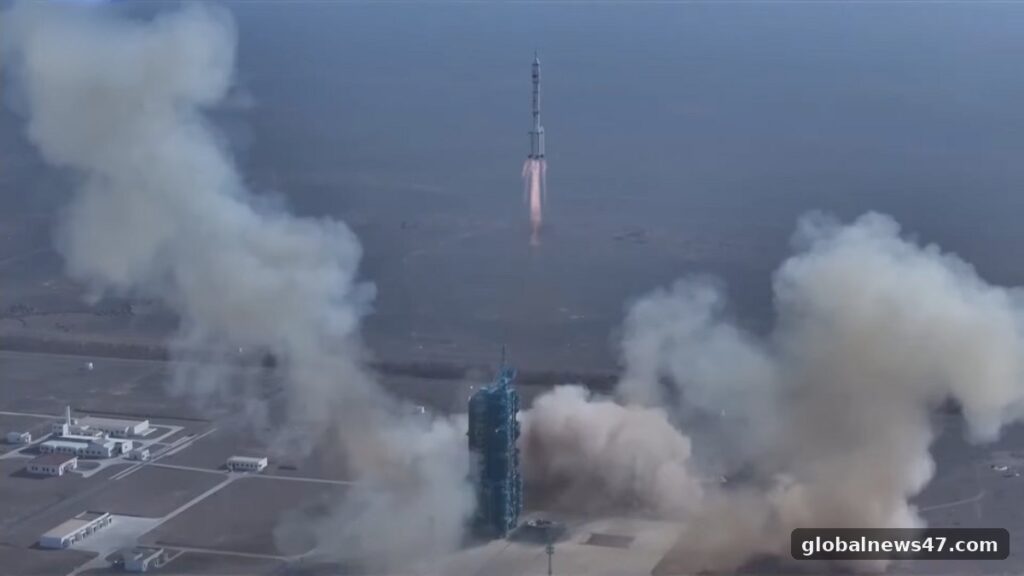
Pakistan’s first astronaut, Muhammad Zeeshan Ali, is set to fly to China’s Tiangong space station early on Wednesday, 25 November 2026. The China Manned Space Agency (CMSA) named the three-person Shenzhou-24 crew on Tuesday at a briefing in Jiuquan, in north-western China. As a result, Ali will also become the first foreign astronaut to visit China’s station.
Lift-off on a Long March-2F rocket is planned for 5:18am Pakistan time (8:18am in Beijing). This report is accurate as of 10pm PKT on 24 November; the launch had not yet taken place.
Who is flying with Pakistan’s first astronaut
Ali, 40, is a Pakistan Air Force pilot. He will fly as a payload specialist. The commander is veteran Chinese astronaut Tang Hongbo, and Wu Yi is the flight engineer.
Tang has flown before, on Shenzhou-12 and Shenzhou-17. According to Geo News, he will become the first astronaut to visit Tiangong three times. Wu, by contrast, is making his first spaceflight.
CMSA spokesperson Zhang Jingbo said the flight would be the first joint mission of Chinese and foreign astronauts in China’s crewed programme, Al Jazeera reported. After reaching orbit, the spacecraft is expected to dock with the Tianhe core module in about three and a half hours.
A short stay with a long research plan
Ali’s time in orbit will be brief. According to SUPARCO, Pakistan’s space agency, he will stay roughly one week. His ride home will be the Shenzhou-23 capsule, which is already docked at the station.
However, his work is designed to last much longer. Ali will run four Pakistani experiments, chosen from more than 300 proposals sent in by universities and research bodies. The work spans biotechnology, materials, fluid behaviour and the life sciences.
One experiment will test whether microalgae can be grown in space as a source of nutrients and oxygen. Another will study how microgravity and cosmic radiation affect quinoa seeds. In addition, two tests will look at self-healing and hybrid composite materials for aircraft and spacecraft.
Some samples will stay on the station’s outer platforms for a year. SUPARCO told Al Jazeera the full set of experiments will need six to 12 months to finish.
Training, language and halal food
Ali and a second pilot, Khurram Daud, were named reserve astronauts in April. They then began training at the Astronaut Centre of China in Beijing. Daud is the backup for this flight. Whether he gets his own mission later has not been announced.
The training included centrifuge runs, survival drills and emergency procedures. Even so, Ali said in a CMSA video that learning technical Chinese was the toughest part. Every switch, screen and voice alert on board uses the language.
China also made bilingual manuals and halal meals for him, Geo News reported. A final full launch rehearsal was completed at Jiuquan on 21 November.
“I carry the hopes of 250 million”
Speaking to reporters on Tuesday, Ali said the mission was bigger than one person. “I am not flying for myself. I carry the name of Pakistan on my shoulder, the hopes of 250 million Pakistanis,” he said.
He also had a message for children following the flight: look up at the sky, because his journey carries their dreams too, The Express Tribune reported.
President Asif Ali Zardari called the mission a “landmark achievement” for the country. Similarly, Prime Minister Shehbaz Sharif said Pakistan stood “on the threshold of a historic first”. Planning Minister Ahsan Iqbal travelled to China for the launch.
Why the mission matters for Pakistan and China
The flight grows out of an astronaut agreement that SUPARCO and CMSA signed in Islamabad in February 2025. The flight also falls in the 75th year of Pakistan-China diplomatic relations. Notably, the Shenzhou-24 mission emblem includes jasmine, Pakistan’s national flower.
There is a wider context too. China built its own station after it was kept out of the International Space Station, partly because a 2011 US law limits NASA’s cooperation with Beijing. Choosing a Pakistani as its first foreign visitor therefore sends a clear signal about the closeness of the partnership.
Pakistan’s earlier space work with China has been robotic. Its iCube-Qamar satellite reached lunar orbit on China’s Chang’e-6 mission in 2024. Meanwhile, SUPARCO says a joint Moon mission with China is pencilled in for around 2028, though details are still under wraps.
What happens next
The immediate test is a safe launch and docking. After that, Ali must set up the experiments and confirm the equipment survived the launch. The results will take months to arrive.
For his part, Ali sees the flight as a start rather than an end. “This mission is not a finish line; it is a launchpad,” he said. Pakistan will be hoping the next chapter brings more joint flights.
Read more: Iran says it trusts Pakistan’s mediation and Pakistan’s latest Test win over Sri Lanka.
Sources & References
- The Express Tribune: ‘I carry the name of Pakistan on my shoulder’: Zeeshan Ali set for historic spaceflight aboard China’s Shenzhou-24 (24 Nov 2026)
- Al Jazeera: Pakistan’s Zeeshan Ali set for historic flight to China’s space station (24 Nov 2026)
- Geo News: Pakistan’s first astronaut Zeeshan Ali set for historic liftoff aboard Shenzhou-24 (24 Nov 2026)
- The Express Tribune: ‘The universe has no borders’: Pakistan’s historic space mission draws global praise (24 Nov 2026)