
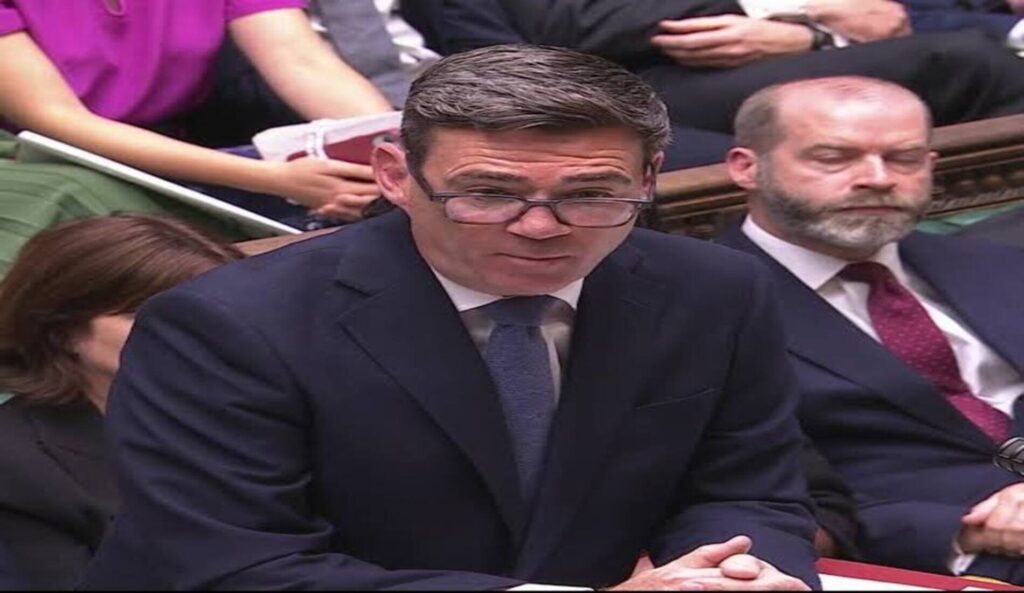
Prime Minister Andy Burnham faced his first Prime Minister’s Questions on Wednesday as UK borrowing costs climbed to their highest level in 18 years.
Conservative leader Kemi Badenoch used the session to challenge Burnham over his spending plans, rising government debt and the possibility of further tax increases.
Meanwhile, Burnham defended his economic approach and blamed the previous Conservative government for leaving Britain exposed to market turbulence.
Badenoch Challenges Burnham Over Spending
Badenoch argued that Burnham had announced numerous spending plans without explaining clearly how the government would pay for them.
She said financial markets were concerned about a government that wanted to satisfy competing demands without identifying the funding.
The Conservative leader then presented Burnham with three choices: higher taxes, more borrowing or spending cuts.
She also pressed the prime minister to say whether he planned to raise taxes in the upcoming Budget.
Burnham Refuses to Rule Out Tax Changes
Burnham did not give Badenoch a direct yes-or-no answer.
Instead, he pointed to the tax reductions his government had already introduced. These included cutting VAT on energy bills and reducing business rates for the hospitality sector.
However, he said he would not attempt to announce the full Budget during PMQs.
Burnham also said he and Chancellor John Healey had deliberately set an early Budget date in October. The move, he argued, would limit prolonged speculation about the government’s financial plans.
UK Borrowing Costs Reach New High
The political clash came as the bond market put additional pressure on the government.
The yield on the UK’s 10-year government bond climbed to around 5.25%, its highest level since 2008. Meanwhile, the 30-year gilt yield reached levels last seen in 1998.
Higher yields mean the government faces greater costs when it borrows or refinances debt.
As a result, the increase could limit the money available for new policies ahead of the autumn Budget.
Burnham Blames the Conservative Legacy
Burnham rejected Badenoch’s criticism and turned the argument towards the Conservatives’ record in government.
He said years of weak growth and rising debt had left Britain vulnerable to global financial shocks.
The prime minister also argued that his government was already making progress.
He highlighted stronger economic growth and claimed that Britain was reducing its deficit faster than any other G7 country.
Badenoch Raises Liz Truss Comparison
The Conservative leader also referred to former Prime Minister Liz Truss and her controversial 2022 mini-Budget.
Badenoch argued that Burnham risked repeating a key mistake by announcing spending commitments before explaining how they would be funded.
Burnham responded by attacking Badenoch’s decision to bring politicians associated with the Truss government into her shadow cabinet.
He said the Conservatives had damaged confidence in the economy during the short-lived Truss administration.
The exchange produced loud reactions from both sides of the Commons.
Lord O’Neill Adds to Economic Pressure
Badenoch also cited comments from economist Lord Jim O’Neill, who has been linked to Burnham.
O’Neill had praised Burnham’s early performance in office. However, he also warned that higher market interest rates could force the government to confront difficult decisions involving welfare spending and the state pension triple lock.
Badenoch used those comments to argue that investors wanted greater clarity from the government.
Burnham, however, noted that he and O’Neill did not always agree.
Global Markets Add to the Pressure
The rise in UK borrowing costs has also occurred during a wider global bond sell-off.
Investors have been watching inflation, energy prices, interest-rate expectations and geopolitical tensions closely.
The conflict involving the United States and Iran has added further pressure to energy markets. Higher energy prices can increase inflation fears and, in turn, raise expectations for interest rates.
Therefore, not all of the pressure on UK government bonds comes directly from Burnham’s policies.
Burnham Promises Fiscal Responsibility
Despite the criticism, Burnham sought to reassure investors.
He said his administration would remain committed to fiscal responsibility and would follow the government’s fiscal rules.
At the same time, he said ministers wanted to reduce pressure on household budgets.
That balance could prove difficult as borrowing costs rise and the government prepares its first major Budget under Burnham’s leadership.
Defence Spending Remains a Major Issue
Defence spending also featured in the wider debate surrounding the government’s financial plans.
Burnham insisted that his government remained committed to increasing defence investment.
He said the government would fully fund its defence investment plan and set out a path towards meeting its NATO commitments.
The issue has become particularly important after disagreements over the timing and scale of planned defence spending increases.
October Budget Faces Greater Scrutiny
The rising cost of government borrowing means Chancellor John Healey faces a tougher task ahead of the October Budget.
Higher borrowing costs can reduce the government’s financial room for manoeuvre. Consequently, ministers may face difficult choices over taxes, spending and debt.
Markets will therefore watch the Budget closely.
Investors will want to see whether Burnham and Healey can fund their policy plans while maintaining confidence in Britain’s public finances.
Political Battle Over the Economy Intensifies
Burnham’s first PMQs set the tone for a potentially difficult political battle with Badenoch.
The Conservative leader is likely to continue attacking Labour over spending, debt and taxation.
Meanwhile, Burnham will need to demonstrate that his government can deliver its cost-of-living promises without losing control of the public finances.
For now, the sharp rise in UK borrowing costs has made that challenge even more urgent.