

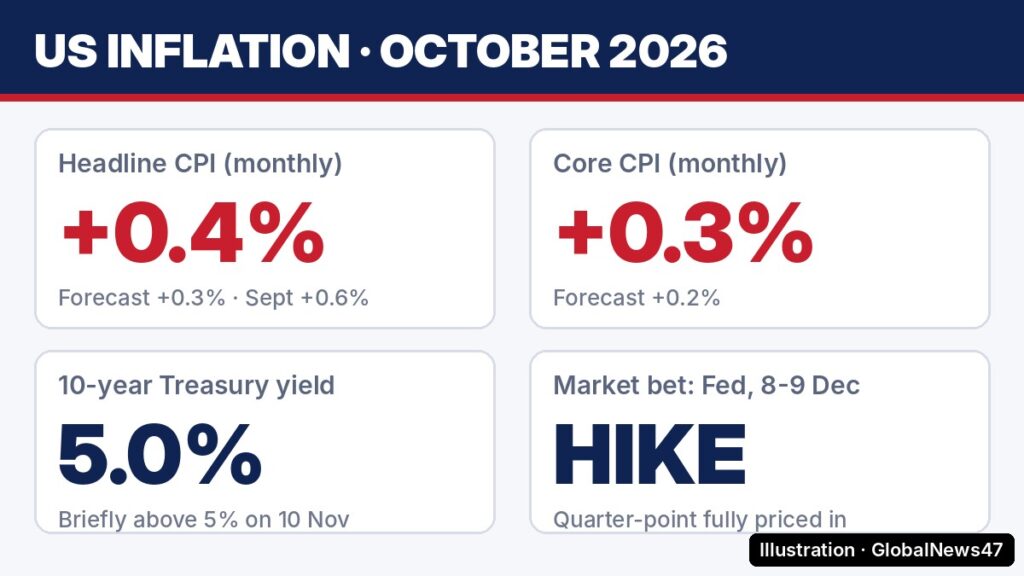
US inflation came in hotter than expected in October, and the bond market reacted fast. Consumer prices rose 0.4% in the month, according to the Bureau of Labor Statistics data released on Tuesday, 10 November. Economists had expected 0.3%. As a result, the 10-year Treasury yield briefly climbed above 5%, and traders now fully expect the Federal Reserve to raise interest rates in December.
Core prices, which leave out food and energy, rose 0.3%. That was also above the 0.2% forecast, CNBC reported. In September, headline prices had jumped 0.6%, while core prices rose 0.3%.
What drove US inflation in October
Energy led the rise. Energy prices climbed 0.7% over the month, with gasoline up 1% and electricity up 0.9%. Natural gas, by contrast, fell 0.8%.
Food prices also rose 0.5%. Beef was up 0.9%, and snacks were up 1%. Meanwhile, shelter costs increased 0.3%. The labour bureau said housing accounted for more than 30% of the overall monthly rise.
Transport services were another pressure point. They rose 0.8%, with airline fares up 0.4%. New vehicle prices edged up 0.2%. Used cars and trucks, however, became 1.2% cheaper.
There is one gap in the data. The bureau did not publish an official annual inflation rate this time. That is because a government shutdown in 2025 stopped price collection for October 2025, so there is no direct comparison. Wolf Street, a financial news site, estimated the annual headline rate at about 4% and core at 2.8%, using the nearby months as a base. These are estimates, not official figures.
Treasury yields jump back to 5%
Bond prices fell after the report, which pushed yields up. The 10-year yield traded above 5% before easing to about 4.99%, a rise of 13 basis points on the day, CNBC said. The 30-year yield rose to about 5.35%.
The biggest move came in the two-year yield, which closely follows expectations for Fed policy. It jumped more than 18 basis points to about 4.74%.
In addition, a weak bond sale added to the pressure. The Treasury sold $42 billion of 10-year notes at a top yield of 5.02%. According to Peter Boockvar of One Point BFG Wealth Partners, dealers were left holding 10% of the sale, the most since May. In simple terms, demand from investors was soft.
Higher Treasury yields matter beyond Wall Street. They tend to push up borrowing costs for mortgages, car loans and companies. They also affect markets abroad, including emerging economies that borrow in dollars.
Fed rate hike now expected in December
The Fed held its benchmark rate at 3.75% to 4% at its October meeting, after a 10-2 vote. Now, markets fully price a quarter-point rise at the 8-9 December meeting, based on the CME FedWatch tool. The odds of a bigger half-point rise rose to 13.6%, from almost zero before the data, CNBC reported.
Several Fed officials had already signalled concern. Speaking in London before the release, Governor Christopher Waller said a half-point move “should be considered” in December if inflation came in higher than expected. He also warned that a quarter-point rise “would put our credibility at risk.”
Dallas Fed President Lorie Logan said she sees a need for two more quarter-point increases. Similarly, Philadelphia Fed President Anna Paulson said “inflation pressures are still very much with us,” and called for further gradual tightening.
Goldman Sachs strategist Lindsay Rosner described a December hike as “our firm base case.” She added that further rises in 2027 cannot be ruled out.
Why prices keep rising
Inflation has stayed above the Fed’s 2% target for about five and a half years. Officials point to several forces at once. These include the Iran war, President Donald Trump’s tariffs and heavy spending on artificial intelligence data centres, which is raising electricity demand.
Businesses also expect to keep raising prices. A National Federation of Independent Business survey found a net 37% of firms plan increases in the next three months. That is the highest share since July 2022.
On the other hand, oil prices have eased. Brent crude dipped below $90 a barrel during Tuesday’s trading for the first time since August, before settling at $91.49.
What comes next
Investors will now watch wholesale price data due on Friday. After that, the Fed’s preferred inflation measure, the PCE price index, is due later in November. A strong reading could add to calls for a larger move.
For now, the message from markets is clear. Higher US inflation has made a December rate hike the base case, and borrowing costs are likely to stay high for longer.
Related on Global News 47: Bank of England Raises Interest Rates to 4% · Global Tech Stocks Plunge on AI Fears