
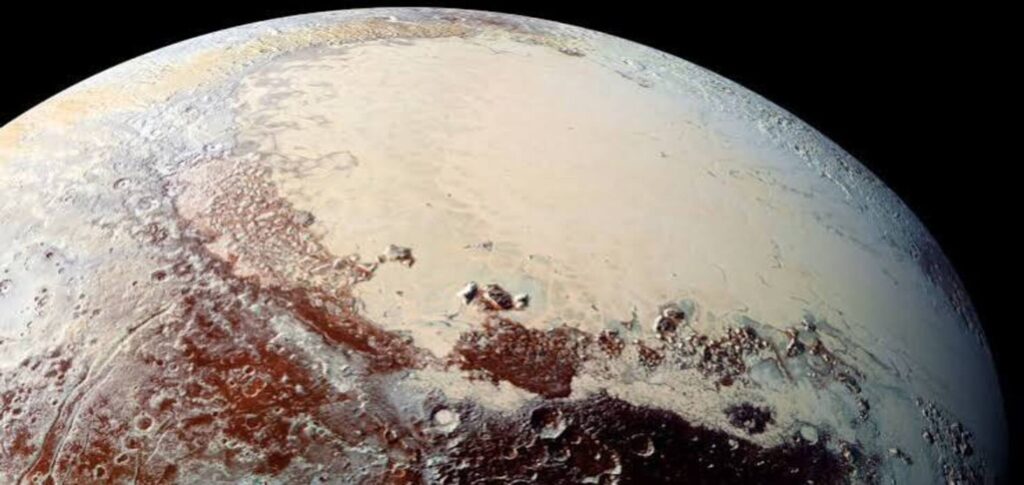
Twenty years after Pluto lost its planetary status, astronomers are once again debating whether the distant icy world deserves to be called a planet.
The controversy dates back to August 24, 2006, when the International Astronomical Union (IAU) voted to change the official definition of a planet.
The decision reduced the number of recognized planets in our solar system from nine to eight and placed Pluto in a new category called a dwarf planet.
Now, as August 2026 marks the 20th anniversary of that decision, renewed research into the outer solar system is bringing the debate back into the spotlight.
Why Did Pluto Lose Planet Status?
For decades, Pluto held a place alongside Mercury, Venus, Earth, Mars, Jupiter, Saturn, Uranus and Neptune.
However, astronomers began discovering many other icy objects beyond Neptune during the late 1990s and early 2000s. Those discoveries forced scientists to reconsider what actually qualifies as a planet.
The debate became especially intense after astronomers discovered Eris in 2005. Eris appeared comparable in size to Pluto and raised an important question: If Pluto remained a planet, should similar objects receive the same status?
The IAU eventually established three requirements for an object to qualify as a planet.
First, it must orbit the Sun.
Second, its gravity must be strong enough to give it a nearly round shape.
Third, it must have cleared most other objects from its orbital neighborhood.
Pluto meets the first two requirements. However, it does not satisfy the third.
As a result, the IAU classified Pluto as a dwarf planet rather than a full planet.
Why Are Scientists Still Disagreeing?
The argument has never completely disappeared.
Some planetary scientists believe the IAU definition places too much emphasis on an object’s orbit and not enough on its physical characteristics.
They argue that scientists should consider how an object formed and what it is physically like when deciding whether it deserves planetary status.
Planetary scientist Dr. Paul Byrne remains one of the researchers who argues that Pluto should still count as a planet.
Byrne has acknowledged that much of the disagreement involves scientific classification and terminology. However, he argues that a geophysical approach could provide a better way to categorize worlds.
The debate does not change Pluto itself. Instead, it raises a broader question about how humans classify the thousands of worlds and smaller bodies found throughout the solar system.
New Exploration Could Keep the Debate Alive
Scientists now have a much better understanding of the outer solar system than they did 20 years ago.
Space missions and increasingly powerful telescopes have revealed new information about distant objects beyond Neptune. Researchers continue to study the Kuiper Belt, a vast region filled with icy bodies and remnants from the early solar system.
As exploration expands, scientists may discover even more objects that challenge existing definitions.
That possibility could keep the Pluto debate alive for years to come.
Could Pluto Become a Planet Again?
There is currently no official decision to restore Pluto’s planetary status.
For that to happen, astronomers would need to revisit the IAU’s definition and potentially adopt a different set of criteria.
Supporters of Pluto’s planetary status believe a definition based more heavily on an object’s physical nature could change the classification.
Others argue that the current definition provides a practical way to distinguish the eight dominant planets from the numerous smaller objects orbiting the Sun.
Either way, Pluto remains scientifically important.
The tiny world at the edge of the solar system has become much more than a debate over a label. It has helped scientists rethink what makes a world a planet and how humanity should classify the diverse objects found in space.
Twenty years after its demotion, Pluto continues to inspire one deceptively simple question: What exactly makes a planet a planet?