
A century-old Seoul ginkgo tree has become the center of a mystery in the city’s Buam-dong neighbourhood.
The large tree once stood green and healthy through Seoul’s humid summers. This year, however, its leaves began turning brown and falling unusually early.
Local residents quickly noticed the change.
For many people in Buam-dong, the tree is more than part of the streetscape. They believe it has stood there for more than 100 years.
Some residents affectionately call it “Grandpa Ginkgo.”
Residents Launch Their Own Investigation
Jung, a local resident, first became concerned when green leaves began falling during summer.
She soon joined other neighbours to find out what was happening.
Their attention turned to 10 white plastic funnels positioned around the tree’s trunk.
At first, Jung thought the funnels might have been used to provide nutrients. However, residents later became suspicious that they could have contained a substance harmful to the tree.
The community then reviewed security camera footage from a nearby property.
The footage appeared to show two men wearing white gloves and using a drill near the base of the tree in late April.
Residents could not confirm from the footage what the men were doing.
Residents Suspect Nearby Museum
The investigation soon focused on the nearby Whanki Museum.
Residents said the local council had previously told them that the museum had contacted property owners about removing the tree.
The museum had reportedly raised concerns that the ginkgo’s roots were putting pressure on its outer brick wall.
Arborists who examined the tree reportedly shared residents’ concerns about possible herbicide exposure.
However, there is no public confirmation that the museum poisoned the tree.
The Whanki Museum has not publicly confirmed or denied injecting herbicide into the ginkgo.
Museum Says Tree Roots Damaged Wall
In a statement published in May, the museum said the wall around its property was collapsing because of the ginkgo’s roots.
The museum said it had contacted more than 40 property owners to seek a solution.
According to the museum, it received no response and its staff then attempted to resolve the problem.
The museum did not explain exactly what action its staff took.
Meanwhile, a local council representative told the BBC that an inspection carried out the previous year found no meaningful connection between the tree and damage to the museum wall.
The official said authorities would have taken action if they had found a serious problem.
Police Investigate the Case
The residents want authorities to identify what was inside the funnels.
They believe this information could help experts determine how to treat the Seoul ginkgo tree.
Residents have also filed a police report against the museum’s director.
Police confirmed that they are investigating the case but did not provide further details.
The museum has not responded to questions about the allegations.
A Tree With Deep Meaning
The Whanki Museum opened in 1992 and honours the late Korean painter Kim Whanki.
Whanki was a major figure in Korean modern art. He was also deeply inspired by nature.
The museum’s own description says architect Woo Kyusung designed the building to complement natural elements that were important to Whanki’s work.
Whanki even used the pen name “Su-wha,” which means “conversation with trees.”
That connection has added another layer to the dispute.
Residents find it deeply ironic that a museum dedicated to an artist who valued nature now faces allegations involving a treasured tree.
Community Comes Together to Save the Tree
The dying ginkgo has brought Buam-dong residents closer together.
Neighbours have supported one another while campaigning for the tree’s survival.
Some residents left food at Jung’s home while she worked to raise awareness.
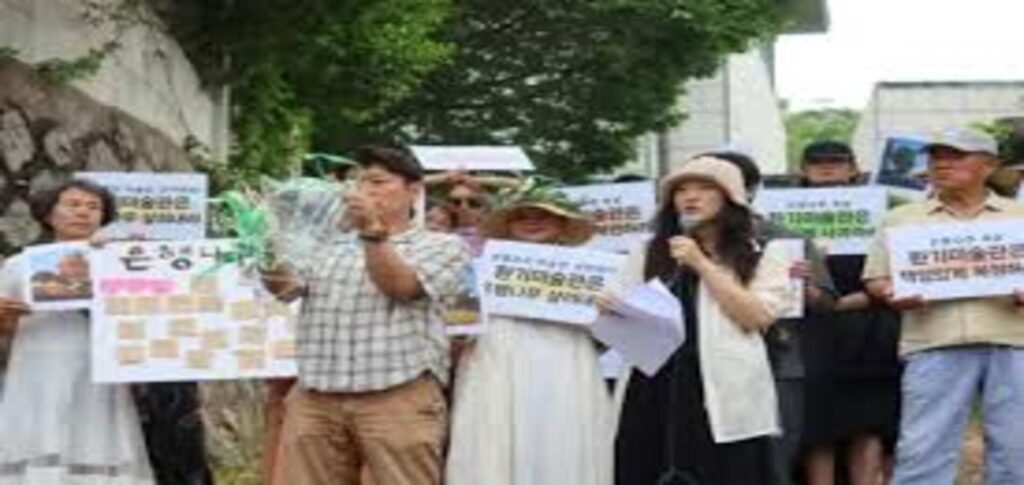
Others joined regular gatherings beside the tree.
At one point, around 20 residents gathered to pray for its recovery.
Some read Whanki’s writings, while a local shaman performed a healing ritual.
Environmental activists have also joined the campaign.
One group has launched a petition calling for stronger protection of urban trees and greater public involvement in their care.
Residents Hope for a Miracle
The tree’s condition has continued to deteriorate.
An arborist who examined it reportedly estimated that the ginkgo was about 90% of the way toward dying.
Its branches have become increasingly bare, while its leaves have turned brown.
Despite the decline, residents have refused to give up.
Jung says caring for the tree has also changed her own life.
After struggling with her health and spending more time at home, she found comfort in visiting the ginkgo.
She sometimes hugged its rough trunk and spent time beside it.
For her, the tree became a source of strength during a difficult period.
Buam-dong Waits for a Miracle
As autumn arrives in Seoul, the city’s trees are beginning to turn shades of yellow and gold.
But the once-lush Seoul ginkgo tree in Buam-dong now has mostly dry, brown leaves.
Residents continue to hope that it can recover.
For generations of people in the neighbourhood, the tree has represented something shared by everyone.
Now, they are waiting to see whether their beloved “Grandpa Ginkgo” can survive.