
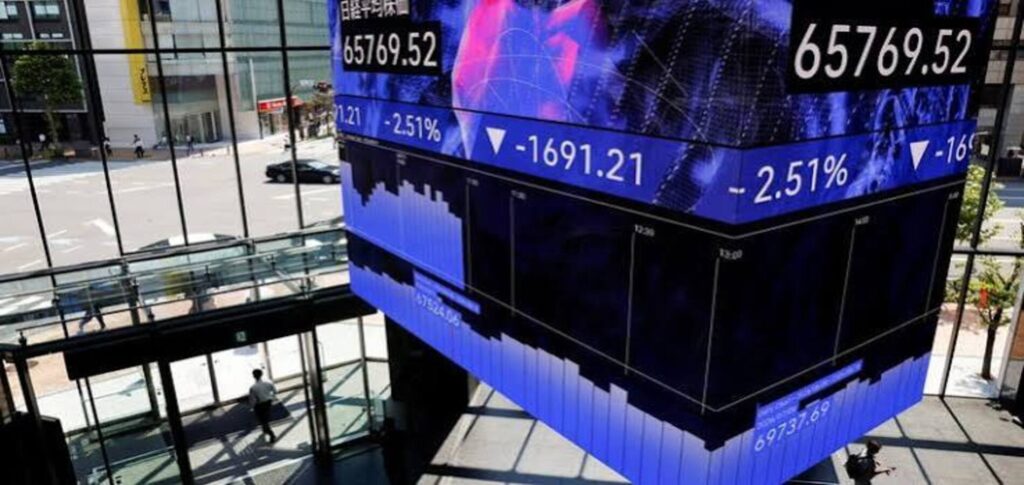
Asia shares fell on Tuesday as investors turned cautious about the technology sector.
Oil prices also extended recent losses after the United States threatened new economic measures against Iran.
The Trump administration had warned other countries about doing business with Iran. However, the United States did not announce immediate sanctions.
That outcome eased some concerns about a major disruption to global oil supplies.
MSCI’s broadest index of Asia-Pacific shares outside Japan fell 0.5%.
Japan’s Nikkei dropped 0.9%. South Korea’s Kospi suffered a larger decline of 2.7%.
Technology stocks faced some of the biggest pressure.
Investors Await Nvidia Results
Investors are now focused on Nvidia’s quarterly results, due on Wednesday.
The chipmaker has become a key measure of demand for artificial intelligence technology.
Analysts expect Nvidia to report quarterly revenue of about $92 billion.
They also expect full-year earnings guidance between $103 billion and $105 billion.
Those forecasts have created high expectations for the company.
Fabien Yip, a market analyst at IG, said investors would look beyond the headline figures.
Markets want to know whether Nvidia can maintain its rapid growth.
Investors are also watching concerns about the complex deals supporting the company’s AI expansion.
Alibaba added to the pressure on technology stocks.
The Chinese technology giant launched a $10.2 billion share sale at a steep discount. The company plans to use the money to expand its artificial intelligence business.
Investors also reacted negatively to Samsung Electronics’ shareholder-return plan.
U.S. stock futures showed limited movement.
Nasdaq futures fell 0.08%, while S&P 500 futures remained flat.
Oil Prices Extend Losses
Oil prices fell sharply on Monday after the United States threatened countries that continue doing business with Iran.
Brent crude futures fell more than 2% overnight.
On Tuesday, Brent slipped 0.1% to $92.08 a barrel.
U.S. crude gained 0.1% to $85.09 a barrel.
The Trump administration described its pressure campaign against Iran as an “economic D-Day”.
However, officials stopped short of announcing penalties.
China remains a major factor in the situation.
China is Iran’s largest trading partner, and analysts doubt Beijing will quickly end its commercial ties with Tehran.
Joseph Capurso, a strategist at Commonwealth Bank of Australia, said the U.S. pressure could also put the trade relationship between Washington and Beijing at risk.
Dollar Gains as Sanctions Threaten Trade
The threat of restrictions on dollar-based financial transactions also affected currency markets.
Some countries and banks may increase their dollar holdings to protect against possible sanctions.
The U.S. dollar gained against the Canadian dollar.
The greenback last traded at C$1.3844 after rising more than 0.5% on Monday.
The euro slipped from a three-month high and traded at $1.1668.
Sterling gained 0.06% to $1.3638.
Markets are also watching the Federal Reserve.
Investors expect Fed Chair Kevin Warsh to speak at Jackson Hole, Wyoming, on Friday.
Traders want more clues about the outlook for U.S. interest rates.
Standard Chartered analysts said Warsh could provide more clarity about how the Fed plans to respond to inflation.
The Federal Reserve aims to bring inflation back toward its 2% target.
Gold Rises as Investors Seek Safety
Gold prices moved higher as investors assessed the latest economic and geopolitical risks.
Spot gold gained 0.5% to $4,675.51 an ounce.
The rise reflects continued demand for the precious metal as markets weigh uncertainty around trade, sanctions, interest rates and technology stocks.