

Scientists Map the Deep Earth With AI
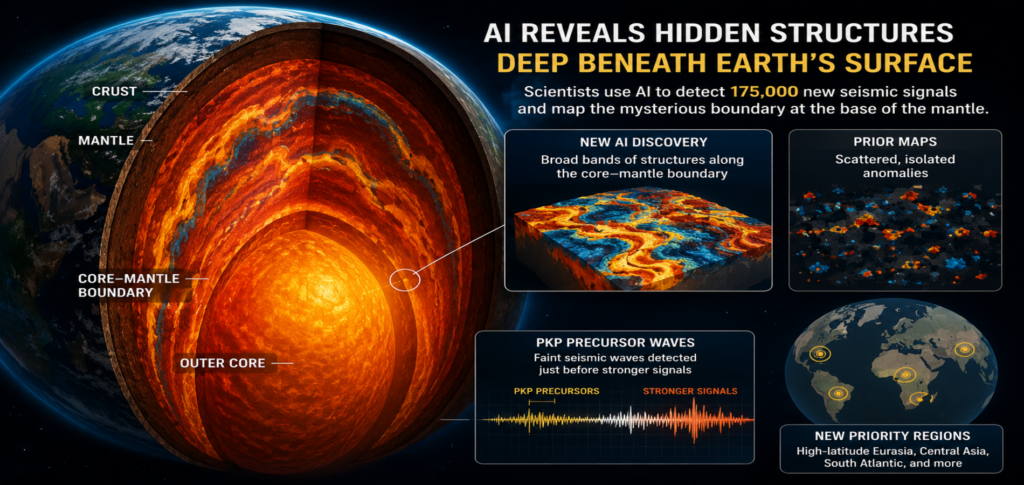
Scientists have gained a much clearer picture of the Deep Earth surface by using a new artificial intelligence tool to analyse seismic data.
Researchers detected almost 175,000 seismic signals that earlier studies had missed. The number is more than ten times higher than previous findings.
The signals come from a region deep inside Earth where the solid mantle meets the planet’s molten outer core.
Scientists from the Institute of Geology and Geophysics at the Chinese Academy of Sciences developed a deep-learning system for the research.
The tool searches for faint seismic waves known as PKP precursors. These waves appear shortly before stronger seismic signals and can reveal irregular structures near the core-mantle boundary.
AI Processes Millions of Seismic Waveforms
The researchers trained their system with more than two million seismic waveforms. The data came from around 5,000 earthquakes recorded between 1990 and 2024.
The AI system repeatedly compared its results with known seismic signals and corrected its mistakes. This allowed it to examine an enormous amount of information much faster than researchers could manage manually.
The findings are expected to appear in the Journal of Geophysical Research: Solid Earth in 2026.
Earlier maps suggested that deep-mantle anomalies appeared as isolated patches. The new analysis presents a different picture.
Researchers found that many of these areas connect with one another. Together, they form broad bands along the core-mantle boundary.
What Lies Beneath Earth’s Mantle?
Scientists believe some of these structures could contain fragments of oceanic crust and sediment.
These materials may have travelled deep into Earth over millions of years through the movement of tectonic plates.
Some structures could also connect with extended low shear-velocity zones, commonly called “blobs”. Other material may have come from the ancient collision that eventually contributed to the formation of the Moon.
The extreme pressure and temperature at these depths can dramatically change rock. Materials may melt or transform into minerals that differ from the surrounding mantle.
These changes make the deep Earth surface an important area for studying the planet’s long geological history.
Six Regions Need More Research
The study also identified six areas that scientists have not examined in enough detail.
They include regions beneath high-latitude Eurasia, Central Asia and the South Atlantic.
Researchers say these areas should become priorities for future studies. Scientists could use several types of seismic waves to build a more detailed picture of the structures.
The new research shows how artificial intelligence can transform the study of Earth’s deepest layers.
By examining seismic signals that were previously difficult to detect, researchers can now investigate patterns hidden deep beneath the planet’s surface.
The findings could eventually help scientists understand how Earth’s mantle evolved and how material moves through the deepest parts of our planet.