
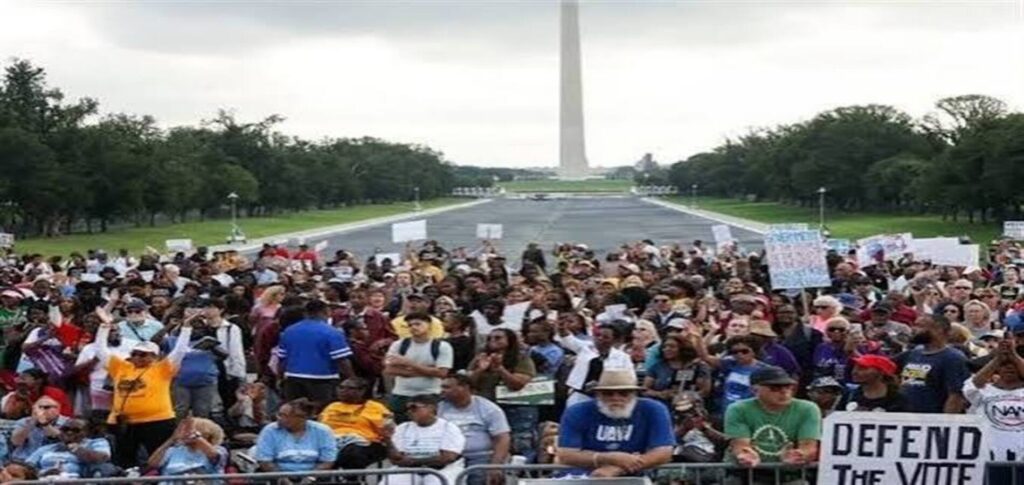
Thousands of people gathered in Washington on Friday to defend voting rights and protest what civil rights leaders described as growing threats to democracy and racial equality.
More than six decades after Martin Luther King Jr. delivered his historic “I Have a Dream” speech at the Lincoln Memorial, activists returned to the nation’s capital with a similar message.
They argued that the fight for equality remains unfinished and warned that voting rights and other civil liberties face renewed pressure.
Thousands Gather in Washington
The event, titled “March on Washington 2026: Defend the Vote,” brought several thousand people to the National Mall.
Union members, students, civil rights activists and members of Black Greek-letter organizations joined the gathering. Participants travelled from different parts of the United States to take part.
The march focused heavily on protecting access to the ballot and opposing measures that organizers believe could weaken civil rights protections.
Leaders Warn of Voting Rights Threats
Civil rights leaders said the right to vote remains central to protecting other democratic freedoms.
Marc Morial, president and CEO of the National Urban League, urged Americans from different backgrounds to unite against efforts that could restrict voting rights.
“We know in this fight we’re fighting powerful forces,” Morial said.
He added that the movement must bring people together to push back against threats to democracy.
Redistricting Battles Add to Concerns
The demonstration comes as several states face renewed battles over congressional maps.
Organizers pointed to recent changes involving the Voting Rights Act and warned that redistricting could affect political representation.
Republican-led state governments in parts of the South have moved to redraw congressional boundaries ahead of the November midterm elections.
Civil rights groups argue that such changes require close scrutiny because redistricting can influence the political power of minority communities.
Martin Luther King III Calls for Action
Martin Luther King III joined the effort alongside his wife, Arndrea Waters King, through the Drum Major Institute.
He said the march was intended to turn the legacy of his father into action.
“Defending the vote means defending the foundation of our democracy,” King III said.
He also noted that 63 years after his father stood at the Lincoln Memorial, Americans were once again being called upon to march.
National Groups Join the March
Al Sharpton’s National Action Network and the Drum Major Institute organized the event with more than 90 community partners.
The NAACP and National Urban League were among the organizations supporting the gathering.
Together, the groups called for stronger protections for voting rights and civil liberties.
They also criticized what they described as a broader rollback of federal civil rights protections.
Trump Policies Face Criticism
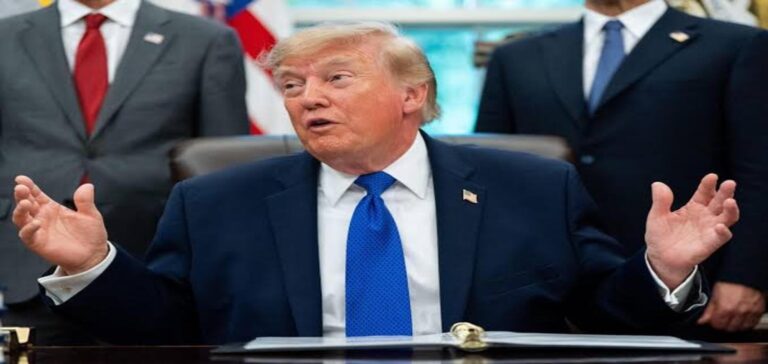
Organizers also raised concerns about policies associated with President Donald Trump.
They pointed to efforts involving mail-in voting, federal anti-discrimination protections and the broader direction of civil rights policy.
Sharpton warned that weakening voting rights could have consequences far beyond elections.
“The right to vote, the very foundation of our power, is being chipped away in statehouse after statehouse,” he wrote in a letter to supporters.
High-Profile Speakers Address Crowd
The program began at 9 a.m. ET and featured several prominent political figures.
Among the confirmed speakers were independent U.S. Senator Bernie Sanders of Vermont, Democratic Representative Alexandria Ocasio-Cortez of New York and House Minority Leader Hakeem Jeffries.
Their participation highlighted the growing political debate surrounding voting rights and racial equality ahead of the midterm elections.
Jeffries Highlights Economic Concerns
Jeffries used his remarks to highlight continuing challenges facing Black Americans.
He pointed to rising Black unemployment, declining Black homeownership and concerns about political representation.
He also warned about tactics in the South that he compared to practices associated with the Jim Crow era.
Those laws enforced racial segregation across much of the American South until the civil rights movement helped bring the system to an end.
A Renewed Civil Rights Movement
The Washington March 2026 reflects a broader effort by civil rights organizations to mobilize voters and activists ahead of the midterm elections.
Organizers say the gathering is not simply about remembering the achievements of the past.
Instead, they want participants to defend voting access and challenge policies they believe could weaken equal political participation.
The message from Washington was clear: civil rights leaders believe the struggle for equality continues, and they are calling on Americans to remain active in defending democratic rights.