
Israel’s political landscape has entered another period of uncertainty as the Bezalel Smotrich political struggle exposes deep divisions within Prime Minister Benjamin Netanyahu’s coalition government ahead of the October elections.
Finance Minister Bezalel Smotrich, once celebrated as a leading champion of the West Bank settler movement, is now facing criticism from some of his own supporters after backing legislation that would protect ultra-Orthodox Jewish men from punishment for refusing compulsory military service.
The controversy has become a major challenge for Netanyahu’s government as coalition partners attempt to balance political survival with growing public frustration over military obligations during wartime.
Why Bezalel Smotrich Is Facing Political Pressure
Bezalel Smotrich built his political career as one of Israel’s strongest advocates for Jewish settlements in the occupied West Bank. As leader of the Religious Zionism Party, he has consistently opposed the creation of a Palestinian state while supporting the expansion of Israeli settlements.
However, some supporters believe he compromised one of their core principles when he backed legislation aimed at preventing the arrest of ultra-Orthodox Jewish men who avoid compulsory military service.
For religious Zionists whose families often serve in Israel’s armed forces, the decision has been particularly controversial.
Military Service Debate Divides Israeli Politics
Military service remains one of Israel’s most sensitive political issues.
Most Israeli citizens are required to serve in the military, while many ultra-Orthodox communities have historically received exemptions to pursue religious studies.
Following a 2024 Israeli Supreme Court ruling that declared the exemptions unlawful, Netanyahu’s coalition struggled to find a compromise acceptable to both religious Zionists and ultra-Orthodox political parties.
The legislation sought to prevent arrests of men who failed to comply with military draft requirements, although Israel’s Supreme Court later blocked its implementation.
Settler Community Voices Growing Frustration
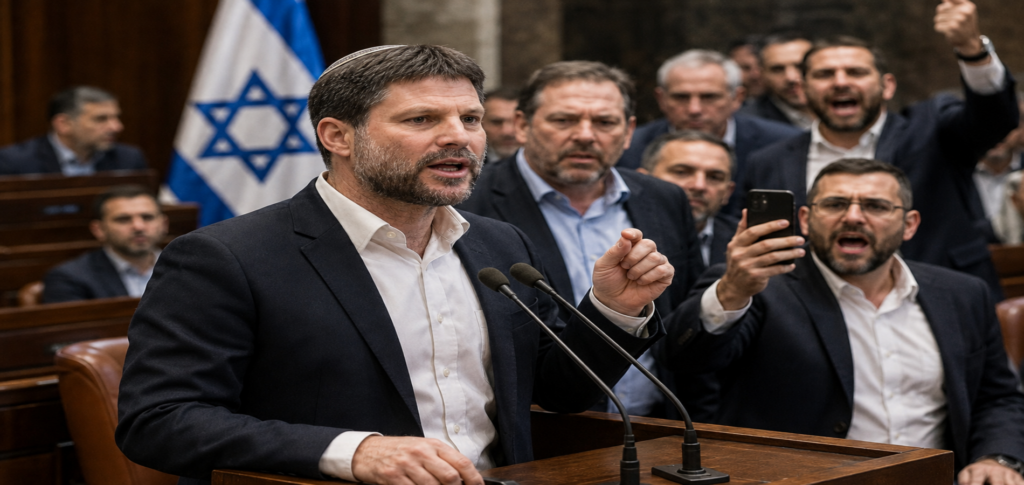
The Bezalel Smotrich political struggle has become particularly visible among West Bank settlers who once regarded him as one of their strongest political representatives.
Many residents argue that reservists have carried much of the burden of Israel’s military operations since the October 2023 Hamas attacks, while ultra-Orthodox communities continue to receive special treatment.
Some former supporters have consequently questioned whether Smotrich still represents the principles that originally attracted them to his political movement.
Public meetings have reportedly become increasingly tense, with some attendees confronting him over his position.
Smotrich Defends His Position
Despite the criticism, Smotrich maintains that he supports military service for ultra-Orthodox Israelis.
He argues that arresting draft evaders would deepen divisions within Israeli society rather than encourage enlistment.
According to Smotrich, national unity is particularly important while Israel continues to face serious security challenges.
He has argued that gradual reform through dialogue could provide a more sustainable solution than immediate enforcement measures.
Netanyahu Faces Coalition Challenges
Prime Minister Benjamin Netanyahu faces the difficult task of keeping his coalition united ahead of October’s national elections.
His government depends on support from both Religious Zionism and ultra-Orthodox political parties. A major disagreement over military service could therefore threaten coalition stability and complicate Netanyahu’s efforts to form another government after the election.
Political analysts expect every parliamentary seat to become increasingly important if coalition negotiations prove difficult.
Opinion Polls Raise Fresh Concerns
Recent opinion polls have suggested that Smotrich’s Religious Zionism Party could struggle to secure enough votes to cross Israel’s electoral threshold.
If the party fails to reach the required threshold, it could lose its parliamentary representation.
Some analysts have suggested that Netanyahu may encourage cooperation between Smotrich and National Security Minister Itamar Ben-Gvir to maximize right-wing representation.
Such an alliance could help prevent conservative votes from being divided among competing parties.
Settlement Expansion Remains Smotrich’s Signature Policy
Despite the controversy over military service, Smotrich continues to receive support from many allies for his efforts to expand Israeli settlements.
During his tenure as finance minister, settlement development has accelerated, reinforcing his long-standing commitment to strengthening Israel’s presence in the West Bank.
Supporters argue that these policies remain central to his political record.
Critics, however, believe his position on military service has overshadowed some of those achievements.
Election Could Reshape Israel’s Right Wing
The Bezalel Smotrich political struggle reflects broader tensions within Israel’s conservative political movement.
Religious Zionists often emphasize military service alongside nationalism, while ultra-Orthodox parties continue defending longstanding religious exemptions.
These competing priorities have created difficult choices for politicians seeking to maintain coalition unity while satisfying their respective voter bases.
The October election could determine whether these factions continue working together or pursue separate political paths.
The Bezalel Smotrich political struggle has therefore become an important test for Israel’s right wing ahead of the election.
As debates continue over military service, settlement policy and coalition unity, Smotrich’s political future — and potentially Netanyahu’s coalition — remains uncertain. Whether voters reward his approach or punish what some supporters view as a political compromise could influence the direction of Israeli politics after October.