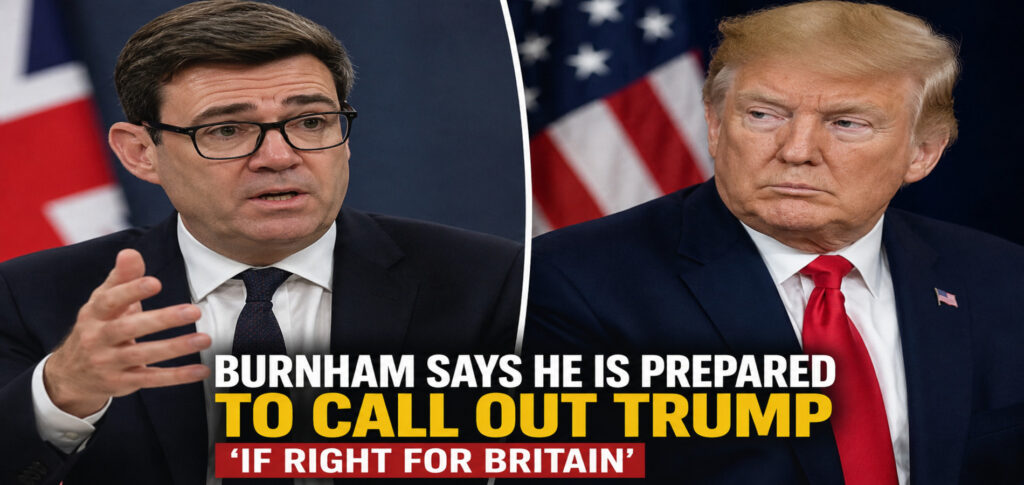
Prime Minister Andy Burnham has said he is prepared to publicly disagree with US President Donald Trump whenever he believes Britain’s national interests require it.
In his first major interview since taking office, Burnham described his initial conversation with Trump as positive and “really warm”. However, he made clear that Britain’s relationship with the United States would not prevent his government from taking an independent position on important international issues.
Burnham Puts Britain’s National Interest First
Burnham said his primary responsibility as prime minister is to protect Britain’s interests.
Although the United States remains one of the UK’s closest allies, he argued that strong relationships do not require governments to agree on every issue.
“I have to defend Britain’s national interest before anything else,” Burnham said.
He added that international politics can change rapidly, meaning governments must be prepared to adjust their positions as circumstances develop.
Prime Minister Ready to Disagree With Trump
Asked whether he would openly criticise Trump if necessary, Burnham said he would not hesitate to express a different view.
He said Britain must maintain an independent foreign policy while continuing to cooperate closely with Washington.
Burnham also raised concerns about Trump’s decision to launch military action against Iran. His comments suggest that the new government intends to maintain close US relations while retaining the ability to challenge American policy when British interests differ.
UK-US Relationship Remains Important
Despite his willingness to disagree with Trump, Burnham stressed the importance of the transatlantic relationship.
The United States is a major British ally on defence, intelligence and international security. Consequently, maintaining constructive relations with Washington remains an important part of Britain’s foreign policy.
However, Burnham’s comments indicate that his government does not intend to automatically support US decisions.
Defence Spending Creates Pressure
Burnham also discussed Britain’s defence budget and acknowledged the growing pressure to increase military spending.
The government is currently concentrating on ensuring that existing defence commitments are properly funded before announcing further increases.
Burnham declined to provide a specific timetable for reaching 3% of GDP in defence spending. He said discussions about future funding would continue before the government’s next Budget.
The prime minister also said his new chancellor understands the need to strengthen Britain’s military capabilities as global security concerns increase.
Burnham Rules Out Early Election
Burnham also rejected speculation that he could call an early general election before 2029.
He argued that Britain needs political and economic stability rather than another national election.
“I don’t think people want another election.”
He said the government’s immediate priorities are rebuilding the economy, improving public services and restoring public confidence.
Opposition Welcomes Independent Approach
Shadow Home Secretary Chris Philp welcomed Burnham’s commitment to maintaining a strong relationship with the United States.
However, he also agreed that Britain should be willing to challenge its allies when national interests demand it.
Philp said the Conservative Party remains prepared for a general election whenever one takes place, while arguing that current polling suggests the political contest remains competitive.
A Balancing Act for Burnham
Burnham’s comments highlight the difficult balance facing his government.
Britain must maintain its close relationship with Washington while protecting its own diplomatic, economic and security interests. At the same time, pressure over defence spending and international conflicts could create further disagreements between London and the Trump administration.
For Burnham, the challenge will be demonstrating that Britain can remain a reliable American ally without simply following Washington’s position.
His message is clear: the UK-US relationship remains important, but Britain’s national interest comes first.