
Saudi Arabia Tourism Vision Expands Beyond the Desert Horizon
Saudi Arabia is rapidly transforming itself into one of the world’s fastest-growing travel destinations. Under the ambitious Saudi Arabia tourism vision and Vision 2030 strategy, the Kingdom is investing billions of dollars in luxury resorts, cultural attractions, entertainment districts, and hospitality infrastructure to attract millions of international visitors.
Recently, this transformation took center stage during the Future Hospitality Summit (FHS) Saudi Arabia, where global tourism leaders, hotel operators, investors, and policymakers gathered in Riyadh to discuss the country’s next phase of tourism development.
Saudi Arabia Rebuilds Tourism Momentum
Following a period of regional geopolitical uncertainty that temporarily restricted travel to essential visits, Saudi Arabia has successfully repositioned itself as a stable and attractive global destination.
During the challenging months, domestic tourism helped offset lower international arrivals. As a result, local travel increased significantly throughout early 2026, keeping hotels, attractions, and tourism businesses active.
Now, with international travel advisories returning to normal, global investors are once again supporting Saudi Arabia’s expanding hospitality sector. Consequently, confidence in the Kingdom’s tourism future continues to strengthen.
Riyadh Continues to Drive Tourism Growth
Meanwhile, Riyadh has become the center of Saudi Arabia’s tourism transformation.
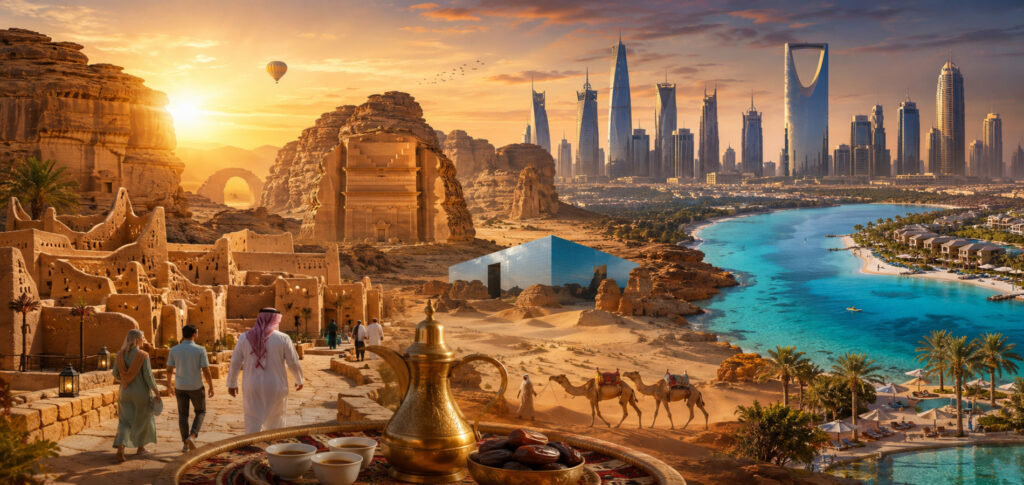
The capital is expanding rapidly with new hotels, entertainment venues, museums, shopping districts, and transportation projects. At the same time, historic attractions such as Diriyah, Al Masmak Fortress, and the National Museum continue preserving the Kingdom’s cultural heritage.
Visitors now experience a destination where ancient history blends naturally with modern development.
Furthermore, the UNESCO-listed Diriyah district has become one of Saudi Arabia’s flagship tourism projects, attracting both local and international travelers while celebrating the country’s origins.
AlUla Offers World-Class Desert Tourism
In addition, AlUla has emerged as one of Saudi Arabia’s most recognizable tourism destinations.
Its spectacular sandstone mountains, ancient Nabataean tombs, luxury eco-resorts, and the famous mirrored Maraya building continue attracting travelers from around the world.
Moreover, luxury accommodation has been carefully designed to blend into the surrounding landscape, allowing visitors to experience both comfort and nature while supporting sustainable tourism practices.
AlUla perfectly demonstrates how Saudi Arabia is preserving its cultural heritage while creating unforgettable visitor experiences.
Jeddah Blends Heritage With Modern Tourism
Meanwhile, Jeddah continues to strengthen its position as one of Saudi Arabia’s leading tourism gateways.
Known as the historic entrance for millions of Umrah pilgrims, the coastal city combines rich cultural heritage with modern attractions. In particular, the UNESCO World Heritage district of Al Balad remains one of the Kingdom’s most visited historic areas, featuring coral-stone buildings, traditional markets, museums, and centuries-old architecture.
Additionally, Jeddah’s expanding waterfront, luxury hotels, shopping centers, and Red Sea beaches provide visitors with a diverse travel experience that combines history with leisure.
King Abdullah Economic City Supports Long-Term Growth
Beyond the major tourist cities, Saudi Arabia continues investing in integrated developments such as King Abdullah Economic City (KAEC).
Located along the Red Sea coast, KAEC features marinas, golf courses, residential communities, conference facilities, and luxury hotels. Furthermore, high-speed rail links connecting Jeddah and Medina make the city increasingly attractive for both business and leisure travelers.
As a result, KAEC has become an important part of Saudi Arabia’s long-term tourism strategy, supporting year-round travel and international events.
Vision 2030 Continues to Transform Tourism
At the heart of this growth is Saudi Arabia’s Vision 2030 program.
Since opening its tourism sector to international visitors, the Kingdom has launched several mega-projects, including:
- The Red Sea Project
- NEOM
- Diriyah Gate
- AlUla Development
- Qiddiya Entertainment City
- New Murabba
Together, these developments aim to diversify the economy, create employment opportunities, and position Saudi Arabia among the world’s leading tourism destinations.
According to industry estimates, more than 105,000 new hotel rooms are expected to be delivered before 2030, with thousands opening every year.
Hospitality Investment Remains Strong
Likewise, confidence among global investors remains high.
The Future Hospitality Summit highlighted continued commitments from international hotel brands, developers, and investment groups that see significant long-term opportunities across Saudi Arabia.
Moreover, expanding airline connectivity, upgraded airports, and improved visitor services are making travel throughout the Kingdom easier than ever before.
Industry experts believe these investments will continue attracting leisure tourists, business travelers, conference delegates, and luxury travelers from around the world.
A New Chapter for Saudi Tourism
Overall, Saudi Arabia’s tourism industry has entered a remarkable new chapter.
While its ambitious mega-projects continue attracting worldwide attention, the Kingdom is equally focused on protecting its heritage, promoting authentic cultural experiences, and developing sustainable tourism.
Ultimately, the Saudi Arabia tourism vision is no longer simply about opening the country to visitors. Instead, it represents a long-term strategy to build a globally competitive tourism industry supported by modern infrastructure, cultural preservation, luxury hospitality, and international investment.
With Vision 2030 progressing rapidly, Saudi Arabia is positioning itself as one of the most exciting emerging travel destinations in the world.