

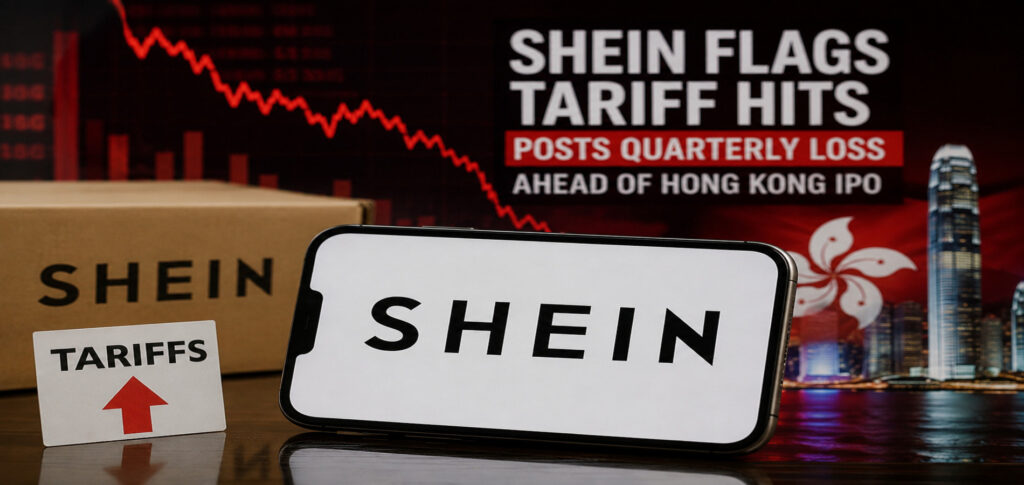
Shein has reported a $99 million quarterly loss as the global fast-fashion giant prepares for its highly anticipated Hong Kong stock market debut. The company blamed slowing sales, rising trade costs, and a significant one-time accounting charge for the disappointing results, highlighting the growing challenges facing its business.
The financial figures were released in Shein’s pre-IPO filing, giving investors their first detailed look at the retailer’s performance before its planned listing.
Tariffs Hit Sales Growth
One of the biggest challenges facing Shein has been the removal of the U.S. de minimis import exemption, which previously allowed packages valued under $800 to enter the United States without customs duties.
Since the rule changed in May 2025, Chinese-made products shipped to U.S. customers have faced import duties ranging from 10% to 87.5%, significantly increasing operating costs.
Shein acknowledged that the tariff changes have hurt sales in its largest market and forced the company to raise prices for American customers to offset part of the additional expenses.
The retailer’s U.S. revenue fell 14.3% during the first quarter, dropping from $2.38 billion to $2.04 billion.
Europe Also Tightens Rules
The challenges are not limited to the United States.
The European Union recently introduced a ¬3 handling fee on low-value e-commerce imports as part of efforts to address what it describes as unfair competition from Chinese online retailers.
Shein warned investors that the new European measures could have an impact similar to or even greater than the recent U.S. tariff changes, placing further pressure on future sales.
Europe accounted for roughly one-third of the company’s total revenue during 2025.
Quarterly Loss and Slower Growth
Shein reported a $99 million net loss during the first quarter of 2026, compared with a $395 million profit during the same period last year.
The company said a major reason for the loss was a $328 million accounting charge related to the valuation of convertible redeemable preferred shares ahead of its planned public listing.
For the full year 2025, Shein generated $41.85 billion in revenue, representing annual growth of 8%, a sharp slowdown from the 20.7% growth recorded in 2024.
Net profit for 2025 also declined by nearly 39%, falling to $2.06 billion, while its operating margin slipped from 3.9% to 2.9%.
Hong Kong IPO Moves Forward
The filing follows approval from the China Securities Regulatory Commission (CSRC) earlier this month, allowing Shein to proceed with its long-delayed Hong Kong listing after previous attempts in New York and London failed.
Although the prospectus does not reveal the number of shares being offered or the expected fundraising target, reports suggest Shein is seeking a valuation of $40 to $50 billion, significantly below the $100 billion valuation it reportedly achieved during a funding round in 2022.
The company said the IPO proceeds will be used to strengthen technology, expand globally, increase brand awareness, support sustainability initiatives, and fund general corporate operations.
Growing Regulatory Scrutiny
Beyond tariffs, Shein continues to face increasing scrutiny from regulators and advocacy groups over labour practices, environmental concerns, and consumer protection issues.
The retailer said it maintains a zero-tolerance policy toward labour abuses and has invested in stronger compliance, supplier monitoring, and risk management systems.
According to the filing, more than 90% of products sold by Shein are still stored in central warehouses in China before being shipped worldwide, leaving the company highly exposed to future trade policy changes.
Despite mounting challenges, Shein remains one of the world’s largest online fashion retailers and is hoping its Hong Kong IPO will provide fresh capital to support its next phase of global expansion.