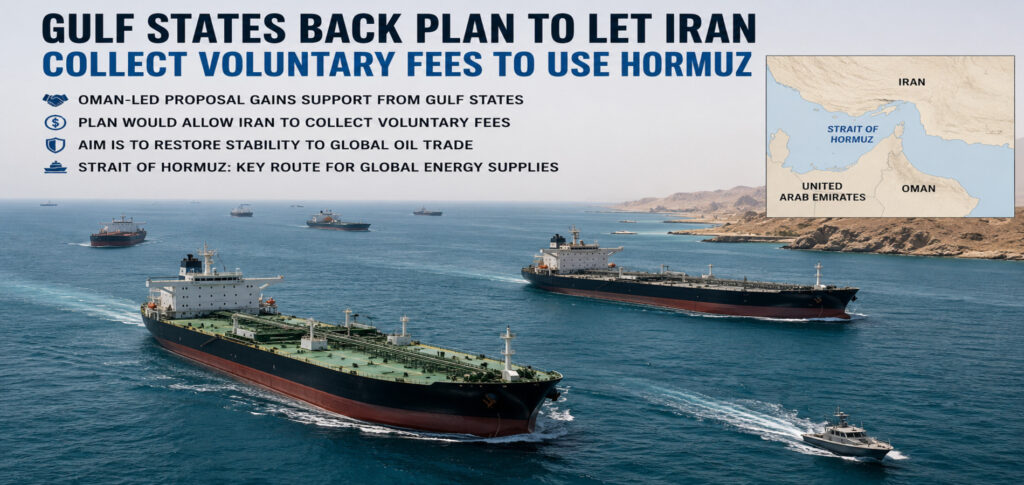
Gulf states have reportedly endorsed an Omani proposal that would allow Iran to collect voluntary navigation fees from commercial vessels using the Strait of Hormuz.
The initiative could help ease regional tensions and restore confidence in one of the world’s most important energy routes. A Gulf source said governments are supporting the proposal as they seek to reduce disruptions to global oil shipments following months of conflict involving Iran, the United States and Israel.
Oman Leads Strait of Hormuz Initiative
The proposal, led by Oman, would allow Iran to receive voluntary contributions from commercial ships passing through the Strait of Hormuz rather than imposing mandatory tolls.
Under the suggested framework, Iran and Oman would jointly oversee navigation through the strategic waterway. Oman controls the opposite side of the strait.
The system would reportedly be similar to arrangements used in the Strait of Malacca, where vessels can contribute voluntarily to services such as navigation safety, environmental protection and search-and-rescue operations.
Regional officials believe the approach could help maintain maritime traffic while reducing disagreements over control of the waterway.
Strait of Hormuz Critical to Global Energy
The Strait of Hormuz is one of the world’s most important maritime chokepoints. A significant share of global oil and liquefied natural gas exports passes through the narrow waterway.
Shipping activity has faced repeated uncertainty since tensions escalated between Iran, Israel and the United States. The disruption has raised concerns among energy traders and governments that rely on stable supplies.
Although temporary arrangements have helped restore some navigation, disagreements over shipping channels remain a concern.
Trump Supports Diplomacy but Issues Warning
US President Donald Trump said Washington had held “good talks” with Iran while warning that military action could resume if diplomatic efforts fail.
The United States has maintained that international shipping through the Strait of Hormuz should remain unrestricted. Washington has also opposed any mandatory payment system for commercial vessels.
Iran, meanwhile, maintains that it has a legitimate role in supervising navigation through the strategic waterway and has called for greater regional cooperation.
Iran Holds Regional Consultations
Iranian Foreign Minister Abbas Araghchi has discussed the Strait of Hormuz with officials from Oman and Saudi Arabia.
The discussions reflect broader diplomatic efforts to improve maritime security and prevent renewed military escalation.
Regional governments are increasingly focused on keeping shipping routes open, protecting energy infrastructure and maintaining stability in international oil markets.
Diplomacy Could Ease Energy Market Concerns
The Omani proposal could provide a framework for addressing competing demands over navigation and security without imposing mandatory charges on commercial shipping.
As diplomatic efforts continue, governments and energy traders will closely monitor developments around the Strait of Hormuz. A stable arrangement could reduce shipping risks and support greater confidence in global energy supplies.