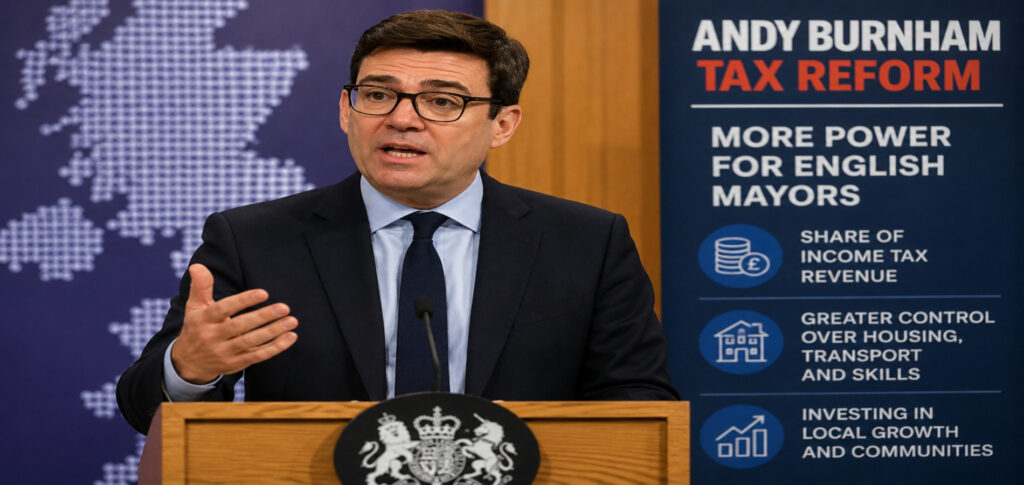
The Andy Burnham tax reform plan would give English regional mayors a share of income tax revenue for the first time, representing a major expansion of financial devolution.
Prime Minister Andy Burnham says the reforms will transfer more economic decision-making from Westminster to local leaders while giving regional authorities greater control over investment, infrastructure and economic development.
The government is expected to provide more details about the funding arrangements in Chancellor John Healey’s autumn budget.
Andy Burnham Tax Reform Gives Mayors New Powers
Under the proposed plan, city-region mayors and strategic authorities in England would receive a share of income tax revenue generated in their areas.
Regional authorities would also gain the ability to retain part of their business rates.
The reforms would give mayors greater responsibility for areas including:
- Housing
- Transport
- Skills and employment
- Economic development
- Major infrastructure
The government has not yet announced the precise percentage of income tax revenue that regional authorities would receive.
How the Tax Reform Will Work
The new system would be introduced gradually.
Regional authorities are expected to begin retaining a portion of business rates from April 2027. The income-tax sharing arrangement would then begin from April 2028.
Importantly, the proposal would not increase existing income tax rates for taxpayers.
Instead, the reform would change how some locally generated revenue is allocated, allowing a greater proportion of funds to remain under regional control.
Devolution Designed to Boost Regional Growth
Burnham says the reforms are intended to move decision-making closer to local communities.
The government argues that regional leaders are better positioned to understand local priorities and make decisions about transport networks, housing development and economic investment.
Mayors would also receive faster approval processes for major infrastructure projects, potentially including new roads, tram networks and light-rail systems.
Ministers believe greater local control could help regions respond more quickly to economic opportunities and invest in projects that support long-term growth.
Opposition Questions the Plans
The proposals have already attracted criticism from opposition parties.
Conservative politicians questioned whether the government had provided enough detail about how the system would operate and warned that weaker regional economies could face financial disadvantages.
The Liberal Democrats also raised concerns about rural areas that do not have elected mayors, arguing that they could potentially receive fewer benefits from the new arrangements.
The government, however, says strategic authorities across England will receive additional investment and greater decision-making powers as part of the wider devolution programme.
Government Plans Safeguards for Weaker Regions
One important issue will be ensuring that areas with lower tax revenues can continue providing essential public services.
Officials are therefore developing a funding system designed to provide financial support to regions that cannot generate as much revenue locally.
The approach aims to combine greater local financial independence with safeguards against significant differences between richer and poorer areas.
What Happens Next
The Andy Burnham tax reform is expected to become clearer when the government publishes further details alongside the autumn budget.
The precise share of income tax allocated to regional authorities, the rules governing business-rate retention and the financial safeguards for lower-income areas will all be important factors.
If implemented as planned, the reforms would represent a significant shift in how England’s regional governments are funded and could give mayors substantially more influence over the economic future of their communities.