

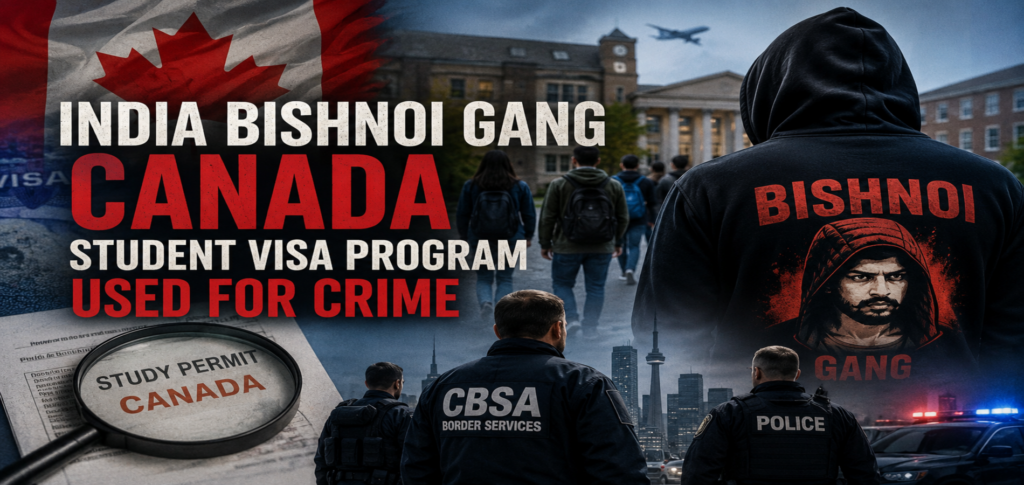
A classified Canadian intelligence report has shed new light on the alleged expansion of the India Bishnoi gang in Canada, including claims that the criminal network exploited the country’s student visa system to recruit members and expand organized crime.
The Canada Border Services Agency (CBSA) prepared the report in December 2025 to help immigration officials assess the threat posed by the Bishnoi gang. According to the assessment, the organization allegedly uses local recruits, temporary residents and international connections to coordinate extortion, shootings and other criminal activities.
However, authorities stress that the vast majority of international students follow Canadian laws and contribute positively to the country. The concerns focus on individuals who investigators believe became involved in organized crime after entering Canada legally.
Classified CBSA Report Raises Security Concerns
The CBSA intelligence report describes the Bishnoi gang as a rapidly expanding transnational criminal network with an increasing presence in Canada.
Investigators reportedly found that some suspects involved in organized crime investigations originally entered Canada through legal immigration programs, including study and work permits.
According to the assessment, criminal groups may exploit vulnerable newcomers who face financial difficulties, limited employment opportunities or social isolation after arriving in Canada.
How the Bishnoi Gang Allegedly Expanded Into Canada
Investigators identify Goldy Brar as a key figure in the gang’s alleged expansion across North America.
Brar arrived in Canada in 2017 as an international student and enrolled at Thompson Rivers University in Kamloops, British Columbia. Canadian authorities allege that he later became involved in establishing the Bishnoi network’s operations in the country.
Authorities have linked Brar to several criminal investigations involving murder, extortion and organized crime. He remains one of the most prominent figures associated with the network outside India.
Student Visa System Comes Under Scrutiny
The intelligence assessment has renewed debate over Canada’s international student program.
Investigators reportedly found cases in which foreign nationals entered Canada legally before allegedly becoming involved in organized crime.
The CBSA has also examined the presence of Indian nationals holding student permits in serious criminal investigations. Officials believe some criminal organizations may target newcomers who need money or struggle to establish themselves after arriving in Canada.
Authorities emphasize that these cases represent a small fraction of Canada’s international student population.
Criminal Cases Increased Between 2016 and 2024
According to the intelligence assessment, investigators recorded a significant increase in criminal cases involving some Indian student permit holders between 2016 and 2024.
The reported cases included allegations involving organized crime, firearms, violent attacks and extortion.
Investigators also identified an increase in extortion cases involving Indian nationals during a period when Canada’s overall extortion rate was declining.
The findings have prompted authorities to examine whether organized criminal groups have deliberately targeted members of South Asian communities.
Extortion Campaigns Spread Across Canada
The alleged Bishnoi network has been linked by investigators to extortion campaigns in British Columbia, Alberta and Ontario.
Business owners have reported receiving threatening messages demanding large payments. Suspects allegedly used platforms such as WhatsApp to contact victims before escalating threats.
When victims refused to pay, attackers allegedly targeted homes and businesses with gunfire or arson.
Investigators believe these attacks serve two purposes: generating illegal income and intimidating wider communities.
Goldy Brar’s Alleged Role in the Network
Canadian authorities identify Goldy Brar as one of the alleged senior figures operating outside India.
Investigators accuse him of coordinating criminal activities while remaining outside police custody.
Brar has also been linked by authorities to the 2022 killing of Punjabi singer Sidhu Moose Wala in India. Canadian authorities have also investigated alleged connections involving Brar and the 2023 killing of Sikh activist Hardeep Singh Nijjar in Surrey, British Columbia.
The circumstances surrounding these cases remain subject to ongoing legal and law-enforcement investigations. Allegations against individuals should not be treated as findings of guilt unless established in court.
Bishnoi Gang Allegedly Uses Local Recruits
Investigators say the organization does not rely solely on permanent members.
Instead, gang leaders allegedly recruit young people already living in Canada to carry out specific assignments, including intimidation, extortion and shootings.
According to the report, some recruits may have entered Canada through legitimate immigration pathways before becoming involved in criminal activity.
Authorities believe financial hardship and social isolation can increase vulnerability to criminal recruitment.
High-Profile Cases Draw International Attention
The intelligence report reportedly highlights several investigations involving alleged members or associates of the Bishnoi network.
One of the most prominent cases involves Hardeep Singh Nijjar, who was killed outside a Sikh temple in Surrey in June 2023. Canadian authorities have investigated alleged connections between individuals associated with the Bishnoi network and the killing.
Investigators have also examined Goldy Brar’s alleged connection to the murder of Sidhu Moose Wala in India.
Because several investigations involve multiple countries, law enforcement agencies continue to examine the evidence and relationships surrounding the cases.
Deportation Hearings Provide Additional Details
Recent immigration proceedings have offered further insight into cases involving suspected gang members.
Some individuals accused of participating in shootings or extortion schemes reportedly entered Canada on valid student permits before allegedly becoming involved in criminal activities.
CBSA officers have cited intelligence during deportation proceedings involving temporary residents accused of links to organized crime.
Authorities say these cases require careful assessment because immigration status and criminal allegations involve separate legal processes.
Extortion Victims Report Growing Fear
Business owners in British Columbia, Alberta and Ontario have described receiving threats demanding substantial payments.
Victims have reported phone calls and encrypted messages warning that their homes, businesses or relatives could be targeted if they refused to cooperate.
Police investigations have linked some threats to subsequent attacks involving gunfire and arson.
Investigators believe publicizing such attacks can help criminal groups intimidate entire communities rather than individual victims alone.
Canada’s Immigration System Faces New Questions
The report has intensified debate over Canada’s international student system.
Canadian officials and education organizations have repeatedly stressed that international students overwhelmingly contribute to the country’s economy and communities.
However, investigators believe criminal organizations can exploit weaknesses in immigration and settlement systems to identify vulnerable individuals.
Experts have suggested stronger background checks, better oversight and improved support for international students could reduce those risks without unfairly targeting legitimate students.
Experts Warn About Transnational Criminal Networks
Criminologists describe decentralized criminal organizations as particularly difficult for law enforcement to dismantle.
Rather than maintaining large permanent crews, such groups can allegedly recruit individuals for specific assignments. Those recruits may have limited criminal records, making them harder to identify before an incident occurs.
Investigators also face challenges created by encrypted communications, social media and international financial networks.
These technologies can allow alleged criminal leaders to coordinate activities across borders while remaining physically distant from the people carrying out attacks.
Canadian Authorities Increase Enforcement Efforts
Canadian law enforcement agencies have increased efforts to investigate the alleged Bishnoi network.
Police task forces have investigated extortion cases and arrested suspects in connection with shootings and other alleged criminal activities.
Immigration authorities have also pursued deportation proceedings against foreign nationals accused of participating in organized crime.
Despite these efforts, investigators face significant challenges because alleged senior figures may operate from outside Canada.
International Cooperation Becomes Essential
Authorities say international cooperation will remain critical in addressing transnational organized crime.
Canada, India, the United States and other countries can share intelligence and coordinate investigations involving suspects, finances and criminal networks operating across borders.
International cooperation can also help authorities identify alleged gang leaders who remain outside the country where crimes are committed.
Canada Continues Monitoring the Bishnoi Gang Threat
The CBSA assessment portrays the Bishnoi gang as a significant organized crime concern, particularly because of its alleged involvement in extortion and violence affecting South Asian communities.
Investigators expect criminal networks to continue adapting their recruitment strategies as authorities strengthen enforcement.
Police are encouraging victims of extortion to report threats quickly. Early reporting can help investigators identify suspects, protect victims and prevent further attacks.
Conclusion
The classified CBSA assessment provides a detailed look at how the India Bishnoi gang allegedly expanded its criminal network in Canada, including claims that some recruits entered the country through legal immigration pathways.
The findings do not represent evidence that Canada’s international student population as a whole poses a security threat. Instead, they highlight concerns about how organized crime groups may exploit vulnerable individuals and legitimate immigration programs.
As Canadian authorities strengthen immigration screening and organized crime investigations, cooperation with international partners will remain essential. The case also underscores the challenge of protecting public safety while ensuring that legitimate international students continue to have access to Canada’s education system.