
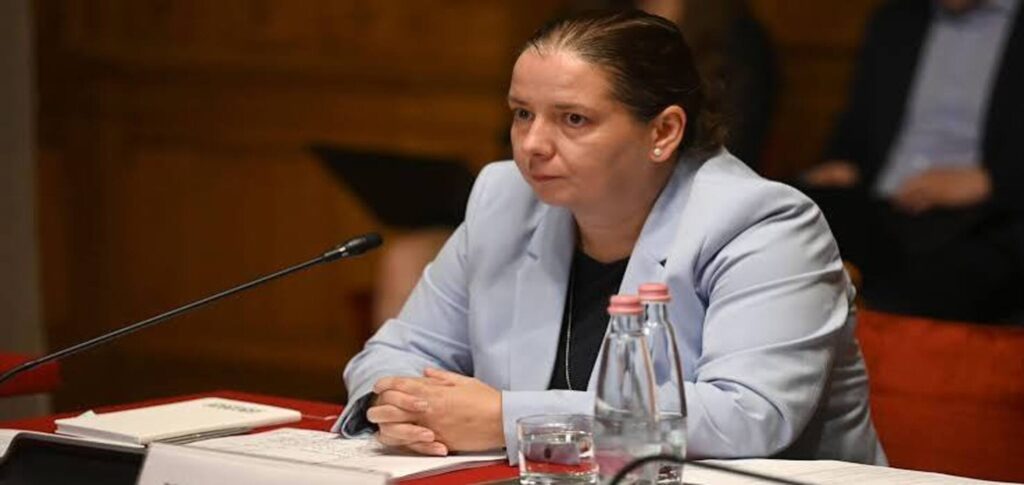
Anna Róza Unger has been elected to lead Hungary’s new National Asset Recovery and Protection Office, known as the NVVH, after receiving 145 votes in a secret parliamentary ballot.
The new authority is expected to play a major role in recovering public assets and financial resources that were allegedly lost or unlawfully managed.
Its creation is also part of the Hungarian government’s wider effort to strengthen safeguards against corruption and improve confidence in the management of public and European Union funds.
Anna Unger Wins Parliamentary Vote
Unger, a political scientist and lecturer at Eötvös Loránd University, was selected after a closely watched nomination process.
The parliamentary Justice and Constitutional Affairs Committee had considered three leading candidates. They included Unger, Transparency International Hungary legal director Miklós Ligeti and Canadian-Hungarian businessman Nicholas Sárvári.
The committee ultimately recommended Unger to parliament.
Ligeti received four votes in favour and four abstentions. Unger received six votes in favour, while one member voted against her and another abstained.
Sárvári failed to secure enough support.
New Authority Gets Broad Powers
The NVVH has been established to track down, secure and recover public money and other assets that may have been unlawfully removed from state ownership.
However, its responsibilities extend well beyond asset recovery.
The authority can examine public procurement procedures, state and municipal decisions, concessions, subsidies, EU funds and state-owned companies.
It can also investigate financial transactions, contractual networks and the individuals who ultimately control companies and assets.
Investigative and Prosecutorial Powers
The authority will have the ability to conduct its own investigations and preliminary proceedings.
It can request and compare information and ask other state bodies to take action.
In certain corruption and public-asset cases, the NVVH will also be able to conduct investigations itself.
The office may take over cases before prosecutors file an indictment when it believes doing so would help protect the state’s criminal or financial interests.
In those cases, the authority can bring charges and represent the prosecution before a court.
Debate Over Unger’s Appointment
Unger’s selection has sparked criticism from some legal experts and politicians.
Some critics argued that Miklós Ligeti had greater experience in anti-corruption work and was therefore better qualified for the position.
Others questioned whether Unger’s background as a political scientist provided enough experience to lead an institution with extensive investigative powers.
Her supporters take a different view. They argue that the president’s main responsibility will be to establish an independent institution, set its strategic direction and coordinate specialists from different fields.
Concerns Over Checks and Oversight
The NVVH’s extensive powers have also raised concerns about accountability.
The authority can use administrative, criminal and civil-law tools at the same time. Supporters see this as essential to effective asset recovery.
Critics, however, say such powers require strong judicial oversight, internal controls and public accountability to prevent political misuse.
Fidesz has opposed the structure of the authority and has argued that its investigative and information-gathering powers are too broad.
The party has also initiated a review by Hungary’s Constitutional Court.
Link to EU Funding
The establishment of the NVVH is closely connected to Hungary’s relationship with the European Union.
Brussels has withheld a significant amount of funding from Hungary because of concerns about corruption prevention, EU subsidy monitoring and the investigation of financial irregularities.
The authority itself is not a legal precondition for releasing those funds.
Nevertheless, its performance could influence perceptions of whether Hungary has effective safeguards for protecting EU money.
Hungary’s decision to join the European Public Prosecutor’s Office is also part of the government’s effort to demonstrate stronger anti-corruption safeguards.
What Comes Next for the NVVH?
The new authority’s effectiveness will ultimately be measured by its results.
Launching high-profile investigations alone will not determine its success. Cases will need to result in sustainable indictments, court convictions and the actual recovery of public assets.
That task could prove difficult when money is moved through foreign bank accounts, complicated corporate structures, property holdings or hidden ownership arrangements.
International cooperation may therefore become essential to recovering assets located outside Hungary.
With Anna Unger now at the helm, the NVVH faces the challenge of proving that its broad powers can be used independently, effectively and transparently.