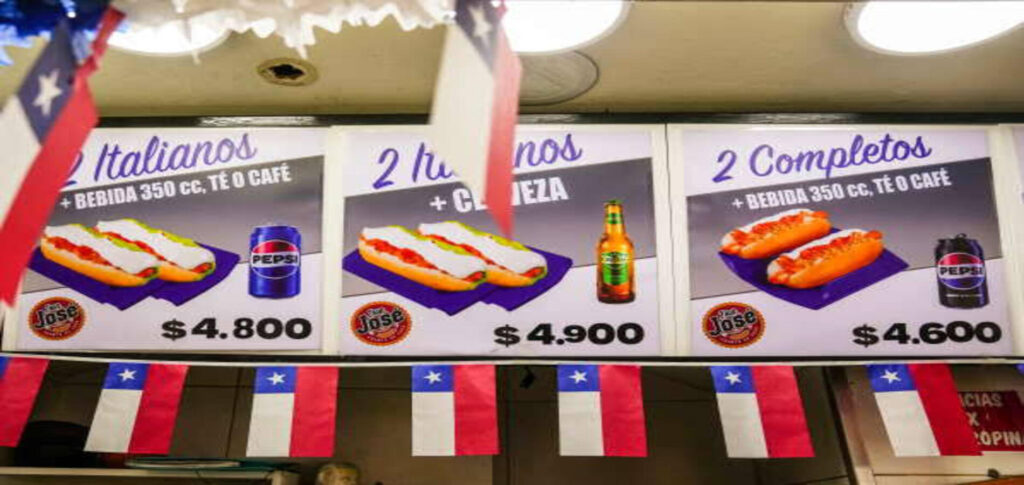
For generations, the Chile completos prices have helped make the country’s famous hot dog an affordable meal for people across social classes.
Now, however, even this beloved street food is feeling the pressure of rising costs.
In downtown Santiago, customers say the price of a completo has climbed sharply. Some now pay 3,500 to 4,000 pesos, compared with around 2,500 pesos not long ago.
That increase may seem small compared with the cost of a full restaurant meal. Nevertheless, it matters to households already trying to stretch their incomes.
Chile Completos Prices Reflect a Wider Cost Squeeze
The rising cost of the completo mirrors broader economic pressure in Chile.
The Central Bank recently cut its 2026 growth forecast to between 0.25% and 0.75%, down from its earlier estimate of 1% to 1.75%. It also said annual inflation had remained around 4%, while higher fuel prices continued to affect households and businesses.
Meanwhile, unemployment has reached 9.5%, according to Chile’s National Statistics Institute.
As a result, families face a difficult combination of weaker employment prospects and higher everyday expenses.
The Completo Has Long Been a Chilean Staple
The completo has a special place in Chilean food culture.
The dish emerged in Santiago during the early 1930s. It traditionally combines a sausage with sauerkraut, tomato and potato-based mayonnaise.
Over time, other toppings, especially avocado, became popular.
The result is a filling meal that has remained accessible to workers, students and families.
That affordability helped turn the completo into more than just a fast-food option. It became part of everyday Chilean life.
Eating Out Is Becoming More Expensive
For many households, however, eating outside the home has become harder to justify.
Food prices have continued to rise, while transportation and fuel costs have added further pressure.
The Central Bank said higher fuel prices have affected household income and contributed to inflationary pressure.
Consequently, some consumers are cutting back on restaurant meals and social outings.
Instead, families are increasingly choosing to cook at home and monitor their spending more closely.
Wages Are Not Easing the Pressure
Workers also say their incomes are struggling to keep pace with the rising cost of living.
Although nominal wages have increased, household budgets remain under pressure because food, transportation and other expenses continue to rise.
Chile’s National Statistics Institute reported annual nominal wage growth of 7.8% in July, while the unemployment rate stood at 9.5% for May-July.
For many families, therefore, higher wages do not necessarily translate into significantly greater purchasing power.
Chile’s Economy Loses Momentum
The pressure on consumers comes as Chile’s economy loses momentum.
The Central Bank reported that total GDP contracted 0.2% year-on-year in the second quarter. It also said July economic activity fell 1.5% from a year earlier, partly because of weaker mining output and adverse weather.
The bank now expects the economy to grow only 0.25% to 0.75% in 2026.
However, officials expect stronger growth from 2027 as investment receives support from the Reconstruction Act and other measures.
Inflation Keeps Household Budgets Tight
Inflation remains another concern.
Chile’s annual headline inflation reached 4.1% in August, according to the Central Bank. Fuel prices played a significant role in keeping inflation above the bank’s 3% target.
The bank expects inflation to remain slightly above 4% toward the end of 2026 before moving closer to 3% during the second quarter of 2027.
Until then, consumers may continue feeling pressure at supermarkets, restaurants and other businesses.
Government Faces Pressure to Deliver Results
President José Antonio Kast’s government has focused on investment, employment and economic recovery.
However, the challenge is turning those policies into improvements that households can actually feel.
Economic analyst Guillermo Holzmann said expectations were increasingly turning into frustration as investment failed to appear at the pace needed.
The government has also been preparing additional measures focused on the labor market.
A Bigger Problem Behind a Simple Hot Dog
The rising price of a completo tells a much larger economic story.
When an inexpensive meal becomes noticeably more expensive, consumers feel the change immediately.
For students, workers and families, those extra pesos can influence whether they eat out, meet friends or simply prepare another meal at home.
Therefore, Chile completos prices have become an everyday reminder of the country’s wider economic squeeze.
For now, Chile’s famous hot dog remains affordable compared with many restaurant meals. Yet its rising price shows how inflation and weaker economic growth are reaching even the country’s most familiar and accessible foods.