
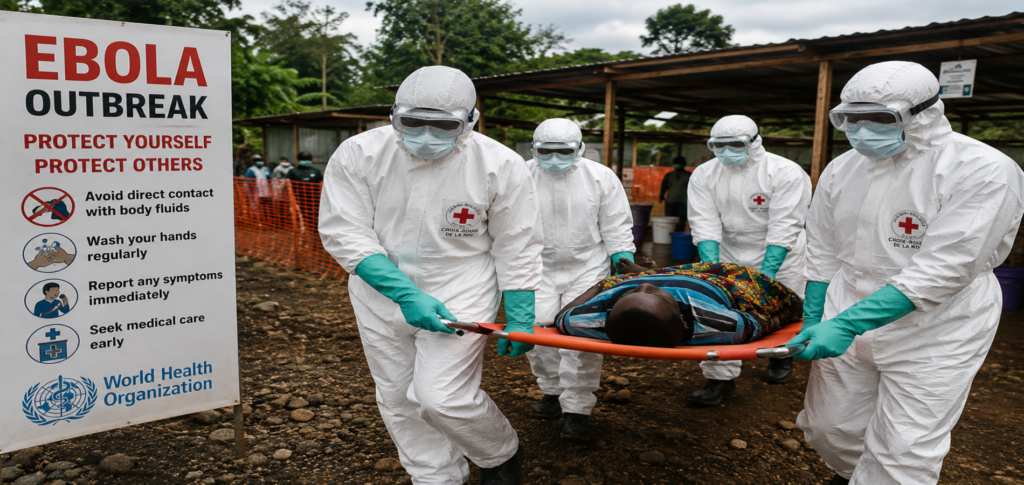
The Congo Ebola outbreak began in February, months before authorities officially declared it in May, according to the World Health Organization. The revelation has raised concerns about how long the virus circulated undetected in eastern Democratic Republic of the Congo.
WHO officials say early cases may have been mistaken for other illnesses, including malaria and typhoid. As a result, health teams are now racing to contain an outbreak that has spread faster than expected.
Congo Ebola Outbreak Started in February
WHO Regional Director for Africa Dr. Mohamed Yakub Janabi said genetic sequencing indicates that the outbreak began in February.
He explained that some early infections were likely misdiagnosed. This delayed the identification of Ebola and allowed the virus to continue spreading.
So we are chasing the virus, the virus is ahead of us,Janabi told reporters.
Dr. Thierno Balde, the WHO incident manager for the response, said researchers carried out the genetic sequencing under the leadership of Dr. Steve Ahuka of Congo’s National Institute for Biomedical Research.
Ebola Cases and Deaths Continue to Rise
According to the latest government figures provided in the report, confirmed cases have reached about 4,200. More than 1,900 people have died.
The numbers make the Congo Ebola outbreak one of the fastest-growing Ebola outbreaks recorded.
WHO currently assesses the global risk of the virus spreading internationally as low. Ebola does not spread through the air, which makes transmission more difficult than respiratory diseases.
However, health authorities remain concerned about the rapid growth of infections in affected communities.
Rare Ebola Strain Has No Approved Vaccine
The outbreak presents another major challenge because it involves the rare Bundibugyo virus.
Unlike some other Ebola strains, Bundibugyo currently has no approved vaccine or specific treatment. Early testing also focused on the more common Ebola virus, which contributed to delays in identifying the outbreak.
This has made the response more difficult for health workers already operating under severe conditions.
Conflict and Misinformation Complicate Response
Health teams are facing numerous obstacles in eastern Congo.
Some health workers have reportedly gone on strike over unpaid wages. Meanwhile, rebel activity has created additional security concerns in affected areas.
Misinformation has also complicated efforts to control the virus. Some communities have questioned whether Ebola is real, making it harder for health workers to gain public cooperation.
Teams must also travel along remote and unpaved roads. Shortages of protective equipment have added to the pressure.
At the same time, large numbers of displaced people lack reliable access to water for handwashing and other basic hygiene measures.
Ebola Spreading Faster Than Response Efforts
WHO Director-General Tedros Adhanom Ghebreyesus recently warned that Ebola was spreading faster than efforts to contain it.
Health authorities say between 60% and 70% of new cases are occurring among people who were not being monitored as known contacts. Officials have described the rate of transmission as alarming.
That trend makes contact tracing increasingly difficult and increases the risk of further infections.
Healthcare Access Remains a Major Concern
Years of armed conflict have already weakened healthcare access across the region.
The affected areas are among Congo’s most remote and vulnerable communities. They lie near the borders with South Sudan, Uganda and Rwanda.
Fear of Ebola has also affected people’s willingness to seek medical care. Some pregnant women and other patients have reportedly avoided health facilities because they fear contracting the virus.
That creates another serious risk, as patients may delay treatment for other potentially life-threatening conditions.
Ebola Can Spread Through Bodily Fluids
Ebola is rare but highly contagious through direct contact with infected bodily fluids.
Transmission can occur through substances such as blood, vomit and semen. People can also become infected through contaminated materials, including bedding and clothing.
The disease can cause severe illness and can be fatal, particularly when patients do not receive timely medical care.
Congo Faces a Historic Ebola Challenge
The current Congo Ebola outbreak is developing faster than several previous outbreaks.
The 2014-2016 West Africa outbreak remains the deadliest Ebola outbreak on record, with more than 11,000 deaths among at least 28,000 reported cases. It took roughly eight months for that outbreak to reach 1,000 deaths.
The WHO says previous Ebola outbreaks have also been recognized weeks or months after the virus first began circulating.
In the West Africa outbreak, authorities declared the epidemic in March 2014, although researchers later determined that the first human case occurred in December 2013.
For responders in eastern Congo, the latest findings underline the importance of faster detection, stronger healthcare access and greater community cooperation as they work to bring the rapidly expanding outbreak under control.