
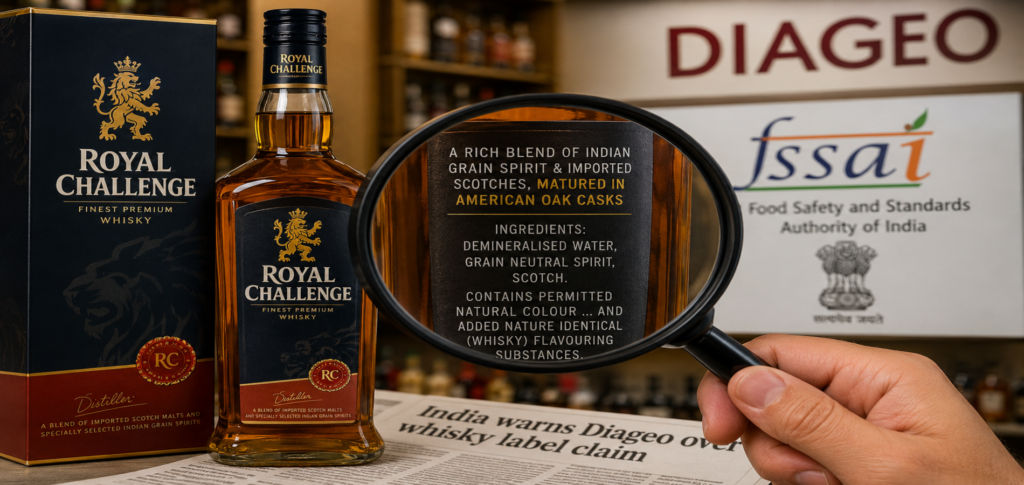
The Diageo whisky claim has come under scrutiny after India’s food safety regulator warned that a label on one of the company’s best-selling whiskies could mislead consumers. The Food Safety and Standards Authority of India (FSSAI) questioned the statement that Royal Challenge Whisky was “matured in American oak casks” because much of the spirit used in the blend had not undergone cask maturation.
The warning came in a confidential notice dated July 20. Reuters reviewed the document, which also raised concerns about how the product described its Scotch content.
Diageo Whisky Claim Faces FSSAI Scrutiny
According to the notice, FSSAI told Diageo that the whisky’s ingredients did not fully support the wording on its label.
The regulator said grain neutral spirit appeared as the second ingredient after demineralised water. It also said a major portion of the alcohol had not matured in wooden casks.
FSSAI argued that the label could therefore mislead consumers into believing the entire whisky had undergone the maturation process.
The notice also stated that any age-related claim should refer to the youngest spirit used in the blend rather than the oldest.
For more coverage of India’s business and regulatory news, readers can also see our related article on India’s consumer market regulations (add your internal link here).
FSSAI Questions the Diageo Whisky Claim
The regulator also raised questions about the use of the word “Scotch” on the label.
FSSAI said the wording did not clearly explain what type of Scotch the company used in the product. It asked Diageo to provide more specific information about that ingredient.
The regulator has increased its scrutiny of food and beverage companies in recent months. Its actions have focused on labelling, product descriptions and compliance with consumer protection rules.
Readers can find additional information about food safety standards on the official Food Safety and Standards Authority of India (FSSAI) website (add outbound link to the official FSSAI website).
Diageo Responds to the Warning
Diageo India, which operates through United Spirits, said it remains committed to high quality standards.
The company said it is actively engaging with FSSAI to address the regulator’s questions about product labelling.
FSSAI did not provide further public comment on the maturation issue after the notice became known.
United Spirits also told stock exchanges that it did not expect the recent regulatory action to have a significant financial impact, although it continues to monitor the situation closely.
Royal Challenge Whisky Draws Attention
Royal Challenge remains one of Diageo’s largest-selling whisky brands in India.
The company says it sells more than 4.5 million nine-litre cases each year. It markets the brand in India’s mid-prestige whisky segment.
The front label describes the drink as a blend of Indian grain spirit and imported Scotches matured in American oak casks.
The back label lists demineralised water, grain neutral spirit and Scotch among the ingredients. It also mentions permitted natural colour and added nature-identical whisky flavouring substances.
The Diageo whisky claim has now placed greater attention on whether the label accurately reflects the production process.
Wider Crackdown on India’s Alcohol Industry
The warning comes during a broader regulatory crackdown on India’s alcohol industry.
Earlier this month, FSSAI prohibited the sale of several whisky and rum products made in Madhya Pradesh. The action involved brands from Diageo and Indian spirits company Inbrew.
The regulator cited concerns about the use of artificial flavouring in some products.
Industry representatives have said they comply with Indian law and continue to work with regulators on compliance issues.
The latest action shows that Indian authorities are paying closer attention to how alcoholic beverages describe their ingredients, ageing methods and production practices.
What Happens Next?
The dispute does not yet amount to a final finding against Diageo. The company continues to engage with FSSAI, and the regulator may seek further clarification before deciding whether additional action is necessary.
For consumers, the case highlights the growing importance of accurate labelling in the alcohol industry. Regulators want product descriptions to match the ingredients and processes used during production, particularly when companies make claims about maturation or ageing.
The outcome could also influence how other whisky producers describe their products in India as regulators continue to tighten oversight of the country’s large alcoholic beverage market.