
Canada is weighing its next move after US President Donald Trump threatened to impose steep new tariffs on Canadian goods, prompting federal and provincial leaders to consider strategies to protect the country’s economy.
Prime Minister Mark Carney said “everything is on the table” as Ottawa prepares its response to the proposed 50% tariffs. However, he stopped short of outlining specific measures the government could introduce before the August 19 deadline.
Carney Urges Patience Before Retaliation
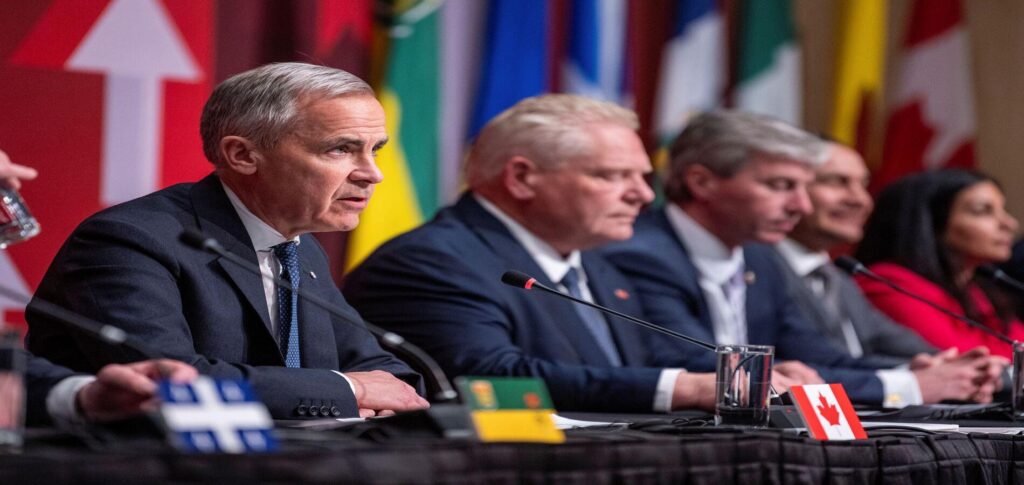
Following a meeting with provincial premiers in Charlottetown, Carney urged governments to avoid rushing into retaliation while negotiations with the United States continue.
He said federal and provincial officials are examining every available option. However, any major response would require close coordination because several provinces could be directly affected by the tariffs.
Carney also stressed that governments across the country remain united in their efforts to protect Canadian workers, businesses and families.
Provincial Leaders Consider Tougher Measures
Several premiers have already proposed stronger action if Washington proceeds with the tariffs.
Ontario Premier Doug Ford has renewed his call for “dollar-for-dollar” retaliatory tariffs. He has also suggested restricting exports of energy and potash to the United States, even though those products are currently excluded from the proposed American measures.
British Columbia Premier David Eby has taken a similar position on Canada’s critical resources. He argued that future access to Canadian critical minerals should depend on Washington removing tariffs and restoring stronger economic cooperation.
Eby said Canada should not continue providing valuable resources while facing significant trade penalties from its largest trading partner.
Critical Minerals Could Strengthen Canada’s Position
Canada’s supply of critical minerals could become an important bargaining tool during negotiations.
Trade experts, however, disagree over how aggressively Ottawa should use those resources. Western University international business professor Andreas Schotter noted that China has previously used restrictions on rare-earth exports during trade disputes with the United States.
Schotter cautioned that Canada does not have the same level of dominance in the global minerals market. He suggested that Ottawa could achieve better results by presenting Canadian resources as part of a long-term strategic partnership.
Providing the United States with reliable access to critical minerals could create incentives for Washington to reach a broader trade agreement.
Negotiations Remain a Priority
Former senior adviser Brian Clow said Canada has historically achieved stronger results through negotiations rather than prolonged confrontation.
Although the United States has considerably greater economic leverage, Clow argued that Canada still has important tools at its disposal.
He encouraged Ottawa to maintain communication with American officials, businesses and other stakeholders while searching for solutions that benefit both economies.
Alberta Calls for Cooperation
Alberta Premier Danielle Smith has also urged caution, warning that an aggressive response could damage both Canadian and American economies.
Smith said Ottawa should focus on reaching a practical agreement rather than immediately escalating the dispute with counter-tariffs.
She argued that negotiations still provide an opportunity to address concerns on both sides before the proposed measures take effect.
Canada Prepares for a Critical Trade Battle
As the tariff deadline approaches, Canadian leaders face the difficult task of balancing diplomacy with preparations for retaliation.
Critical minerals, energy exports and reciprocal tariffs remain among the potential tools available to Ottawa. At the same time, federal officials continue to emphasise negotiations as the preferred path.
The outcome could have significant consequences for businesses, workers and consumers in both countries, particularly given the deep economic relationship between Canada and the United States.