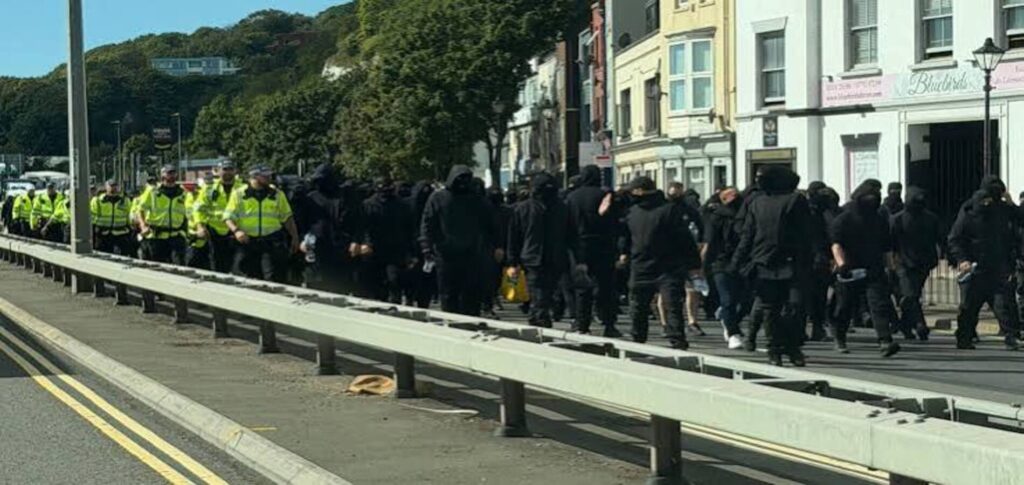
Police were slow to respond to a protest that brought traffic around the Port of Dover to a standstill for several hours, according to the leader of Dover District Council.
Kevin Mills said the demonstration appeared to be exceptionally well organised. He told the BBC that protesters caught several agencies off guard when they arrived in Dover on Saturday.
Hundreds of masked men blocked roads and disrupted access to the port. Demonstrators chanted slogans including “stop the boats”, causing long traffic queues in the area.
Dover protest causes major disruption
Mills said the response from police appeared slower than expected.
“The protesters knew what they were doing,” he told the BBC. “I’m not sure the police did know what was going to happen.”
He said officers appeared slow to keep roads and transport networks open. Mills described that as disappointing.
However, he also acknowledged the pressure on police resources.
The council leader said no one appeared to have a clear picture of what was happening early on Saturday. He called for a full review of the response.
“All in all it was a pretty traumatic day,” Mills said, referring to the disruption faced by people trying to travel and carry out their business.
Kent Police said on Saturday that officers made no arrests. The force described the demonstration as a “spontaneous protest”.
Protest blocks access to Port of Dover
The demonstration lasted from about 07:00 BST until around 11:30.
Road closures and large crowds caused significant disruption around Dover. The blocked routes also prevented people from reaching the Port of Dover for several hours.
Mills said the council later received complaints from residents in Preston.
He said protesters appeared to have parked vehicles in the village before travelling into Dover.
Chris Vinson, who leads the Conservative group on Dover District Council, had previously claimed that protesters arrived after travelling in rental vans.
Images from the scene showed dozens of men wearing black clothing and face coverings as police officers escorted them along a dual carriageway.
Questions over who organised the protest
Police have not publicly identified who was behind the demonstration.
However, anti-hate organisation Hope Not Hate claimed that the Patriot Platform network organised the protest.
The organisation said the network began meeting in July. It also claimed that the group had brought together members of anti-migrant groups from different parts of the country.
Protesters approached by the BBC generally declined to speak to journalists. Some participants could nevertheless be heard using anti-immigration slogans.
Far-right activists Tommy Robinson and Danny Thomas also posted about the demonstration on X and praised those involved.
Thomas described the protesters as disciplined and said they had followed their plan.
Government condemns Dover demonstration
Business Secretary Jonathan Reynolds condemned the protest during an appearance on the BBC’s Sunday with Laura Kuenssberg.
He said peaceful protest remains an important part of British life. However, he argued that the behaviour seen in Dover was intimidating.
Reynolds also expressed sympathy for residents and travellers affected by the disruption.
He criticised Tommy Robinson and others who supported the demonstration. Reynolds said they were more interested in exploiting online followings than solving problems linked to immigration.
Meanwhile, Great Yarmouth MP Rupert Lowe, who leads Restore Britain, said his party supported people protesting against illegal immigration in Dover.
Lowe said wearing balaclavas was undesirable. However, he argued that people were entitled to protect their identity in what he described as an “Orwellian age”.
The events have now raised questions about police preparedness and the organisation of large protests. Mills said a review is needed to establish what happened and how authorities can respond more effectively in the future.