

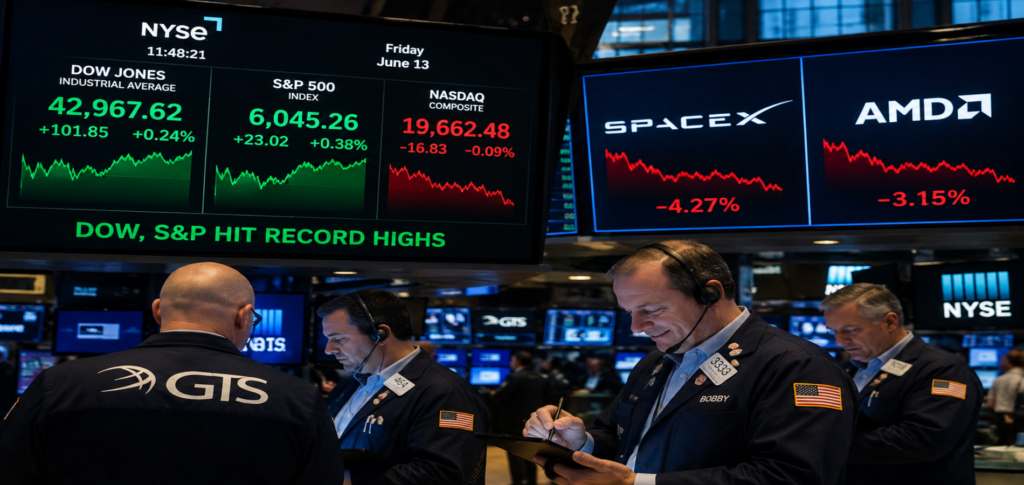
Dow record highs returned on Wednesday as investors welcomed signs of progress toward a potential peace agreement involving Iran. The optimism helped push both the Dow Jones Industrial Average and the S&P 500 to fresh intraday records. However, the Nasdaq slipped after disappointing reactions to earnings from SpaceX and Advanced Micro Devices (AMD).
Although technology stocks struggled, improving geopolitical sentiment encouraged investors to continue buying blue-chip shares.
Iran Peace Deal Hopes Drive Dow Record Highs
Investor confidence improved after reports suggested Iran and Oman were discussing a proposed agreement involving shipping through the Strait of Hormuz.
According to Reuters, the proposal would give Tehran greater control over vessels entering the Gulf. Markets viewed the development as a possible step toward easing tensions in the Middle East.
As a result, oil prices and U.S. Treasury yields declined. Lower energy prices also eased inflation concerns, encouraging investors to return to equities.
Consequently, the Dow record highs reflected renewed optimism that global economic risks could begin to stabilize.
Wall Street Performance
During afternoon trading, the major U.S. indexes showed mixed performance:
-
- Dow Jones Industrial Average: +447.96 points (0.83%) to 54,533.87
-
- S&P 500: +5.53 points (0.07%) to 7,742.05
- Nasdaq Composite: -129.56 points (-0.49%) to 26,455.43
While the Dow and S&P reached new records, the Nasdaq faced pressure from weakness in major technology companies.
SpaceX Shares Tumble After Earnings
SpaceX reported its first quarterly earnings since becoming a publicly traded company.
The company announced that revenue nearly doubled compared with the previous year. Operating losses also narrowed as Starlink and artificial intelligence businesses continued expanding rapidly.
However, investors remained concerned about SpaceX’s massive spending on AI infrastructure, including expensive data centers and Nvidia-powered computing systems.
As a result, SpaceX shares fell about 12%.
Analysts also warned that additional selling pressure could emerge after the company’s IPO lock-up period expires later this week.
Meanwhile, Tesla shares declined 1.3% alongside weakness across growth stocks.
AMD Falls Despite Strong Revenue Outlook
Advanced Micro Devices also reported better-than-expected revenue guidance driven by growing demand for AI chips.
Nevertheless, investors wanted stronger evidence that heavy AI investments would produce faster earnings growth.
Consequently, AMD shares dropped approximately 6%.
The decline weighed heavily on the technology sector and contributed to the Nasdaq’s losses.
Healthcare Stocks Support the Market
While technology struggled, healthcare companies helped offset some weakness.
Amgen shares climbed 3.5% after reporting a 9% increase in second-quarter sales.
Similarly, Eli Lilly gained nearly 4% after raising its full-year revenue forecast.
Together, these gains pushed the S&P 500 Healthcare Index higher by about 1%, making it one of the day’s strongest-performing sectors.
Disney also contributed positively after posting stronger-than-expected quarterly profits.
Its shares rose 3.4%, providing additional support for the Dow.
Labor Market Data Sends Mixed Signals
Fresh economic reports suggested the U.S. labor market remains stable but is gradually cooling.
Private payroll data from ADP showed slower hiring growth during July than economists had expected.
Meanwhile, the Institute for Supply Management reported that its services activity index increased slightly to 54.1.
Although the reading remained above the 50-point expansion level, it fell short of market forecasts.
Overall, the reports indicated steady economic activity without signaling a sharp slowdown.
Federal Reserve Remains in Focus
Despite improving market sentiment, investors continue monitoring Federal Reserve policy.
Minneapolis Federal Reserve President Neel Kashkari said gradual interest rate increases may still be appropriate given ongoing inflation risks.
At the same time, traders reduced expectations for another rate hike in September.
According to CME FedWatch data, the probability of a September increase fell to roughly 55%.
Therefore, markets remain highly sensitive to upcoming inflation and employment reports.
Market Breadth Remains Healthy
Despite weakness in technology stocks, market participation remained relatively balanced.
On the New York Stock Exchange, declining stocks slightly outnumbered advancing shares.
Meanwhile, the S&P 500 recorded 34 new 52-week highs and only three new lows.
The Nasdaq also registered 94 new highs despite broader selling pressure in several technology names.
These figures suggest investors continue rotating into sectors benefiting from improving economic conditions.
Outlook for Wall Street
The return of Dow record highs demonstrates that investors remain willing to buy equities despite ongoing geopolitical and monetary policy uncertainty.
However, concerns surrounding expensive AI investments continue weighing on technology companies such as SpaceX and AMD.
Going forward, Wall Street will closely monitor developments in Middle East peace negotiations, upcoming employment data, and future Federal Reserve comments.
If geopolitical tensions continue easing while inflation remains under control, analysts believe U.S. stock markets could extend their record-breaking rally through the remainder of the quarter.