
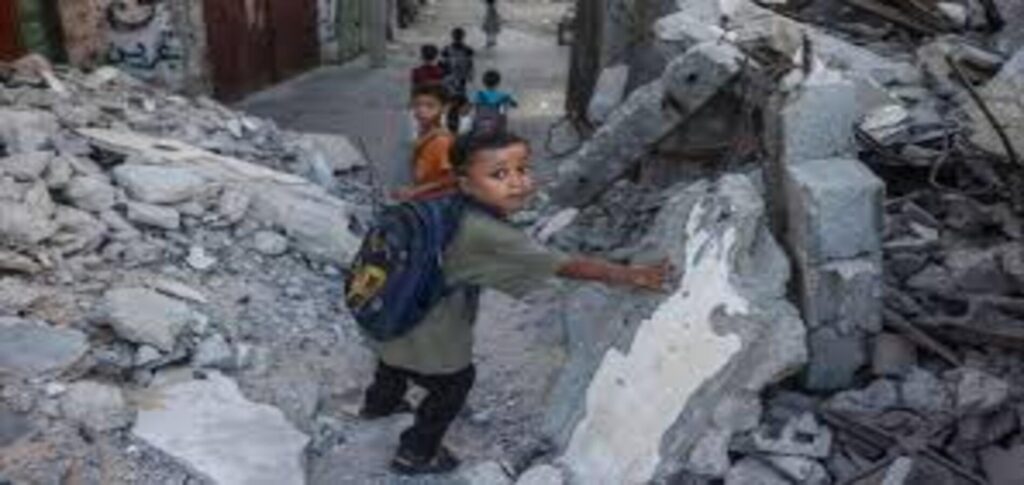
Gaza unsafe buildings are becoming a growing danger for families who have nowhere else to live.
Across Gaza, thousands of people are sheltering inside damaged homes and apartment blocks. Many structures suffered major damage during the war.
However, safe housing remains scarce. As a result, some families have returned to buildings with damaged foundations, cracked walls and unstable floors.
The United Nations says 84% of Gaza’s structures had been damaged or destroyed by October 2025. Gaza’s civil defence has also warned that about 2,000 buildings are at risk of collapse.
Gaza Unsafe Buildings Leave Families With Few Choices
Heba Arafat, 47, lives with her husband and six daughters in Gaza City’s Al-Shati Refugee Camp.
Their four-storey building suffered severe damage during the conflict. The ground floor collapsed inward, leaving the entire structure tilted.
Inside Arafat’s apartment, the floor is so uneven that a water bottle placed on it quickly rolls away.
“We were forced to live here because we had nowhere else to go,” Arafat said.
Her family had left the area during the war. They later returned after the October 2025 ceasefire.
Now, around 30 people live in the damaged building.
Building Collapse Kills 21 in Gaza City
The risks became clear again last week.
A six-storey, war-damaged building collapsed in Gaza City on September 16. According to the UN, 21 people, including 12 children, died. Dozens of others were injured.
Local authorities said the building had suffered repeated strikes. Israel denied striking the structure.
The collapse has increased concerns about other damaged buildings across the territory.
UN officials say many people continue to live in unsafe structures because they lack better housing options.
Gaza Officials Mark Buildings at Risk
Gaza City municipal workers have been checking damaged structures.
Officials mark buildings they consider dangerous so residents and people nearby can recognize the risks.
Gaza City spokesman Hosni Muhanna said these structures threaten people living inside them and those nearby.
However, warnings alone cannot solve the housing crisis.
Thousands of displaced people still need shelter. Many face a difficult choice between damaged buildings and overcrowded displacement camps.
Reconstruction Remains Stalled
Reconstruction has yet to begin on the scale needed across Gaza.
Humanitarian agencies also face shortages of heavy machinery, fuel, spare parts and other equipment. These shortages limit rescue operations and efforts to repair damaged structures.
Restrictions on construction-related materials have also complicated rebuilding efforts.
Some equipment needed to clear rubble or repair infrastructure can face restrictions because of concerns over potential military use.
Meanwhile, talks surrounding the ceasefire and reconstruction process have stalled.
Gaza Housing Crisis Deepens
The destruction has left families with very limited options.
Many people live in tents or makeshift shelters. Others have moved into damaged homes despite the danger.
The UN says people are sheltering in hundreds of structures considered unsafe because better housing arrangements are unavailable.
Health conditions also add to the pressure.
The UN reported tens of thousands of impetigo cases between early August and September. Overcrowding and inadequate sanitation have contributed to difficult living conditions.
Gaza Needs Major Reconstruction Effort
A joint assessment by the United Nations, World Bank and European Union estimated that Gaza will need $71.4 billion for recovery and reconstruction over the next decade.
That effort will involve rebuilding homes, roads, hospitals, schools and other essential infrastructure.
For families like Arafat’s, however, the need is immediate.
They are living inside damaged buildings while waiting for safer housing.
“We’re afraid a wall or the roof might fall on us,” Arafat said.
For many families, Gaza unsafe buildings remain a daily reality while large-scale reconstruction continues to face delays.