
Iran launched fresh attacks against US military targets in Kuwait on Thursday, escalating tensions in the Middle East despite warnings from US President Donald Trump that Washington could carry out further strikes.
The latest exchange marks another dangerous escalation in a war that has now entered its sixth month. Iran continues to exert pressure on the strategic Strait of Hormuz, while the United States maintains a counter-blockade aimed at restricting Iranian ports.
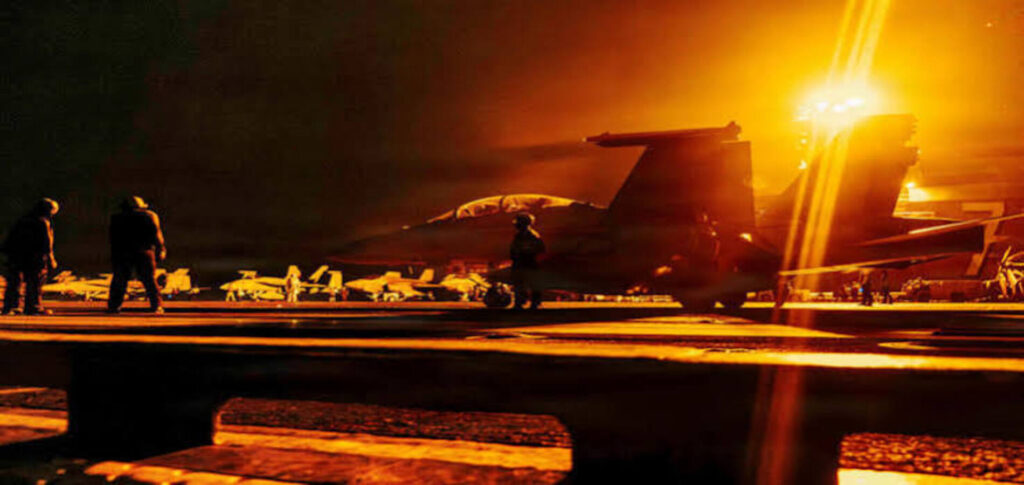
Trump said the US military was prepared to strike Iran “any time we want” after American forces carried out extensive bombardment across Iran earlier in the week.
The US strikes reportedly killed at least 19 people in Iran between Tuesday and Wednesday, according to the information provided in the report.
Iran responded with attacks against US bases and forces across several parts of the Middle East.
Iran targets US bases in Kuwait
Kuwait became the latest focus of Iran’s regional attacks on Thursday.
The Kuwaiti military said it was intercepting missiles and drones launched from Iran. Tehran’s army later said it had targeted Ahmad al-Jaber Air Base in Kuwait with both missiles and drones.
The Iranian military also claimed that it had struck Al Minhad Air Base in the United Arab Emirates.
The UAE, however, did not report such an attack.
Iran has also claimed attacks against US-linked positions in Bahrain, Jordan, Iraq’s Kurdistan region and the UAE during the latest round of fighting.
The attacks demonstrate the widening geographical scope of the conflict. US forces and military facilities remain spread across several countries in the region, making them potential targets as Washington and Tehran continue their confrontation.
Trump warns Iran of more strikes
The Iranian attacks came despite a direct warning from Trump.
The US president said Washington could launch additional military action against Iran whenever it chose.
His warning followed heavy American strikes on Iranian targets earlier in the week.
Trump’s comments have raised fears that the latest confrontation could develop into a broader regional conflict. Iran has repeatedly warned that attacks on its territory or forces will trigger retaliation against US interests.
Iranian security chief Mohsen Rezaei said on Wednesday that Tehran had adopted a “new strategy” in the conflict.
He warned that the strategy would “shatter” the foundations of the United States.
The comments came as Iranian forces expanded their response beyond Iran’s borders.
Wedding attack fuels Iranian anger
Tensions increased further after a US attack struck a wedding in southern Iran, according to Iranian officials.
The Iranian Red Crescent said missile shrapnel killed four people in the coastal town of Kuhestak. A child was among those killed, while more than 50 other people were reportedly wounded.
The US military did not directly address the reported strike.
Tim Hawkins, a spokesman for US Central Command, defended the American military’s conduct. He said US forces do not target civilians and accused Iran’s Islamic Revolutionary Guard Corps of doing so.
The incident has nevertheless intensified anger in Tehran and added another layer to the already serious confrontation.
Kuwait condemns Iranian attacks
Kuwait strongly condemned the attacks on its territory.
The Kuwaiti government described the strikes as a direct threat to the country’s security and stability. It also said the attacks endangered citizens and residents and represented a serious violation of international law.
The situation is particularly sensitive because Kuwait hosts US military forces and facilities.
Iran’s attacks against American targets in the Gulf therefore risk placing regional governments in an increasingly difficult position as they try to avoid becoming directly involved in the conflict.
Washington seeks maximum economic pressure
The confrontation is not limited to military strikes.
Washington has also promised to increase economic pressure on Iran and countries that continue to trade with Tehran.
US Energy Secretary Chris Wright said on Wednesday that planned sanctions targeting Iran’s economic partners would create “absolutely maximum pressure” on the Islamic Republic.
The proposed measures could affect businesses and governments that maintain economic relationships with Iran.
The US strategy combines military pressure with efforts to restrict Iran’s ability to generate revenue and maintain international trade.
Strait of Hormuz remains at the center
The Strait of Hormuz remains one of the most important flashpoints in the conflict.
The narrow waterway connects the Persian Gulf with the Gulf of Oman and is crucial to global energy shipments. Before the current crisis, roughly one-fifth of the world’s oil supplies passed through the route.
Iran has effectively restricted shipping through the strait during the conflict.
The disruption has created major concerns for global energy markets and international shipping.
Trump even suggested changing the waterway’s name to “Trump Strait” in a post on Truth Social. He later appeared to indicate that the proposal was not serious.
The unusual suggestion came as the United States continued efforts to challenge Iran’s control over the strategically important route.
Iran accuses Washington of acting like Satan
Iranian officials have responded angrily to the latest US attacks.
Iran’s top negotiator, Mohammad Bagher Ghalibaf, strongly criticized Washington after the reported wedding strike.
He described the United States as “Satan” and accused it of targeting civilians.
The statement reflects the increasingly hostile rhetoric coming from both sides as diplomatic efforts struggle to gain traction.
For many Iranians, the latest fighting has brought back fears of another prolonged conflict after hopes for stability had emerged during the previous ceasefire.
How the latest war began
The current war began on February 28, when US and Israeli forces launched attacks against Iran.
The strikes reportedly killed Iran’s Supreme Leader Ayatollah Ali Khamenei.
The conflict then continued through months of military confrontation and disruption around the Strait of Hormuz.
A fragile ceasefire eventually collapsed in July after attacks involving commercial vessels in the strategic waterway.
The breakdown of that ceasefire opened the door to renewed fighting and a fresh cycle of attacks and retaliation.
Israel also warns Iran
Israel has also warned that it is prepared to respond if Iran launches attacks against Israeli targets.
Israeli Defence Minister Israel Katz said his country was ready to respond with “great force” if Iran attacked during the Jewish high holiday season.
The holiday period begins in mid-September.
Katz said Iran was currently striking targets across the region but had not yet attacked Israel directly.
“For now, they are striking throughout the region except us,” he said.
His comments highlight the wider danger created by the latest escalation. Any direct Iranian attack on Israel could open another front and further complicate efforts to contain the conflict.
A widening regional confrontation
Iran’s latest attacks show that the confrontation with the United States is no longer confined to Iranian territory.
US military facilities across the Gulf and wider Middle East remain exposed to Iranian missile and drone attacks. At the same time, Washington has signalled that it is prepared to continue military and economic pressure on Tehran.
Countries such as Kuwait and the United Arab Emirates face a difficult balancing act. They host important American military assets but also want to avoid becoming direct participants in the war.
The continued fighting around the Strait of Hormuz adds another major risk.
Any prolonged disruption to the waterway could affect global oil supplies, shipping costs and energy prices.
For now, neither Washington nor Tehran appears ready to back down.
Iran continues to threaten retaliation against US interests, while Trump has warned that American forces could launch further attacks whenever he chooses.
The latest strikes in Kuwait therefore mark another serious moment in a conflict that continues to threaten stability across the Middle East.