
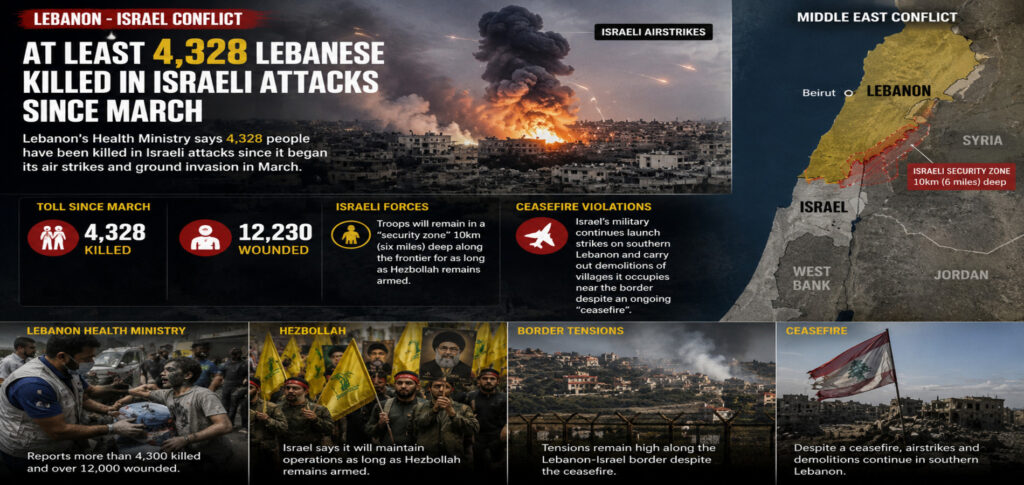
Lebanon’s Health Ministry says the death toll from Israel’s military campaign has risen to 4,328, while another 12,230 people have been injured since fighting intensified in March.
The latest figures highlight the continuing humanitarian impact of the conflict, which has caused widespread destruction across southern Lebanon and forced thousands of families to flee their homes.
Humanitarian Toll Continues to Grow
Lebanese health officials say casualties have continued to increase as Israeli airstrikes and military operations persist in several areas.
Hospitals and emergency services remain under significant pressure as they treat wounded people and respond to the growing humanitarian needs of communities affected by the fighting.
Damage to homes and essential infrastructure has also made it difficult for displaced families to return safely.
Israeli Forces to Maintain Southern Lebanon Security Zone
Israeli authorities have said their forces will continue operating within a security zone extending roughly 10 kilometres (six miles) into southern Lebanon.
Israeli officials say the military presence will remain necessary as long as Hezbollah maintains armed positions near the border.
The continued deployment has raised concerns in Lebanon over the future of communities located close to the frontier.
Violence Continues Despite Ceasefire
Although a ceasefire agreement is officially in effect, military activity has continued in parts of southern Lebanon.
Israeli forces have carried out airstrikes and demolition operations in villages near the border, according to Lebanese reports. Residents in several areas remain unable to return home because of security concerns.
The continued operations have added pressure on an already fragile ceasefire and complicated humanitarian recovery efforts.
Displaced Families Face an Uncertain Future
Thousands of Lebanese families remain affected by the destruction and insecurity caused by the conflict.
Many residents are waiting for improved security before returning to their communities, while local authorities and humanitarian organisations face the challenge of providing shelter and essential services.
Rebuilding damaged homes and infrastructure is also expected to require significant time and resources.
Ceasefire Stability Remains Uncertain
The rising Lebanon death toll has renewed concerns about the durability of the ceasefire and the possibility of further escalation.
As Israeli forces and Hezbollah maintain their respective positions, humanitarian organisations continue to warn about the risks facing civilians.
The immediate priority remains preventing renewed large-scale fighting, protecting civilians and creating conditions that allow displaced communities to return and begin rebuilding.