

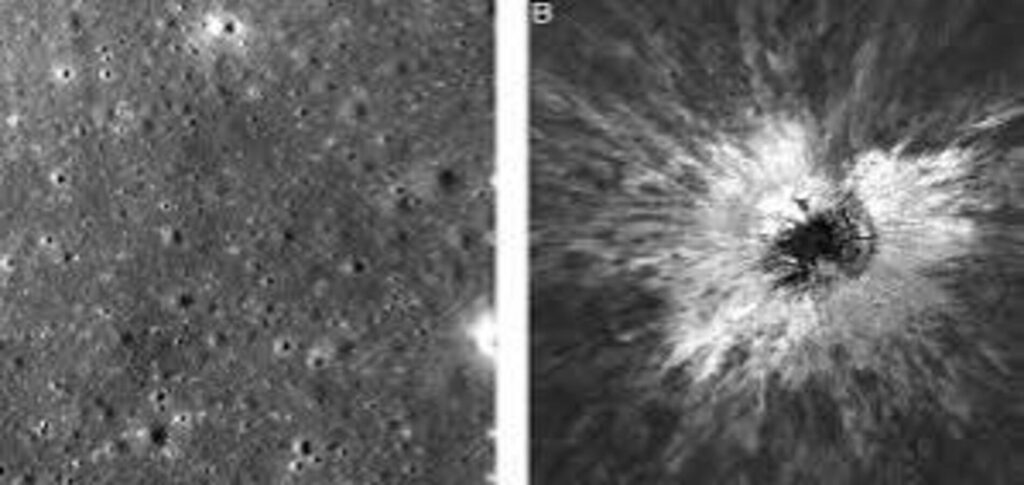
Moon impact crater research has received a major boost after NASA’s Lunar Reconnaissance Orbiter (LRO) identified the largest new crater found during its 17 years of lunar mapping.
Scientists named the crater McGetchin after lunar scientist Tom McGetchin. It measures about 222 meters (728 feet) across and reaches roughly 43 meters (141 feet) deep.
The crater formed on the eastern edge of the Moon sometime between April 11 and May 22, 2024.
Researchers believe an asteroid or comet roughly the size of a three- to six-story building slammed into the lunar surface at extremely high speed.
The impact created a crater large enough to span roughly the length of two football fields.
Impact Created a Huge Debris Pattern
Robert Wagner, an image-processing specialist working with the LRO Camera team, first noticed the new crater while comparing lunar images.
He found an unusually large bright debris pattern in images from the Lunar Reconnaissance Orbiter Camera.
The impact blasted lunar soil across the surrounding surface. It also created bright rays that stretched for kilometers.
Wagner described the debris pattern as the most obvious impact signature he had seen in LRO imagery.
Scientists then used the spacecraft’s sharper Narrow-Angle Camera to examine the site in greater detail.
Those images helped researchers measure the crater and study the changes around it.
A Rare Lunar Collision
The discovery also highlights how uncommon an impact of this size can be.
NASA says scientists estimate that an impact capable of producing a crater this large occurs roughly once a century or even less often.
Before McGetchin, the largest new crater discovered by LRO measured about 70 meters across.
The new crater therefore gives researchers a rare opportunity to study the immediate effects of a powerful lunar collision.
Because the Moon has virtually no atmosphere, incoming space rocks can reach its surface without the atmospheric resistance that objects encounter on Earth.
Scientists Discover a Massive Cold Spot
The impact produced another unexpected feature.
NASA scientists used the LRO’s Diviner thermal instrument to study temperatures around McGetchin. They found a cold region about 6.4 kilometers (4 miles) wide around the crater.
During the long lunar night, the area becomes about 16 degrees Fahrenheit colder than nearby terrain.
Researchers believe the impact disturbed the upper layer of lunar soil.
The collision may have loosened and altered the soil structure. As a result, the surface cannot retain heat as effectively during the lunar night.
This thermal effect gives scientists another way to study how major impacts reshape the Moon.
What the Crater Means for Future Missions
The discovery could also help scientists prepare for future lunar exploration.
Loose and disturbed lunar soil can create challenges for spacecraft, rovers and construction equipment.
Future crews may need to account for changes in soil density when selecting landing sites or building structures.
NASA continues to use LRO to study the Moon’s surface and identify changes caused by impacts and other processes.
The McGetchin crater now provides scientists with a particularly valuable example of how a sudden collision can transform the lunar landscape.
For future missions, the discovery is a reminder that the Moon remains an active and changing environment, even though its surface may appear unchanged from Earth.