

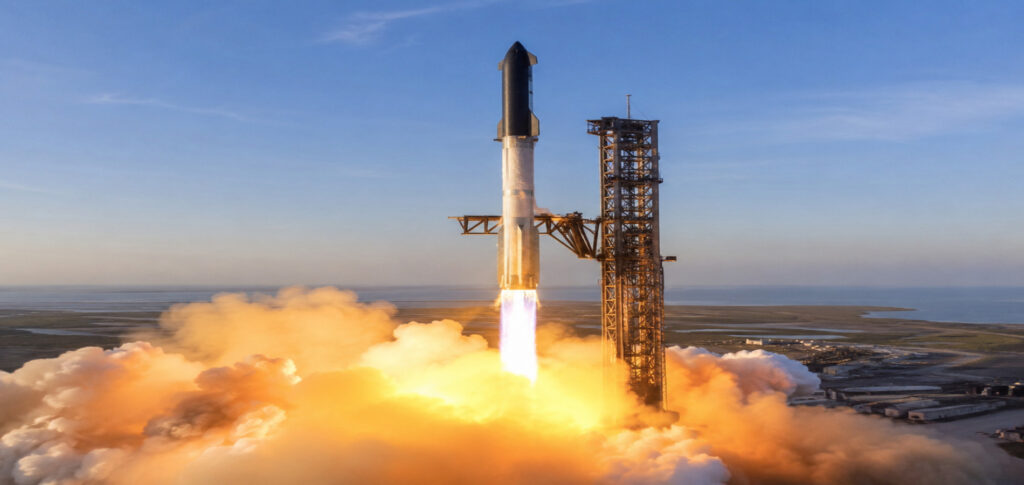
SpaceX has successfully completed another major Starship test mission, marking an important milestone in the development of the world’s most powerful rocket. During the latest flight, the company successfully deployed 20 of its most advanced Starlink satellites, demonstrating significant progress toward future missions to the Moon and Mars.
Standing an impressive 407 feet (124 metres) tall, the massive Starship rocket lifted off from SpaceX’s Starbase facility in South Texas on Friday. The mission lasted about an hour and concluded with the spacecraft making its softest-ever splashdown in the Indian Ocean, where it remained floating after landing.
The successful mission represents another significant step for SpaceX as it prepares Starship for future NASA Artemis lunar missions and long-term plans for deep-space exploration.
Advanced Starlink Satellites Successfully Deployed
One of the primary objectives of the mission was the deployment of 20 next-generation Starlink satellites.
The satellites were released approximately 200 kilometres above Earth, with each one successfully establishing communication through laser and radio links before beginning its planned atmospheric re-entry.
SpaceX engineers confirmed they received valuable telemetry and operational data from every satellite, further strengthening the company’s growing Starlink internet network, which already consists of more than 10,000 operational satellites worldwide.
Major Improvements to Starship Performance
Before launch, SpaceX replaced six of the booster’s 33 engines after a last-minute launch cancellation earlier in the week.
This time, all engines ignited successfully during liftoff, allowing Starship to begin its mission without any major launch issues.
Although the booster was unable to complete a controlled return to the Gulf of Mexico after several engines failed to restart, the upper-stage spacecraft continued its mission exactly as planned.
The spacecraft later performed its most successful atmospheric re-entry to date before gently touching down in the Indian Ocean, remaining largely intact instead of breaking apart as seen during previous tests.
Valuable Data for Future Moon Missions
The mission also allowed SpaceX to collect extensive information about Starship’s heat shield.
Several newly launched Starlink satellites captured high-resolution images of the spacecraft during re-entry, providing engineers with detailed information about the performance of the thermal protection system.
Sensors installed beneath the heat shield also measured temperatures and structural stress experienced during atmospheric re-entry.
SpaceX deliberately painted several heat shield tiles white to simulate damaged or missing tiles, helping engineers evaluate how well the spacecraft can survive under extreme conditions.
Company founder Elon Musk later confirmed that engineers gathered all the data they needed from the experiment.
NASA Watching Closely
NASA closely monitored the mission because Starship is expected to serve as the lunar landing system for the Artemis III mission, which aims to return astronauts to the Moon.
The space agency hopes Starship will soon complete enough successful test flights to support crewed lunar operations later this decade.
NASA Administrator Jared Isaacman congratulated SpaceX on the mission, describing it as another valuable opportunity to improve the spacecraft before future human missions.
SpaceX Eyes Mars and Full Reusability
SpaceX ultimately plans to make both the Starship spacecraft and its massive booster fully reusable, dramatically lowering the cost of space travel.
The company has already demonstrated its ability to catch returning boosters using giant mechanical arms at its Texas launch site and eventually plans to recover the spacecraft the same way.
Beyond NASA’s Moon programme, Elon Musk envisions Starship becoming the primary transportation system for building a permanent human settlement on Mars, while also supporting future commercial missions to both the Moon and deep space.