
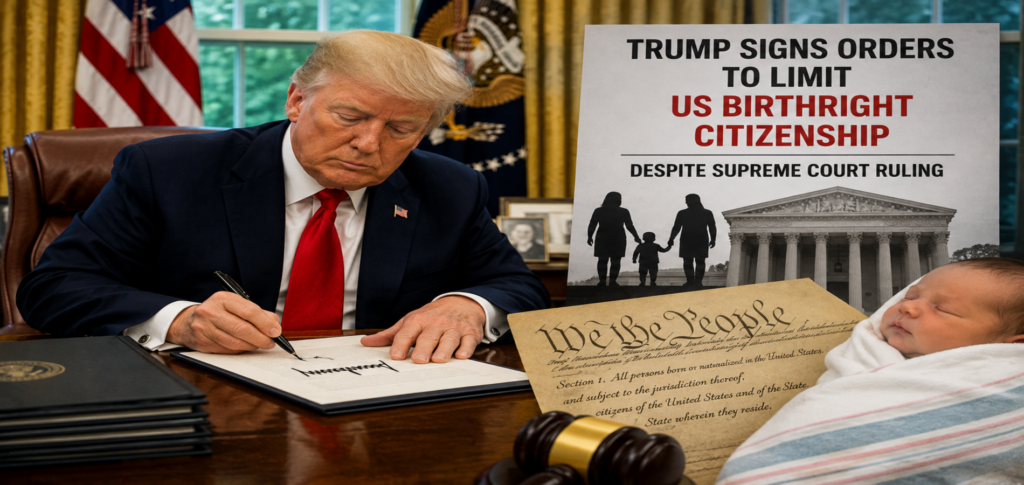
The Trump birthright citizenship orders have sparked another major legal and political battle after President Donald Trump signed two executive orders seeking to limit automatic US citizenship for certain children born in the country.
The new measures come after the US Supreme Court rejected a broader effort by the administration to restrict birthright citizenship. The latest orders focus on specific categories that the White House says fall within historical exceptions to the constitutional guarantee.
Critics, however, argue that the administration is attempting to achieve through executive action what the courts have already rejected.
Trump Renews Push to Restrict Birthright Citizenship
President Donald Trump signed two executive orders Thursday aimed at narrowing eligibility for automatic citizenship at birth.
The administration says the orders target practices such as birth tourism, in which foreign nationals travel to the United States to give birth and obtain US citizenship for their children.
The measures also address children born to certain foreign government employees and individuals classified by the administration as enemy aliens. The White House has presented the actions as an effort to address what it considers loopholes in existing immigration rules.
White House adviser Stephen Miller described the measures as necessary to strengthen immigration enforcement and prevent what officials view as abuse of the citizenship system.
Supreme Court Previously Rejected Broader Executive Order
The latest Trump birthright citizenship orders follow a major legal setback for the administration.
On June 30, the US Supreme Court ruled against Trump’s earlier attempt to restrict birthright citizenship through executive action.
That earlier order sought to deny citizenship to certain children born in the United States when neither parent was a US citizen or lawful permanent resident.
The administration’s latest approach is narrower. White House officials argue that the new orders address specific historical exceptions rather than attempting to eliminate birthright citizenship broadly.
White House Targets Birth Tourism
The Trump administration has made birth tourism a major focus of its immigration policy.
According to the Center for Immigration Studies, between 20,000 and 25,000 women traveled to the United States annually during 2016 and 2017 specifically to give birth.
Trump has argued that businesses have developed around the practice and that the system can be exploited by foreign nationals seeking US citizenship for their children.
The administration says restricting birth tourism would strengthen immigration enforcement and prevent misuse of US citizenship laws.
Legal Experts Expect New Court Challenges
The new executive orders have already attracted criticism from immigration advocates and constitutional experts.
The American Civil Liberties Union has argued that the measures could face immediate legal challenges because birthright citizenship has long been protected under the 14th Amendment.
Legal organizations maintain that the Constitution generally grants citizenship to people born on US soil, subject to limited historical exceptions.
Critics also warn that the new policy could create uncertainty for families and pregnant women who are legally present in the United States.
14th Amendment Remains at the Center of Debate
The constitutional dispute focuses heavily on the Citizenship Clause of the 14th Amendment.
The amendment states:
“All persons born or naturalized in the United States, and subject to the jurisdiction thereof, are citizens of the United States.”
Supporters of birthright citizenship argue that this language provides a clear constitutional guarantee.
The Trump administration takes a different position, arguing that the provision has been interpreted too broadly and that certain categories of people fall outside its protections.
The disagreement is likely to remain at the centre of future court challenges.
Immigration Policy Remains a Trump Priority
Restricting birthright citizenship has remained an important part of Trump’s immigration agenda.
The latest orders come alongside broader efforts to tighten border enforcement, increase deportations and impose stricter immigration controls.
The administration argues that its revised approach can withstand legal scrutiny. Opponents, however, are expected to challenge the measures in federal court.
The resulting legal battle could once again bring the issue before the Supreme Court.
What Happens Next
The Trump birthright citizenship orders have reignited one of the most significant constitutional debates in US immigration policy.
The White House maintains that the new measures address narrow exceptions rather than eliminating birthright citizenship altogether. Critics argue that the orders still conflict with the 14th Amendment and established legal precedent.
As lawsuits move through the federal courts, the dispute could become another major test of presidential authority and the constitutional limits of executive action.
For now, the future of birthright citizenship remains uncertain, with courts expected to play a central role in determining whether Trump’s latest immigration measures can take effect.