
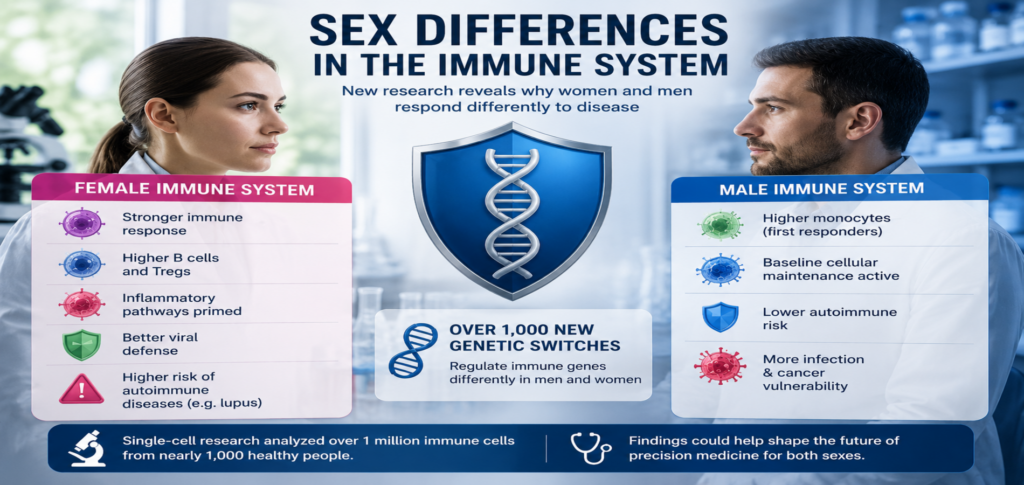
Scientists have uncovered important sex differences in the immune system, finding more than 1,000 genetic switches that work differently in male and female immune cells. The discovery may help explain why women often mount stronger immune responses but face a much higher risk of autoimmune diseases.
Researchers from the Garvan Institute of Medical Research and UNSW Sydney studied more than 1.25 million immune cells from nearly 1,000 healthy people. They used single-cell RNA sequencing to examine how individual immune cells behave.
The study appeared in The American Journal of Human Genetics in May 2026.
Sex Differences Immune System Research Goes Beyond X and Y Chromosomes
Scientists have long linked differences between male and female immunity to hormones and sex chromosomes. However, the new research points to another important factor: genetic regulation across the rest of the genome.
The researchers identified more than 1,000 sex-specific genetic switches, known as expression quantitative trait loci, or eQTLs. Most of these switches sit on autosomes rather than the X and Y chromosomes.
These genetic switches work like volume controls. They can increase or reduce the activity of particular genes in specific immune cells.
Women Show Stronger Inflammatory Activity
The study found clear differences in immune-cell profiles.
Women had higher proportions of B cells and regulatory T cells. Their immune cells also showed stronger activity in inflammatory pathways.
This highly responsive immune profile can help women fight viral infections and may support stronger responses to vaccines. However, the same heightened activity can increase the chance that the immune system mistakenly attacks healthy tissue.
Lupus provides a striking example. Researchers noted that the disease affects about nine women for every one man. The study identified genetic variants linked to genes associated with systemic lupus erythematosus.
Men Show a Different Immune Profile
Male participants had higher proportions of monocytes, which serve as important first responders during immune reactions.
Their immune cells showed greater activity linked to basic cellular maintenance and protein production. Researchers say the less inflammatory profile may reduce some autoimmune risks, but it can also leave men more vulnerable to certain infections and non-reproductive cancers.
Therefore, scientists describe the difference as a biological trade-off rather than a simple advantage for either sex.
What the Findings Mean for Future Treatments
The research could eventually influence precision medicine. Doctors may one day use sex-specific genetic and immune information to help select treatments for autoimmune diseases and other conditions.
The researchers stress that genetics represents only one part of the picture. Hormones and other biological factors also influence immune function.
Still, the findings challenge the idea that the same treatment approach will work equally well for everyone.
The study also highlights the importance of including both men and women in medical research. Understanding how immune cells differ could help scientists develop more targeted therapies instead of relying on a one-size-fits-all approach.