
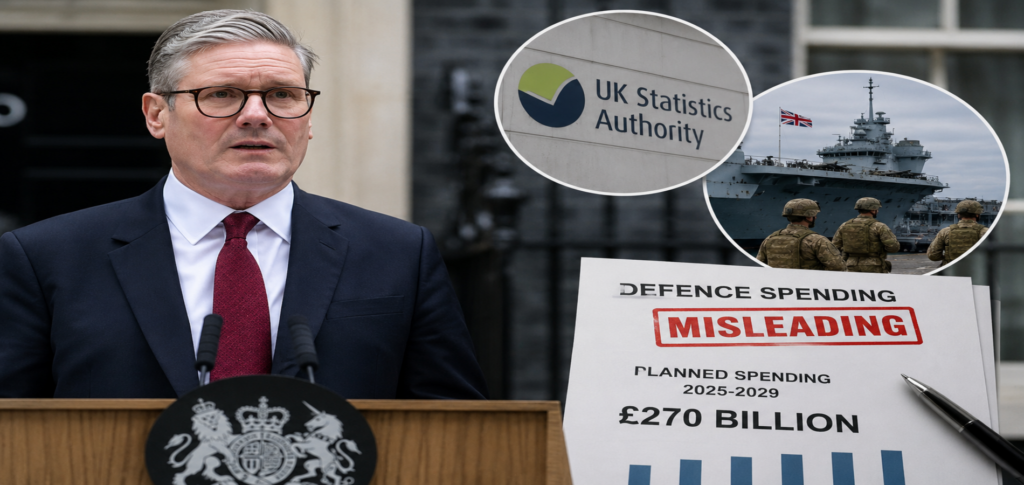
Former UK Prime Minister Sir Keir Starmer has faced criticism after the UK Statistics Authority ruled that a government claim about defence spending was misleading. The watchdog said Starmer, the Ministry of Defence (MoD), and the Wales Office incorrectly described £270 billion as additional defence spending.
In fact, the figure represents the government’s total planned defence budget for the 2025–2029 parliamentary period, rather than £270 billion in new or extra funding.
The ruling has renewed debate over how ministers and government departments communicate major public spending commitments.
Starmer Defence Spending Claim Comes Under Scrutiny
In March, Starmer told MPs that the government would spend £270 billion more on defence during the current Parliament.
The Ministry of Defence and Wales Office later used similar wording in official communications.
However, the UK Statistics Authority reviewed the statements and concluded that the description was inaccurate. The watchdog clarified that £270 billion refers to the overall defence budget planned between 2025 and 2029.
Therefore, describing the entire figure as “extra spending” could give the public a misleading impression about the scale of additional funding being provided.
Watchdog Clarifies the £270 Billion Figure
Interim UK Statistics Authority Chair Penny Young wrote to Conservative Shadow Defence Secretary James Cartlidge to explain the issue.
Young said government departments should avoid describing the £270 billion figure as additional expenditure because doing so could confuse people about the government’s actual increase in defence spending.
The Wales Office subsequently removed a social media post containing the disputed wording after the error was identified.
The watchdog also welcomed steps taken by the Wales Office and Ministry of Defence to improve their communications and prevent similar problems in the future.
Government Acknowledges Wording Error
A UK government spokesperson said officials recognised the problem with the wording and corrected it promptly.
The government also said departments had updated their internal guidance to help ensure that future spending announcements use clearer and more accurate language.
The controversy nevertheless highlights the importance of distinguishing between a total budget allocation and additional funding, particularly when discussing billions of pounds in public expenditure.
Conservatives Demand Greater Transparency
Conservative Shadow Wales Secretary Mims Davies criticised the way the figure had been presented.
She argued that the public deserves accurate and transparent information about government spending, particularly as defence remains a major political issue amid growing international security concerns.
The criticism adds to wider questions about how governments communicate large financial commitments and whether headline figures accurately reflect changes in spending.
Why the Distinction Matters
The difference between £270 billion in total planned spending and £270 billion in additional spending is substantial.
A total budget figure includes money that would have been spent under the government’s existing defence plans. Calling the entire amount “extra” can therefore make the increase appear significantly larger than it actually is.
The UK Statistics Authority’s intervention serves as a reminder that government spending claims need to distinguish clearly between existing budgets, planned expenditure and genuinely additional funding.
The ruling is likely to keep attention focused on the government’s handling of public spending figures and the standards expected when ministers and departments communicate financial information.