
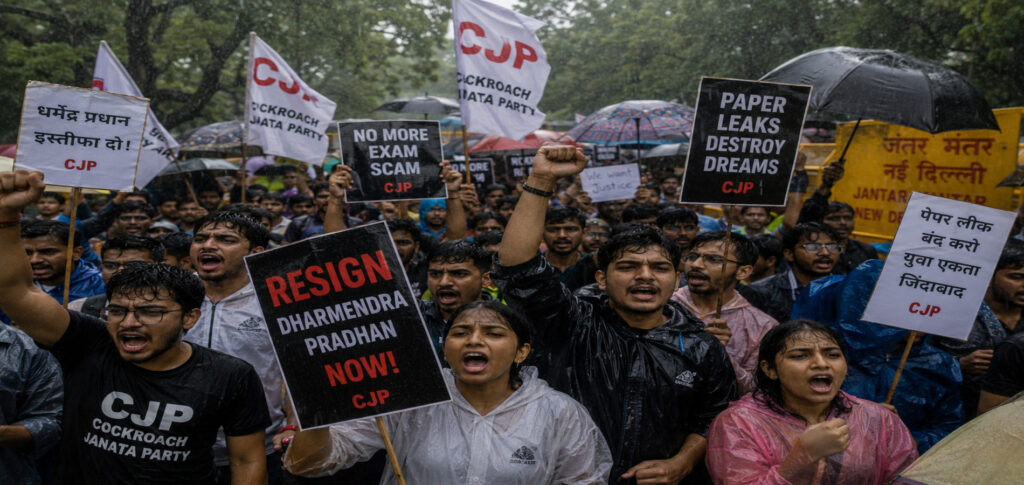
India’s youth-led protest movement has intensified after the government requested additional time to respond to demands for the resignation of Education Minister Dharmendra Pradhan over a series of controversial exam paper leaks.
The discussions took place on Friday between senior government ministers and representatives of the rapidly growing youth movement, offering a possible opportunity for dialogue after weeks of nationwide demonstrations.
Government Requests Time After Talks
Following negotiations in New Delhi, leaders of the protest movement said the government asked for time until Saturday afternoon before giving its final response.
Youth leaders insisted that the resignation of Education Minister Dharmendra Pradhan remains their primary demand, warning that demonstrations would continue and expand if no action is taken.
Government representatives described the meeting as constructive and confirmed that discussions would resume the following day.
Protest Movement Continues to Gain Momentum
The youth movement, which initially began online as a satirical campaign, has transformed into one of the largest public challenges faced by Prime Minister Narendra Modi’s government in recent years.
Public anger intensified after a national medical entrance examination was cancelled following allegations that its question paper had been leaked before the test. The controversy affected nearly two million students across the country and triggered widespread frustration over repeated failures in India’s examination system.
Three Key Demands From Protesters
Alongside the education minister’s resignation, protest leaders are calling for:
- Withdrawal of police cases registered against demonstrators.
- Financial compensation for families of students who reportedly died by suicide following the examination controversy.
- Stronger government action to prevent future examination paper leaks.
Movement representatives said these demands are essential for restoring public confidence in India’s education system.
Nationwide Demonstrations Continue
While negotiations were underway in Delhi, protests spread across several Indian states, including West Bengal, Karnataka, Telangana and Tamil Nadu.
Students, youth activists and opposition supporters organised rallies, carried placards demanding accountability and, in some areas, boycotted educational institutions.
The protests have also disrupted India’s Parliament, where opposition lawmakers have repeatedly demanded the education minister’s resignation, preventing normal legislative business throughout the week.
Security Tightened in the Capital
Authorities continued to enforce strict security measures across New Delhi as thousands of demonstrators gathered near Jantar Mantar.
Several metro stations remained closed, while mobile internet services in parts of central Delhi were suspended for another day in an effort to maintain public order.
The government has defended its security measures, arguing that surveillance and restrictions are necessary to protect public safety during large-scale demonstrations.
Growing Political Pressure on the Government
Political analysts believe the movement reflects broader frustration among India’s younger population over unemployment, examination irregularities and governance issues.
Although the next national election is still several years away, upcoming state elections could be influenced by the growing public dissatisfaction, especially if the government fails to address the protesters’ concerns.
For now, all eyes remain on Saturday’s scheduled talks, where the government’s response could determine whether negotiations succeed or whether India’s largest youth protest movement in years escalates even further.