
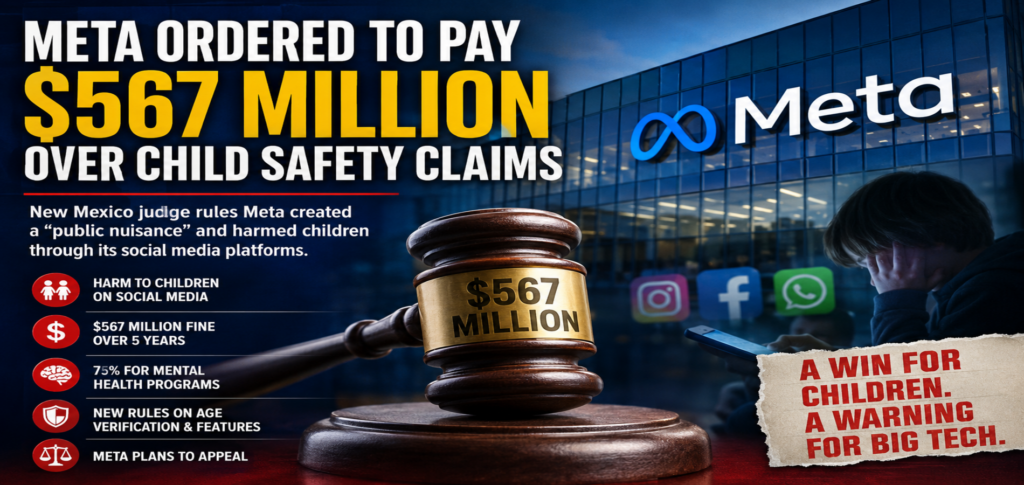
A US judge has ordered Meta to pay more than $567 million following a legal battle over the safety of children on its social media platforms.
The Meta $567 million ruling comes after New Mexico accused the company of creating a public nuisance and exposing young users to serious online risks.
A jury had already found Meta liable in March. It ordered the company to pay $375 million in damages after concluding that Meta violated the state’s Unfair Practices Act.
Meta has rejected the claims and said it will appeal the latest ruling.
We disagree with the ruling and will appeal,†the company said in a statement.
Meta faces claims over harm to children
New Mexico Attorney General Raul Torrez filed the lawsuit against Meta in 2023.
The case focused on Facebook, Instagram and other Meta services. Prosecutors argued that the company failed to adequately protect children from predators and harmful material.
During closing arguments, prosecutor Linda Singer said Meta’s recommendation systems could direct adults toward content posted by teenage users.
She also accused the company of hiding internal research about risks faced by young people on its platforms.
The jury ultimately found that Meta had misled consumers about the safety of its products for children.
Torrez welcomed the latest decision.
He said the case was about protecting children and holding large technology companies accountable when their business practices put young people at risk.
How Meta must use the $567 million
The court has outlined how much of the money should go toward addressing the problems identified in the case.
Around three-quarters of the Meta $567 million ruling will fund mental health treatment. Meta will pay the amount over five years.
The remaining money will support programs covering awareness, prevention, screening, assessment and referrals.
The company must also provide the court with updates twice a year about its compliance with the ruling.
Court orders changes to Meta products
The judge also ordered Meta to make changes aimed at protecting younger users.
The company must continue efforts to prevent children under 13 in New Mexico from using Facebook and Instagram.
The ruling also addresses features that can encourage prolonged social media use.
These include autoplay, infinite scrolling, visible like counts, push notifications and algorithmic recommendations.
For users under 18, the judge ordered Meta to limit push notifications and usage to 90 hours per month. The ruling also calls for like counts to be hidden.
Age verification has become a growing issue for social media companies. However, regulators and technology firms continue to face challenges in implementing effective systems.
Meta plans to appeal the ruling
Meta said it remains confident in its efforts to protect teenagers online.
The company argued that the case does not accurately reflect its safety practices and said it would continue defending itself.
The Meta $567 million ruling could also have wider implications because similar lawsuits are spreading across the United States.
More than 30 states have brought cases against Meta over alleged harms to children and young people.
A separate case involving Meta and other major social media companies could go to trial in California in August.
Social media companies face thousands of lawsuits
The New Mexico case forms part of a much broader legal fight over social media and children’s mental health.
Thousands of lawsuits have been filed across the US. Many accuse technology companies of designing platforms in ways that encourage excessive use while exposing young people to harmful content.
A previous bellwether trial in Los Angeles ended with a jury ordering Meta and Google to pay $6 million to a 20-year-old woman.
Other major platforms, including TikTok, Snap and YouTube, have also faced lawsuits and settlements involving alleged harm to young users.
The latest New Mexico decision therefore puts renewed pressure on technology companies to show how they protect children while balancing user engagement, privacy and free speech concerns.