

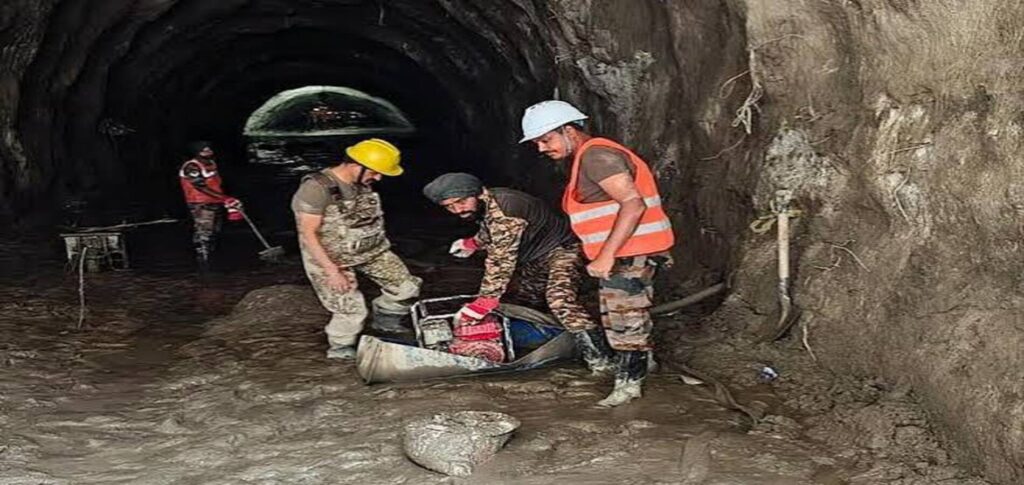
Nepal’s flood disaster has created an “unprecedented” challenge for rescue teams searching for workers trapped inside Himalayan hydropower tunnels.
Australian rescue expert Arnold Dix said multiple operations are now taking place in different locations. Each site presents its own dangers and uncertainty.
The disaster began after a glacial and mountain collapse along the China-Nepal border on August 26. According to the figures provided, at least 1,385 people have died across the two countries, while more than 5,500 remain missing.
Hundreds of hydropower workers are among those still unaccounted for. Rescue teams have continued their work into the thirteenth day.
Multiple tunnel rescues underway
Dix, president of the International Tunnelling and Underground Space Association, described the scale of the operation as unlike anything he had experienced before.
“We are facing something I have never faced before,” Dix said in a social media post.
He said rescuers were not dealing with one isolated operation. Instead, several potential rescues were unfolding at the same time.
Each location brings different risks. Teams must also deal with uncertain conditions while searching for people who could still be alive.
Nepal Army spokesman Raja Ram Basnet said rescuers have maintained the same pace since the first day.
“Our focus is on search and rescue at three levels — on ground, by air, and in the tunnels,” Basnet told AFP.
He said teams were working to make sure nobody remained trapped.
Rescued workers raise hopes
The rescue of three workers has given families and rescuers renewed hope.
Two Nepali workers were rescued from deep inside tunnels on Friday. A Chinese worker was then brought out on Saturday.
Those successful rescues have encouraged teams to continue searching other areas for possible survivors.
International experts are also supporting Nepal’s efforts. Specialists from China, India and South Korea have joined Nepali teams working across the disaster zone.
Dix is among the foreign experts involved in the rescue operation.
Expert draws on Silkyara experience
Dix has extensive experience with difficult underground rescues.
He served as a key adviser during the rescue of 41 workers trapped for 17 days inside the collapsed Silkyara tunnel in India’s Uttarakhand state in 2023.
That experience continues to shape his approach in Nepal.
“We are measured not only by the lives we save, but by the lives we refuse to abandon,” Dix said.
He added that the Silkyara rescue taught him an important lesson: an outcome that appears unlikely should never automatically be considered impossible.
Rescue work continues during mourning
Nepal observed a national day of mourning on Monday in accordance with traditional Hindu rituals.
Despite the mourning period, rescue operations have continued across the affected areas.
Army teams are searching from the ground and air while specialist crews work inside tunnels.
For families still waiting for news, every operation carries enormous importance. Rescuers now face the difficult task of navigating damaged infrastructure and unstable conditions while continuing to search for people who may still be trapped underground.
The successful recovery of three workers has strengthened hopes that further survivors could be found as the search enters its third week.