
The United States is tightening restrictions on Chinese technology imports as part of a broader strategy to strengthen domestic manufacturing and reduce national security risks. The latest measures target products such as robots, drones, routers, and power inverters, with officials saying the goal is to encourage American companies to build critical technologies at home.
Brendan Carr, chairman of the Federal Communications Commission (FCC), explained that the policy focuses on protecting the nation’s communications infrastructure while creating new opportunities for U.S. manufacturers.
FCC Pushes Domestic Production
Carr said the US telecom restrictions on Chinese tech imports are designed to accelerate investment in American manufacturing.
According to him, the government wants companies to relocate production to the United States before Chinese technology becomes deeply embedded in critical infrastructure.
He warned that allowing millions of imported connected devices into the country could create long-term security challenges.
Chinese Robots and Power Inverters Targeted
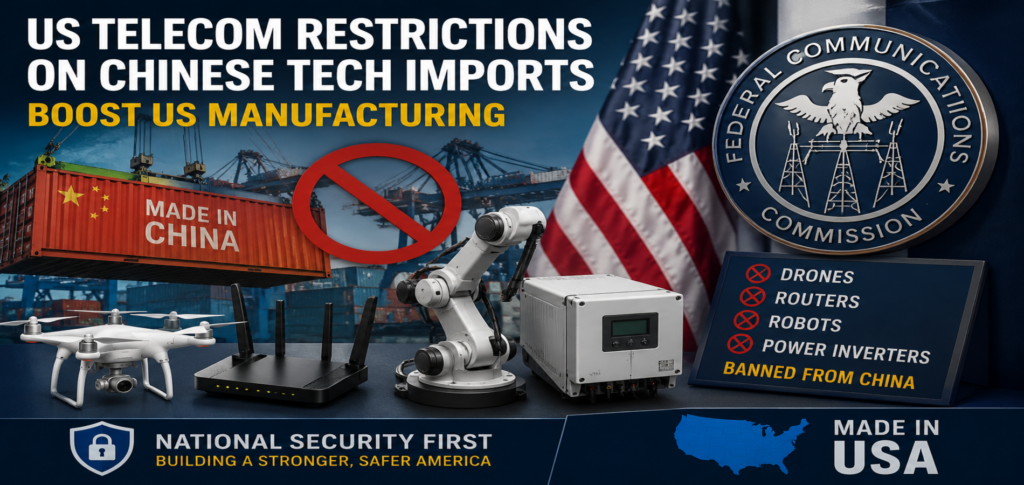
Since December, the FCC has prohibited the import of new Chinese-made models of several connected technologies, including:
-
- Drones
-
- Routers
-
- Humanoid robots
-
- Quadruped robots
- Connected power inverters
The agency has granted waivers for approved non-Chinese manufacturers while effectively blocking new products from Chinese suppliers.
Power inverters play an important role in connecting renewable energy systems, batteries, and data centers to the electrical grid, making them a growing focus for security officials.
Data Center Components May Be Next
Reports suggest the FCC is preparing additional US telecom restrictions on Chinese tech imports, including new limits on optical transceivers used in data centers.
These components support the rapid expansion of artificial intelligence infrastructure across the United States.
When asked about the reports, Carr said national security agencies determine which products require restrictions, while the FCC carries out those decisions.
He declined to confirm whether optical transceivers would become the next target.
National Security Remains the Priority
Carr emphasized that the restrictions are primarily intended to reduce national security risks.
He said the government wants to avoid a future where millions of connected Chinese devices become essential parts of America’s communications, energy, and technology networks.
The policy reflects broader efforts by Washington to reduce dependence on Chinese-made technology across several strategic industries.
Democratic Commissioner Calls for More Transparency
FCC Commissioner Anna Gomez supported efforts to strengthen national security but criticized how the restrictions have been introduced.
She said many American technology companies remain concerned about the lack of transparency surrounding the new rules.
According to Gomez, businesses need clearer guidance to understand how future restrictions will affect their operations and investment decisions.
She warned that without greater openness, the policy could appear to favor certain companies rather than follow consistent national security standards.
China Responds to US Measures
The new US telecom restrictions on Chinese tech imports have already prompted retaliation from China.
The growing dispute adds another chapter to the ongoing technology competition between Washington and Beijing, as both countries continue imposing restrictions on critical industries.
Analysts expect additional technology controls as governments seek greater control over supply chains linked to artificial intelligence, communications, and renewable energy infrastructure.